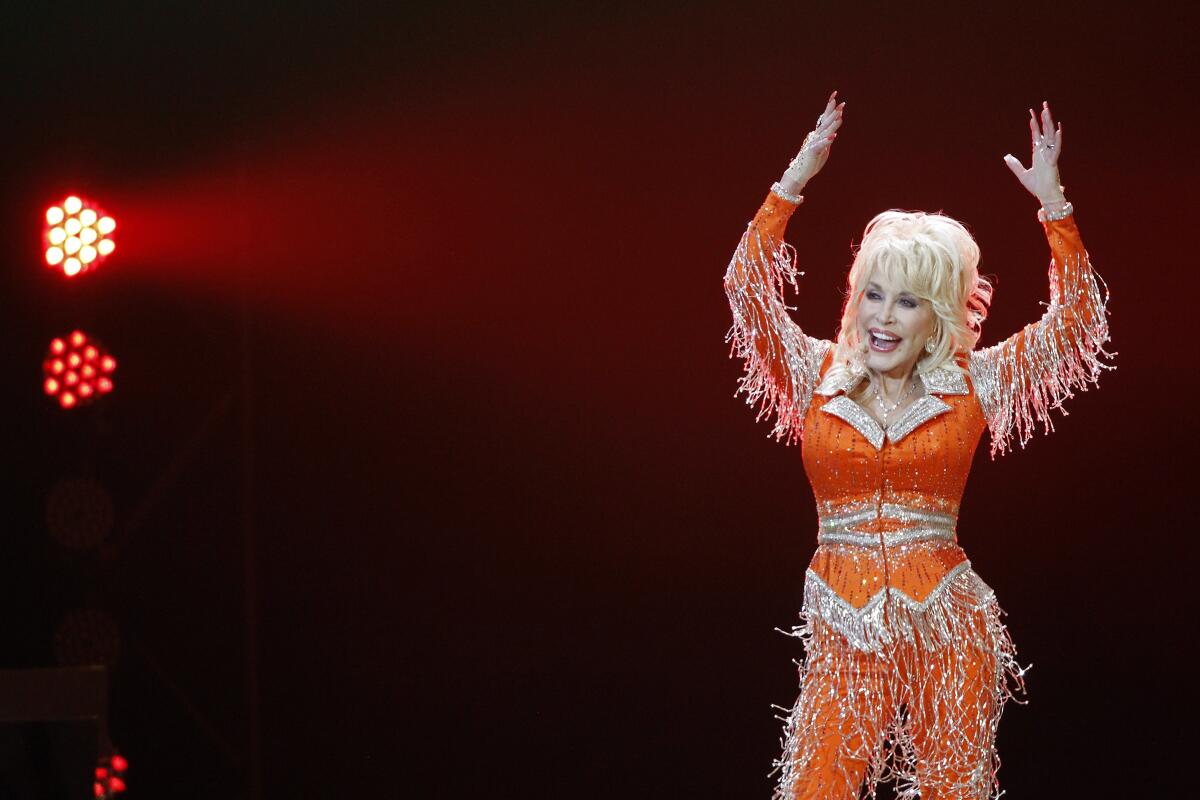
In the early 2000s, while much of the music industry chased pop trends, Dolly Parton was quietly reshaping her own legacy. Stepping away from polished country-pop, she returned to her Appalachian roots, launching a trilogy of bluegrass-inspired albums that reintroduced her as both a traditionalist and a fearless musical explorer. The boldest moment of that era arrived when she crossed genre lines and transformed a 1990s grunge hit into something entirely unexpected—without even warning the songwriter behind it.
That songwriter was Ed Roland.
In 2001, Roland, frontman of Collective Soul, was sitting down for dinner in Arizona, unaware that his band’s signature song, Shine, was about to take on a new life on national television. Originally released in 1994, the track was known for its heavy guitar riffs and brooding, spiritual tension—an anthem shaped by the sound of post-grunge rock.
Then the phone rang.
His father was on the other end, shouting in disbelief: “Turn on the TV! Dolly Parton is singing your song!” Roland rushed to watch, only to witness a performance that felt almost surreal. Where Collective Soul’s version was dark and driving, Parton’s interpretation was bright, energetic, and uplifting—banjos and fiddles replacing electric guitars, urgency transformed into joy.
Parton had reimagined Shine for her album Little Sparrow, fully embracing bluegrass tradition. Rather than softening the song’s spiritual message, she amplified it. The chorus plea—“Heaven let your light shine down”—shifted from existential struggle to something closer to a revival hymn.
The gamble was significant. At the time, genre boundaries were far less flexible, and a country icon covering a grunge-era alternative rock song could easily have felt like a novelty. Instead, Parton approached the track with deep respect, treating it less as a cover and more as a reinterpretation. Backed by masterful acoustic musicianship and a driving tempo, she preserved the song’s emotional urgency while completely reinventing its sound.
Roland was reportedly stunned—and honored. He later described himself as “blown away,” saying that hearing an artist of Parton’s stature reinterpret his work felt like the ultimate validation as a songwriter.
The industry responded just as strongly. At the 44th Annual Grammy Awards in 2002, Parton’s version of Shine won Best Female Country Vocal Performance, turning an unexpected television moment into one of the decade’s most unlikely Grammy victories.
While Collective Soul’s original reached No. 11 on the Billboard Hot 100, Parton’s rendition gave the song a second life, bridging generations and musical worlds. It proved that a truly great song isn’t defined by genre or era—but by the emotion it carries.
For Ed Roland, it remains one of the most surprising phone calls he ever received. For Dolly Parton, it was simply another example of a belief she has always held: great songwriting doesn’t belong to rock, country, or bluegrass—it belongs to whoever knows how to let it shine.