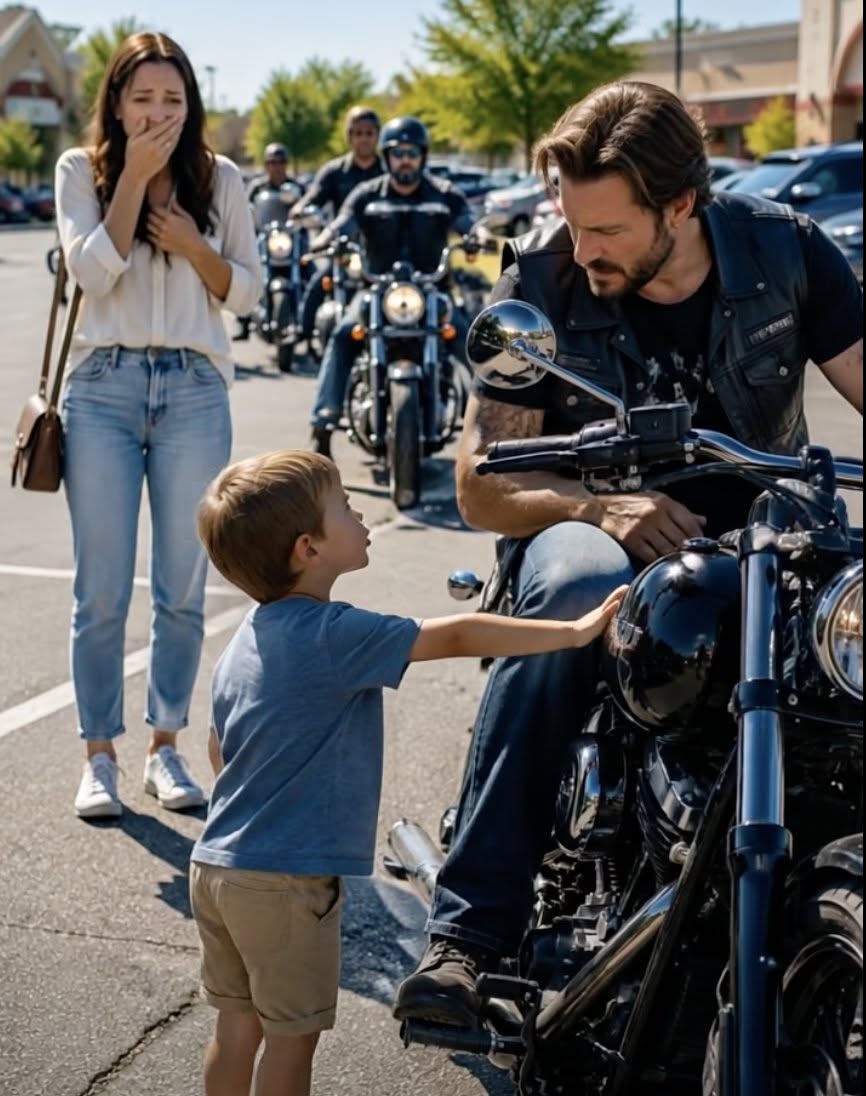
The parking lot smelled of hot asphalt and distant rain. Tessa Parker pushed the cart with one hand and held her son’s small fingers with the other, the way she always did now—gently, but never letting go. Owen was six, small for his age, with serious eyes that had learned how to watch everything without giving anything away. Four years of silence had carved something careful into him.
They had come for milk, bread, and the cereal he liked because the blue box made him feel safe. Nothing more. Nothing that should have changed their lives.
Then Owen stopped walking.
His hand slipped from hers so fast she almost didn’t feel it leave. Tessa turned just in time to see him running—small legs pumping, arms tight at his sides—straight toward a black motorcycle parked near the far curb. The rider was still swinging one leg off the bike, helmet under his arm, when the boy reached him.
“Owen!” Tessa’s voice cracked across the lot. She abandoned the cart and ran.
The biker looked up, startled but not angry. He was broad-shouldered, maybe early fifties, with a salt-and-pepper beard and a leather vest that had seen real miles. A patch on the front read *Forge & Thunder Veterans MC*. He froze when he saw the child standing in front of his front wheel, staring at the chrome like it was something holy.
Owen reached out and touched the handlebar with two fingers. His lips moved. At first the sound was too small to carry. Then it came again, clear and trembling.
“Daddy’s bike.”
Tessa’s world tilted. She stopped three feet away, heart hammering so hard she felt it in her teeth. Owen had not spoken a single word in four years. Not since the two men in uniform had stood in their doorway in Colorado Springs and handed her the folded flag. Not since the night she had to explain to a two-year-old that his father’s voice would never come through the phone again.
The biker slowly dropped to one knee so he was eye-level with the boy. His voice was rough but careful, like he was afraid of breaking something fragile.
“What did you say, little man?”
Owen looked straight at him. “Daddy said to look for the bikes when the quiet gets too loud.”
The biker’s face changed completely. The lines around his eyes deepened. He reached out slowly and rested one big hand on the seat beside Owen’s fingers, not touching the boy, just anchoring himself.
“What was your daddy’s name?”
“Caleb Parker.”
The man closed his eyes for one full second. When he opened them, they were wet.
“Staff Sergeant Caleb Parker,” he said quietly. “Goddamn. I rode with him before his last deployment. He was one of us.”
Tessa finally found her voice, though it came out thin. “You knew my husband?”
The biker stood, but kept his movements small. “Ma’am, Caleb wasn’t just someone we knew. He patched in with Forge & Thunder after his second tour. Said the sound of the engines helped the noise in his head quiet down. We were his road family.” He swallowed. “He talked about you and this little guy every single ride.”
Owen was still staring at the motorcycle. His small shoulders had relaxed for the first time in years. Tessa watched him and felt something crack open inside her chest—four years of locked breath finally moving.
The biker pulled out his phone with hands that weren’t quite steady. He hit one number and waited.
“It’s Wade,” he said when someone answered. “I’m at the shopping center off Route 7. You need to get here. Now. It’s Caleb Parker’s boy. He found us.”
He listened for a second, then ended the call.
Tessa wanted to ask what that meant, but the sound reached her first.
A low, rolling thunder began in the distance. One engine, then two, then more—deep, steady, respectful. Not racing. Not showing off. Just coming. Owen turned toward the sound the way a child turns toward a voice he has been waiting to hear his whole life. His eyes widened. Not with fear. With recognition.
Motorcycles rolled into the lot in a long, careful line. Eight of them. Then ten. Black, matte gray, deep blue. Chrome caught the afternoon light and threw it back like signals. The riders parked in a loose half-circle, engines dropping to idle before cutting off one by one. No one revved. No one shouted. They simply dismounted and stood, helmets under arms, watching the small boy beside the single bike.
An older rider with silver hair and a weathered face stepped forward. On his vest, stitched above his heart, was a small rectangular patch: *Caleb Parker – Never Forgotten*. Tessa’s knees nearly gave out when she saw it.
The man stopped a respectful distance away. “Mrs. Parker,” he said, voice steady but thick. “We tried to find you after the service. You moved before we could reach you. We’ve been carrying his name with us ever since.”
Owen took one small step toward the group. “Daddy said you help people be brave when the quiet comes.”
The older rider—his name patch read *Gus*—dropped slowly to one knee. “Then that’s what we’re here to do, son.”
Wade opened a saddlebag and pulled out a small wooden box wrapped in an old olive-drab cloth. Tessa recognized Caleb’s handwriting on the envelope taped to the lid. Her breath caught.
“He left this with us before his final deployment,” Wade said gently. “Told us if anything happened, and if the boy ever went quiet, we were to give it to him when the time felt right. He said the time would come when Owen went looking for the sound.”
Tessa took the box with shaking hands. Inside the envelope was a single sheet of paper in Caleb’s familiar scrawl—quick, a little messy, like he had written it between missions.
*If our boy stops talking, don’t think he’s gone. He’s just carrying more than his heart knows how to hold. The bikes helped me breathe when nothing else could. One day he’ll hear the sound and remember he was never left behind. Tell him I loved him loud enough to shake the sky. Tell him the road still runs both ways.*
Tessa pressed the letter to her mouth. Inside the box lay a tiny denim vest, perfectly sized for the four-year-old Owen had been when Caleb left. On the back, stitched in careful white letters:
*Owen Parker*
*Little Road Brother*
Owen reached for it without being asked. “Mine?”
Tessa nodded, tears falling freely now. “Yes, baby. It’s yours.”
Wade helped him slip it on over his T-shirt. It was a little short in the arms now, but the riders adjusted the shoulders with careful fingers until it sat right. Owen looked down at the patch, then up at the line of silent motorcycles.
“Can they stay?” he asked.
The question was small. It was also the first full sentence he had spoken in four years. Tessa dropped to her knees right there in the parking lot and pulled him against her chest. Around them, grown men in leather wiped their eyes without shame.
Wade’s voice was rough when he answered. “As long as your mom says it’s okay.”
Owen turned those serious eyes on her. “Mom… please?”
Tessa laughed through the tears and nodded. “They can stay.”
The riders didn’t take Owen onto the highway that day. Instead they formed a quiet circle and let him sit on Wade’s parked bike with the engine off. They showed him the mirrors, the grips, the little bell that hung near the frame—the one Caleb had insisted every bike in their group carry. Owen touched everything with careful fingers.
“Daddy had one like this,” he said.
“He did,” Wade answered. “And every time he rode, he told us stories about you.”
Owen was quiet for a long moment. Then he spoke again, voice barely above the idle of the cooling engines.
“I missed him.”
Tessa closed her eyes and pressed her forehead to his. “Me too, baby. Every single day.”
That night they didn’t go straight home. They sat on a bench outside the store while the riders stayed nearby—close enough to be there, far enough to give them space. Owen leaned against her shoulder, the little vest still on, and watched the line of motorcycles like they were old friends who had finally found their way back.
In the months that followed, Forge & Thunder became part of their life in quiet, steady ways. They showed up for school events without making a scene. They fixed Tessa’s leaky faucet one Saturday and taught Owen how to hold a wrench. On Caleb’s birthday they brought flowers and a single cupcake with a tiny motorcycle candle. Wade became the person Owen called when thunder made the quiet inside him feel too big again.
A year later they held the first official memorial ride for Caleb. Owen stood beside Tessa at the starting line wearing a new vest that actually fit. On the back it still read *Little Road Brother*. Before the engines started, Gus knelt beside him.
“You ready, son?”
Owen looked at the waiting motorcycles, then at the sky, then at his mother. “Daddy can hear them?”
Gus nodded. “Love hears louder than engines, little brother.”
Owen lifted one small hand.
The riders started their bikes. The thunder rose—not frightening, not overwhelming, but strong and steady, like a heartbeat made of steel and chrome. Owen didn’t flinch. He stood tall, one hand in his mother’s, the other resting on the patch over his heart.
As the column pulled away, he whispered into the wind, “Go find the brave for him.”
Tessa held his hand tighter and smiled through tears that no longer felt like only grief. Four years of silence had ended in a parking lot beside a single motorcycle because one father had trusted his road family to remember his son when the time came.
The road had waited. The boy had found it. And the sound that once belonged only to his father now belonged to both of them.