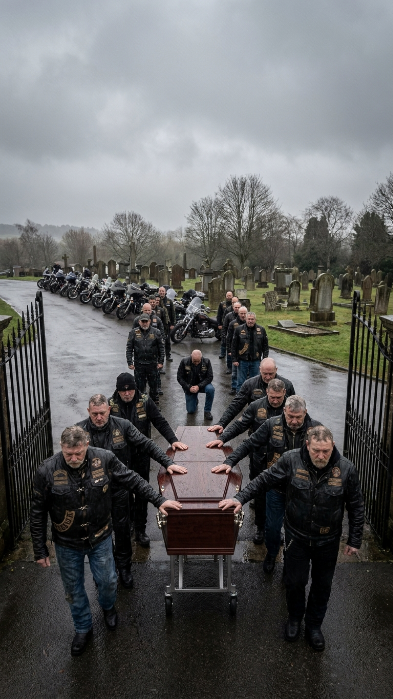
He stopped my father’s funeral cold. He stood at the edge of the grave and refused to let them lower the coffin.
I had never seen this man before in my life. Big guy, gray beard, leather vest covered in faded patches. He just walked up out of nowhere and put his hand flat on the lid.
“Not yet,” he said. His voice was low but everybody heard it.
The funeral director looked at me. My mother grabbed my arm so hard it hurt. Forty people stood frozen in the rain, staring at this stranger blocking my dad’s burial.
I thought he was drunk. I thought he was at the wrong service. I started to tell him to leave.
Then he reached into his vest and pulled out an old photograph. Cracked, yellow, falling apart at the corners.
He held it up so I could see it. And my whole body went cold.
Because the man standing next to my father in that photo was wearing the same vest. And the date on the back was three days before I was born.
My name is Daniel. I was thirty-four when we buried my dad, and I want to tell you something right up front.
I did not cry at that funeral.
I came because my mother asked me to. I stood in the back. I wore a borrowed suit because I owned nothing black, and I counted the minutes until I could leave.
My father and I were strangers who happened to share a last name. That is the truth of it. He was a quiet man who worked at a paper mill for thirty years and came home smelling like chemicals and never said more than ten words at dinner.
I left home at eighteen and barely looked back.
So when this biker put his hand on the coffin and said “Not yet,” my first feeling was not grief or fear. It was anger. I wanted this over with. I wanted to go home.
“Sir,” I said, walking toward him. “You need to step away from there.”
He did not move. He just looked at me with these pale blue eyes, and there was something in them that stopped me cold. Not aggression. Sorrow. The kind of sorrow I had not even let myself feel.
“You’re Daniel,” he said.
It was not a question. The rain was coming down harder now, soaking through everyone’s nice clothes, and this man knew my name.
“How do you know who I am?”
He turned the photograph around so I could see it again. I made myself look at it this time, really look.
It was my father. Younger, maybe twenty-five, with a full head of dark hair I had never seen because he was bald my whole life. He was standing next to a row of motorcycles, and his arm was around the shoulders of the man in front of me now.
Both of them wore the same leather vests. Same patches.
My father had never owned a motorcycle. My father had never owned a leather anything. The man I knew wore flannel shirts and brown work boots and a watch he got for twenty years of service.
I did not know this person in the photograph at all.
“His name with us was Pulse,” the biker said. “Mine’s Cooper. They called me Coop.”
“With us,” I repeated. “With who?”
Coop looked over at my mother, who had gone white as the lilies on the coffin. He looked back at me.
“Your father was a road captain for nine years,” he said. “Before you were born. Before he met your mom.”
I almost laughed. It came up in my throat like something sour. This was insane. This was some kind of mistake or some kind of con, and I was standing in the rain at my father’s grave listening to a stranger tell me my dad was a biker.
“You’ve got the wrong guy,” I said. “My father worked at a mill. He fixed lawn mowers on weekends. He fell asleep in his chair watching the news.”
“I know what he became,” Coop said quietly. “I’m telling you what he was.”
The funeral director cleared his throat and stepped forward, this nervous little man in a gray suit. “Perhaps we should continue, and any personal matters can be—”
“No.” Coop’s voice cracked like a branch. “He made me promise. He made me promise I’d be here, and I’d say it out loud, in front of his family, before they put him in the ground.”
He reached into his vest again.
My mother spoke for the first time.
“Robert,” she said. Not to Coop. To the coffin. Like my father could still hear her. “Robert, you swore you’d never.”
I turned to look at her. “Mom. What is he talking about?”
She was shaking. Forty years I had known this woman and I had never seen her face look the way it looked right then. Like a wall coming down.
“Your father had a life before us,” she whispered. “I made him bury it. I made him.”
The rain ran down her cheeks, or maybe it was not the rain.
“I was pregnant with you,” she said. “I told him I couldn’t raise a child around that world. The danger. The people. I told him he had to choose.”
Coop was nodding slowly, like this was the part he already knew.
“He chose,” my mother said. “He walked away from everything. He never rode again. He never saw any of them again. He gave it all up for you, Daniel, and you never even—”
She could not finish. Her hand went over her mouth.
And I stood there feeling like the ground was tilting under me. Every quiet dinner. Every night he sat alone in the garage with the door closed. Every time I thought he had nothing inside him, that he was just an empty, boring man who never lived.
He had lived. He had lived a whole life and then locked it in a box for me.
“What’s in your hand,” I said to Coop. My voice did not sound like mine.
He opened it.
It was a small brass medallion on a worn leather cord. Old. Scratched. The kind of thing a man carries in his pocket for fifty years until it goes smooth.
“Eleven years ago, your father found us again,” Coop said. “Found me. Tracked me down. Showed up at my door looking like a ghost.”
Eleven years. The exact number of years my father and I had not spoken.
“He said he was sick,” Coop went on. “Said the doctors gave him time and not much of it. And he said there was one thing he needed to do before the end, and he needed his old brothers to help him do it.”
I could barely breathe. “Help him do what?”
Coop pressed the medallion into my hand and closed my fingers around it.
“Find you,” he said. “He spent the last eleven years trying to find you, son. You’d moved. Changed your number. Cut everybody off. And he was too proud and too ashamed to think you’d ever want to hear from him.”
The brass was warm from his hand. I stared at it.
“So he came to us,” Coop said. “Every weekend for years. We rode the back roads looking. He showed your picture in every town. He wrote you letters he never sent because he didn’t have the address.”
My knees went weak. “He looked for me. For eleven years.”
“He found you four months ago.” Coop’s voice broke fully now, and this huge man, this stranger, started to cry in the rain. “He found out where you lived. He had the letter in his hand. He was going to drive out and see you that weekend.”
I knew what was coming. I felt it like a fist.
“He had the heart attack on Thursday,” I said. The words came out hollow. That was when they called me. Thursday morning, a number I did not recognize, a hospital, a man already gone.
“He died with your address in his shirt pocket,” Coop said. “Forty miles from your door.”
I do not remember sitting down. But suddenly I was on the wet grass next to the coffin, and the brass medallion was digging into my palm because I was squeezing it so hard.
Forty miles. Four days. A letter he carried for eleven years.
And I had stood in the back of his funeral counting the minutes.
“Why,” I said. I was looking up at Coop and I could not stop the question. “Why didn’t he just call? Why didn’t he try harder? Eleven years, and he never just showed up?”
Coop crouched down in front of me. His knees cracked. He was older than I had thought.
“Because of what you said to him,” he told me gently. “The last time you talked.”
I felt sick. Because I remembered. God help me, I remembered exactly what I had said.
I was twenty-three. We had fought about something stupid, money I think, or maybe just everything that money was standing in for. And I had told him, I had looked my father in the eye and told him, that he had never been a real father. That he was a coward who never took a single risk in his whole gray little life. That I was ashamed to be his son.
And then I left. And I never called again.
“He believed you,” Coop said. “He spent eleven years thinking he had to earn the right to talk to you again. He thought if he just kept looking, kept trying, he could prove he wasn’t the coward you thought he was.”
“He wasn’t a coward.” The words tore out of me. “He gave up his whole life for me. That’s the opposite of a coward.”
“I know that,” Coop said. “We all knew that. We told him a hundred times. But the only person who needed to know it was you.”
I looked at the coffin. The rain was beading on the polished wood and running off in little streams. My father was in there. The man who rode motorcycles down back roads at sixty-three years old searching for a son who had thrown him away.
“That’s why I stopped them,” Coop said. “He made me promise. He said, ‘Coop, if I don’t make it to him in time, you make sure he hears the truth before they close the ground over me. Don’t let them bury me as the man he thinks I was. Make him see who I really was.’”
He put his hand on my shoulder.
“You weren’t ashamed of a coward, Daniel,” he said. “You were ashamed of the bravest man I ever rode with. And he loved you enough to hide all of it, just because your mother was scared and you were on the way.”
I broke. Completely.
Thirty-four years old, on my knees in a graveyard, sobbing into my hands while a stranger held my shoulder. I cried for the father I buried and the father I never knew and the eleven years I could have had and would never get back.
I cried because the last words I ever said to him were a lie, and he spent the rest of his life trying to prove the lie wrong instead of just knowing I was the one who got it wrong.
They did not lower the coffin that day. Not until I asked them to.
But first, Coop did something I will never forget.
He raised his hand, and from the road beyond the cemetery gates, where I had not even noticed them parked, came a sound. Engines. One after another after another.
Eleven motorcycles rolled slowly through the gates and lined up along the path. Eleven men in leather vests, gray-bearded most of them, some with canes strapped to their bikes, climbed off and walked to the grave.
They had been waiting. Coop had called them. My father’s old brothers, the ones who had spent years riding the back roads with him looking for me, had come to bury their road captain.
One by one they walked past the coffin. Each of them put a hand on it. Each of them said a word I did not understand, an old club word, a goodbye.
And then they stood in a line behind me, these eleven old men, and they put their hands on my shoulders and my back, every one of them, so that when I finally nodded to the funeral director and they lowered my father into the ground, I was not standing alone.
I was held up by the brotherhood my father gave up for me. The family he chose to lose so that I could exist.
Coop was the last to leave. He looked at the medallion still clutched in my hand.
“He wore that every day of his life,” he said. “Even after he quit. Even in the mill. Kept it in his pocket so your mother wouldn’t see. It was the only piece he couldn’t give up.”
“I can’t take this,” I said. “It’s his.”
“It’s yours now.” Coop almost smiled. “That was the deal. You were always the deal, son. From the day he found out you were coming, you were the only thing that ever mattered to him more than the road. And that’s saying something, because that man loved the road more than his own breath.”
He started to walk back to his motorcycle.
“Coop,” I called out.
He turned.
“Tell me one thing about him. One thing I never knew. Something good.”
The old man stood in the rain and thought about it. Then he smiled for real, this broad watery smile under his gray beard.
“He used to sing,” Coop said. “On the long rides, when he thought nobody could hear him over the engines. Sang at the top of his lungs. Worst voice you ever heard in your life. We used to ride next to him just to laugh.”
I thought about my father. Silent at the dinner table. Silent in his chair. Silent for thirty years.
He gave up his voice too. He gave up the singing.
For me.
I keep the medallion in my pocket now. Smooth brass, worn cord. I touch it sometimes without meaning to, the way he must have, all those years in the mill.
I went and found the letter. It was still in the bag of his belongings the hospital gave us, the one I had not been able to open for weeks. His shirt, his wallet, his watch. And a folded piece of paper soft from being carried.
It was four pages long. He had written it and rewritten it, you could tell. Some lines crossed out. Some words smudged.
It started, “Dear Daniel, I know I have no right to write this.”
I am not going to tell you everything it said. Some things a son gets to keep for himself.
But I will tell you the last line, because I think he would want someone to know he meant it.
He wrote: “You called me a coward, and maybe in the ways that count to a young man, I was. I was too scared to fight your mother and too scared to lose you and too scared to ever tell you what I’d been. But I want you to know I rode forty thousand miles looking for your face in every town I passed. I was not brave enough to live my old life. But I was brave enough to spend what was left of me looking for you. I hope that counts for something. I hope someday you’ll let it count. Your father, always, even when you didn’t want me. Robert. They called me Pulse.”
I ride now. I bought a used motorcycle six months after the funeral, an old thing I rebuilt in my garage with the door closed, just like he used to.
Coop taught me. He still rides with me, him and the few of the old brothers who are still around. They call me Pulse Junior, which is a terrible name, and I love it more than anything I have ever been called.
And sometimes, on the long rides, on the back roads where nobody can hear me over the engine, I sing.
I have a terrible voice. The worst.
And the old men ride up next to me, and they laugh, and I know exactly who they are seeing when they do.