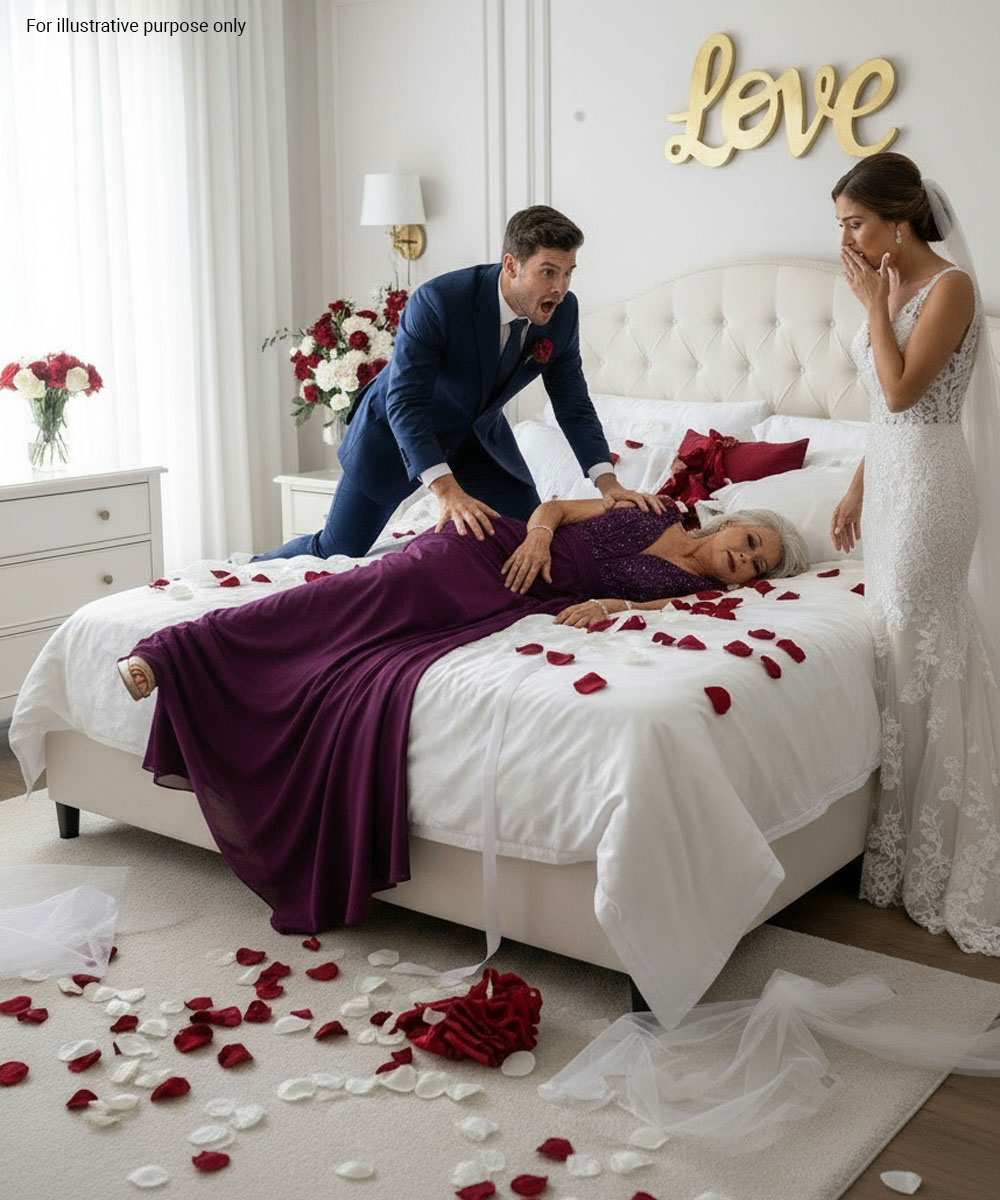
The Wedding Night That Changed Everything
My name is Claire Miller, 26.
Last month, I married Ethan, a young, quiet doctor — the kind of man who made me believe that happiness could be steady and real.
Our wedding was perfect.
The ceremony took place on the California coast, surrounded by flowers, laughter, and sea breeze. By evening, I was exhausted — ready to take off my makeup, hug my new husband, and finally rest.
But as I sat on the edge of the bed, the door opened.
“Mom’s a little drunk,” Ethan said softly. “Let her lie down for a while. It’s too noisy downstairs.”
Before I could respond, Margaret, my new mother-in-law, walked in. Her face was flushed, her steps unsteady, but her eyes looked oddly clear.
I hesitated.
I’d heard stories about Margaret — how protective she was, how she had raised Ethan alone after his father’s tragic accident. Still, it was our wedding night, and it felt strange to have her there.
“Just for tonight,” Ethan whispered. “Please.”
So I quietly picked up a pillow and went down to the living room sofa. I didn’t want to argue — not on the first night of our marriage.
But as I turned to leave, I noticed her gaze on her son — not motherly, exactly. It was something else: a look of fierce possession.
The Morning After
When I woke up at dawn, the house was silent.
I went upstairs, meaning to wake Ethan and start breakfast before my family arrived.
The door was slightly open.
Inside, the room smelled faintly of perfume. The bedsheet was wrinkled, and the air felt heavy — as if someone had just left in a hurry.
On the nightstand was an old photograph of Ethan as a child, sitting on his mother’s lap. His father stood behind them, but his face had been cut out of the picture.
On the back, written in looping handwriting, were five chilling words:
“We don’t need anyone else.”
Just then, Margaret appeared behind me. Her smile was calm, but her tone carried quiet control.
“Good morning, dear. Did you sleep well?”
Her eyes didn’t look tired at all. They looked watchful.
The Subtle Cage
Over the following days, I began to notice things.
Margaret was always there — in the kitchen, in the garden, at the dinner table.
If I reached for Ethan’s hand, she would suddenly need his help with something.
If I cooked, she insisted on tasting every dish first.
One evening, she told me, almost kindly:
“My son is delicate. He’s always needed me.”
Something about the way she said my son made me shiver.
Ethan avoided confrontation. “Mom’s just lonely,” he’d say. “She lost everything after Dad’s accident.”
But late one night, when I couldn’t sleep, I heard quiet sobbing from the attic — a room Margaret had always kept locked. Curiosity overcame fear.
Inside, I found old photos of Ethan covering the walls, from childhood to adulthood — mostly without anyone else beside him. On a small desk lay a journal.
The first entry read:
“After the fire, it was just the two of us. He’s all I have left.”
A later page, in shakier handwriting, repeated the same line again and again:
“No one will take him away.”
And then — taped to the last page — was our wedding photo. My face had been carefully torn away.
The Confrontation
I brought the diary to Ethan.
He went pale as he read.
“When I was ten,” he said slowly, “my father died in a house fire. The police thought my mother might have caused it… but there wasn’t enough proof.”
He paused, his eyes distant.
“Since then, she’s never let anyone get close to me. Friends, girlfriends — they all drifted away.”
A heavy silence filled the room.
Then he whispered, “Maybe it’s time to stop pretending.”
That evening, while Ethan went for a walk, I found Margaret in her study.
Her hands trembled slightly as she arranged old letters on the desk.
“You can’t keep him like this,” I said softly.
“He needs to live his own life.”
Her expression hardened.
“The world already took everything from me once. I won’t let it happen again.”
Her voice wasn’t angry — just full of sorrow that had turned into obsession.
“You call it love,” I said, “but it’s fear. And fear isn’t protection.”
For a moment, she said nothing. Then her shoulders slumped, and she whispered,
“Maybe you’re right.”
The Letter
The next morning, as we prepared to leave the house, the maid handed me an envelope. Inside was a short note in Margaret’s handwriting.
“Claire, forgive me.
The past broke me, and I tried to hold on too tightly.
I only wanted to keep him safe, but I see now — I’ve kept him prisoner.
Please help him live freely.
— Margaret.”
From the window upstairs, she watched us drive away. Her face looked tired, but peaceful for the first time.
A Different Kind of Love
Months later, Ethan began therapy. Slowly, he learned to untangle the invisible ties that had bound him since childhood.
And I learned something too — that love, when mixed with fear, becomes something else entirely.
Possession can disguise itself as devotion, but real love allows freedom, even when it hurts.
As I wrote in my diary one night:
“Love doesn’t destroy.
But when love becomes control — that’s when it truly disappears.”