My husband went to the bank every Tuesday at exactly 2:00 p.m.
Not almost two. Not sometime after lunch. Two o’clock on the dot.
For thirty‑eight years of marriage, rain or shine, flu or migraine, Christmas week or the Fourth of July, he never missed a Tuesday. If we were on vacation, he’d find a branch there. If we had guests, he’d slip out between dessert and coffee. I used to joke that the tellers at First National probably thought he lived in the vault.
Bob would just smile, lean over, and kiss my forehead.
“Just keeping our future secure, Maggie,” he’d say, the same line every time.
I believed him. Why wouldn’t I? My husband was an accountant. Numbers were his language, order his comfort, organization his kind of prayer. Our bills were always paid on time. Our taxes were filed early. In a world where people panicked every April, Bob floated through tax season like it was a Sunday stroll.
He handled the spreadsheets; I handled everything else.
There’s a little American flag magnet on our refrigerator, faded around the edges from years of grocery lists and kids’ drawings being slapped on underneath it. For almost four decades, our life looked as steady and ordinary as that magnet—nothing fancy, just dependable. I thought our money was like that, too. Safe. Sturdy. Quietly working in the background while I focused on birthday cakes and church potlucks and making sure the car got its oil changed.
I didn’t know that, in the end, that magnet and that bank and my husband’s perfect punctuality would all tie together like a knot I’d have to cut my way out of.
The day Bob died, I was standing in the produce aisle at Safeway, thumbing avocados.
I remember that detail because it was so stupidly normal. Fluorescent lights humming. A kid crying in the cereal aisle. Sinatra crooning over the speakers about a very good year. I had my cart half full—milk, chicken, a bag of those baby carrots Bob liked to snack on—when my phone buzzed in my purse.
“Hey, David,” I said, tucking it between my ear and shoulder as I checked one more avocado. “You caught me mid‑guacamole planning.”
My son’s voice didn’t sound like my son.
“Mom.” Flat. Careful. Like he was afraid the words themselves might shatter and cut us both. “You need to come to the hospital. Now. Dad collapsed at work.”
Time does strange things when someone says a sentence like that. The world went muffled, as if someone had wrapped the whole store in cotton. Sinatra kept singing. A cart squeaked by. My heart thudded so hard I could feel it in my throat.
“What do you mean collapsed?” My voice came out thin, brittle. “Is he—”
“Just come, Mom.”
By the time I rushed through the sliding doors of the ER, breath burning in my lungs, Bob was already gone.
“Massive heart attack,” the doctor said, in that kind, remote way they must practice in a mirror. “Quick. Likely almost painless.” He said words like blockage and coronary artery, but all I heard was the one that mattered: gone.
I didn’t cry at the funeral.
People assumed I was in shock. They hugged me in the church foyer, beneath the big wooden cross and the neatly folded American flag hanging in its glass case for the veterans in our congregation, and said things like, “It’ll hit you later,” and “Stay strong, Maggie.”
I nodded. I smiled when I was supposed to. I thanked them for the casseroles and sympathy cards that piled up on the kitchen counter under that faded flag magnet. I went to bed every night in the same spot I’d slept beside Bob for almost forty years and stared at the ceiling until dawn.
Everyone thought the tears were just stuck.
The truth was stranger and uglier.
I felt…relief.
Not because I hated him. I didn’t. Bob had held my hand through childbirth, through my mother’s memorial, through our daughter’s wedding. We had movie nights and inside jokes and a shared weakness for diner coffee at midnight.
But under the shock, under the exhaustion, under the constant stream of, “If you need anything, call us,” there was a small, shameful pocket of air in my chest. Like I’d been holding my breath for years without knowing it, and suddenly, finally, I could inhale.
I just didn’t know why yet.
Three days after the funeral, a plain white envelope showed up in our mailbox.
No return address. My name typed neatly on the front: MRS. MARGARET THOMPSON.
I almost tossed it into the pile on the counter, but there was something about the weight of it, the feel of the paper, that made me slit it open with the back of a butter knife.
“Dear Mrs. Thompson,” it read, on First National Bank letterhead. “We wish to express our condolences regarding your husband’s passing. Per the terms of the safe deposit box lease, we must inform you that you are listed as the secondary holder. The box has been paid through the end of the year. Please contact us at your earliest convenience to arrange access.”
I read it once. Twice. A third time.
We had a safe deposit box?
In thirty‑eight years of Tuesday bank trips, Bob had never mentioned one. Not once. Not in passing, not during tax season, not while we sat at the kitchen table signing mortgage renewals and refinancing papers.
A safe deposit box was for important things. Birth certificates. Jewelry. Wills.
Secrets.
I called the bank that afternoon, the envelope still on the table, anchored by the little American flag magnet like it might blow away.
The woman who answered sounded like she wore a blazer even if I couldn’t see her.
“Yes, Mrs. Thompson,” she said after a few clicks of her keyboard. “Box 847 is registered to Robert Thompson, with you listed as co‑holder. We’re very sorry for your loss. You can access it any time during business hours. Would Thursday at 10:00 a.m. work?”
Thursday. Two days away.
I said yes. Hung up. Then spent forty‑eight hours moving through our house like a ghost.
I opened drawers Bob had organized, thumbed through files he’d labeled in his precise block letters. Auto INSURANCE. TAXES 2019. HOME MAINTENANCE RECEIPTS. Everything lined up, orderly, boring. It felt like a stage set of our life, too neat, too perfect, like if I pushed hard enough, the walls might wobble.
Wednesday evening, David came by.
My boy—though at thirty‑five he was more gray at the temples than boy—looked like he hadn’t slept since that call from the hospital. His tie hung loose. His eyes were rimmed with red. He dropped into the kitchen chair that had been Bob’s spot for as long as I could remember.
“Mom,” he said, rubbing the bridge of his nose. “We need to talk about Dad’s finances.”
My stomach tightened. “What about them?”
“I’ve been going through his office at the firm. His personal files, not the client stuff.” He slid a folder across the table. Inside were bank statements, investment reports, documents I’d never seen before in my life.
“Did you know Dad had three different checking accounts?”
“Three?” I frowned. “No. We only have the joint one. Had,” I corrected myself, the past tense catching in my throat. “We had the joint one.”
David tapped a column of numbers with his finger.
“This one’s been empty for six months,” he said. “This one was closed last year. And this one—” he pointed to another statement “—has a balance of forty‑three dollars.”
I stared at the paper. The room tilted slightly, like when you step off a curb you didn’t see.
“That’s not right,” I said. “Your father said our retirement account alone had over four hundred thousand in it.”
David’s face told me the truth before his words did.
“Mom,” he said gently, “I can’t find it. The retirement fund. Any of it.”
That night, I didn’t sleep at all.
I lay in our bed, on my side of the mattress, the imprint of Bob’s body still faintly there beside me. My mind replayed every Tuesday at 2:00 p.m., every “Don’t worry about the boring money stuff, Maggie, I’ve got it covered.”
He’d had it covered, all right.
Covered like a trap.
Thursday morning dawned gray and cold. I dressed like I was going to war: navy blazer, pressed slacks, low heels that wouldn’t wobble. David offered to come with me, but I said no.
“Whatever’s in that box,” I told him, sliding my purse strap over my shoulder, “I need to see it first. Alone.”
First National’s branch downtown was all glass and steel, the kind of building that tried to look reassuring and modern at the same time. Inside, the lobby smelled faintly of printer ink and coffee. An American flag stood in one corner near the customer service desks, its edges slightly frayed.
A woman in her fifties with a sleek bob and a nameplate that read PATRICIA BRIGGS, BRANCH MANAGER met me near the entrance.
“Mrs. Thompson?” Her smile was sympathetic, professional. “I’m so sorry for your loss. Your husband was a valued client for many years.”
I wondered what, exactly, valued meant.
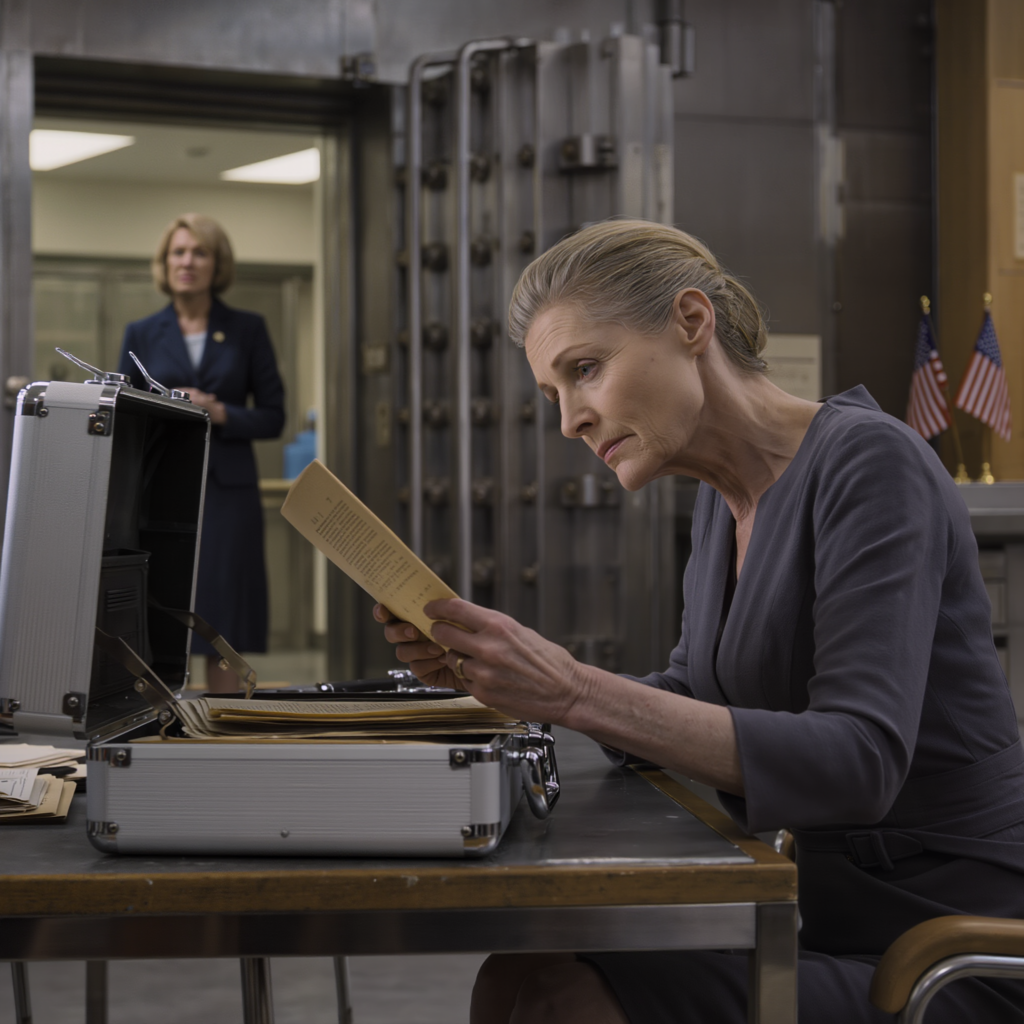
She led me down a carpeted hallway to a thick metal door. Inside, the vault was colder than the lobby, lined floor to ceiling with small metal doors. Safe deposit boxes, hundreds of them, stacked like dull silver teeth.
“This way,” Patricia said. She stopped at a slot labeled 847 and inserted her key. “Do you have yours?”
I realized I’d been gripping the tiny brass key in my hand the entire time, my palm damp around its red plastic tag.
I slid it into the second lock. There was a soft, decisive click.
“I’ll give you some privacy,” Patricia said, easing the long, narrow box free and setting it on a rolling cart. “You can use the room just there.”
The private room was barely bigger than a closet, with a table, a chair, and no windows. The box felt heavier than it looked when I lifted it.
For a long minute I just stood there, staring at that plain metal rectangle. Thirty‑eight years of Tuesdays at 2:00 p.m. sat in front of me, silent and waiting.
I opened it.
Inside were folders. Lots of them, neatly stacked, labels facing up in Bob’s handwriting.
INVESTMENTS – ACTUAL.
My hands shook as I opened the first one.
Page after page of losses. Bad investments. High‑risk stocks that had tanked, speculative ventures that went nowhere. Red numbers, negative balances, notes from advisors politely saying things like we recommend cutting your losses.
These weren’t accounts I recognized. No joint signatures. No Maggie anywhere. Just ROBERT E. THOMPSON, over and over.
I flipped through year after year of statements, watching hundreds of thousands of dollars disappear into the ether.
The second folder was worse.
HOME EQUITY LOANS.
Three of them, taken out against our house. Our house. The little three‑bedroom in the Portland suburbs where we’d brought our babies home from the hospital, where I’d planted roses along the fence, where I’d painted the kitchen three different colors over the years until Bob finally said, laughing, “Pick one, Mags, the walls are getting dizzy.”
Total debt: $270,000.
My breath went shallow. I could feel my pulse in my throat again, a drumbeat of disbelief.
The third folder almost broke me.
CREDIT CARDS – MAGGIE’S ACCOUNTS.
Except I’d never opened credit cards in my name alone. We had one joint card for groceries and gas, paid off every month. I’d never applied for another. I’d never signed a thing.
But there it was, again and again. MARGARET L. THOMPSON. My Social Security number. My forged signature. Fifteen different cards. Every single one of them maxed out.
Total balance: $96,000.
My husband—my steady, Tuesday‑at‑two husband—had stolen my identity.
I sat very still, the folder open in front of me, the air in the little room feeling thinner by the second. Bob’s face flashed in my mind: laughing at David’s graduation, tearing up as he walked Emily down the aisle, sleeping beside me with his glasses sliding down his nose and a book tented on his chest.
That man. That man had done this.
At the bottom of the box, under the folders, was an envelope. Thick, cream‑colored. My name written across the front in Bob’s looping script.
MAGGIE.
My hands stopped shaking.
Shock had burned off. Grief, too. What was left was something colder, harder, like a blade being sharpened.
I opened the envelope.
“Mag,” the letter began. Only he called me that. “If you’re reading this, I’m already gone, and you’ve found the box. I’m sorry. It’s not enough, I know, but it’s all I have.”
He went on.
Five years ago, he wrote, he’d made an investment he was sure would pay off. It hadn’t. He’d tried to fix it. Every Tuesday, he went to the bank to restructure, to shuffle, to apply for new lines of credit, always sure the next thing would finally fill the hole he’d dug.
“I kept thinking I could fix it before you ever had to know,” he wrote. “The house loans, the cards in your name—I did it to buy time. I told myself I was protecting you from my mistakes. I was wrong.”
By the time I read his words, we were, according to him, bankrupt. The house would likely go into foreclosure. My credit was destroyed. He said he knew I’d hate him. Said I should.
“I was trying to protect you,” he wrote, “but all I did was make you pay for it. I’m sorry. I love you. That part was always real. —Bob.”
I read the letter twice. Folded it back along its creases. Slipped it into the envelope again.
Then I put every folder back into the box, slid the box closed, and carried it out of that little room with my spine straight and my jaw set.
Patricia was waiting just outside.
“Are you all right, Mrs. Thompson?” she asked.
“No,” I said honestly. “But I will be. I need copies of everything in this box. And I need the name of a good attorney who handles financial fraud.”
Her eyes widened just a fraction, but she nodded.
“I’ll make the copies myself,” she said. “And…Mrs. Thompson? I’m truly sorry.”
The tiny brass key felt heavy in my pocket as I drove home.
David’s car was already in the driveway when I pulled in. He met me at the door, his face tight with worry.
“Mom,” he said, “I found something else.”
“If it’s another empty account,” I said, dropping my purse on the hall table, “just add it to the pile.”
He shook his head and held up a folder.
“Dad’s life insurance policy,” he said. “Or what I thought was his life insurance policy.” He took a breath. “There isn’t one.”
My laugh came out sounding like a bark.
“Let me guess,” I said. “He let it lapse.”
David blinked. “How did you know?”
“Because your father spent the last five years destroying everything we built,” I said, my voice flat. “Apparently, he was very thorough.”
I took the copies from my bag and spread them across the kitchen table—the investments, the loans, the credit cards, the letter.
“Sit down,” I told my son. “We have work to do.”
He read silently, his face going from pale to flushed to something like sick.
“Mom,” he said finally, his voice breaking. “This is bad. This is really, really bad.”
“I know.”
“The house. Your retirement. Your credit. Everything is gone.”
“I know,” I repeated.
He stared at me. “How are you so calm?”
Because anger, I wanted to say, wouldn’t pay a single bill. Because fury wouldn’t fix my credit score or keep a roof over my head. Because someone in this family needed to stay upright.
Instead, I folded my hands on the table and met his eyes.
“Because what I need isn’t rage,” I said. “It’s a plan.”
The attorney Patricia recommended was named Jennifer Rodriguez.
Her office downtown had big windows that looked out over Portland’s gray skyline and a coffee maker humming in the corner. She wore a navy suit and a ponytail and listened without interrupting as I laid everything out: the Tuesday bank trips, the safe deposit box, the failed investments, the home equity loans, the forged credit cards, Bob’s letter.
When I finally stopped talking, she sat back in her chair.
“Mrs. Thompson,” she said, “I’m going to be direct with you.”
“Please do.”
“This is one of the worst cases of spousal financial abuse I’ve seen. And I see a lot.”
The word abuse hung in the air between us. I thought of bruises, of shouting, of slamming doors. Our house had never sounded like that.
“Our money life,” though? That was another story.
“Your husband systematically destroyed your financial security,” Jennifer continued, “and did it in your name. That’s not just mismanagement. It’s fraud. It’s identity theft. It’s a crime.”
“But he’s dead,” I said. “What can we actually do?”
“We can prove you weren’t complicit,” she said. “We can work with the creditors to show the signatures were forged. We can potentially save the house by demonstrating the loans were fraudulent. But it’s going to be a fight.”
“How long of a fight?”
“Six months, maybe a year,” she said. “And it’s going to cost money you probably don’t have.”
I thought about the forty‑three dollars in the checking account. About the empty retirement funds. About the ninety‑six thousand dollars of debt sitting in folders under my name.
Then I thought about Bob’s careful handwriting in that letter. About thirty‑eight years of, “Don’t worry, Maggie. I’ll find the money.”
“Tell me what we need to do,” I said.
That night, my daughter called.
Emily had always been closer to her father than to me. She was his mini‑me, everyone said—same dark eyes, same love for spreadsheets, same dry humor. When I told her what I’d found, the silence on the other end stretched so long I pulled the phone away to see if the call had dropped.
“Em?”
“Mom,” she said finally, her voice small. “Are you sure?”
“I have the documents,” I said. “I have his letter admitting it.”
“But Dad wouldn’t do that,” she whispered. “He loved you. He loved us.”
“He did,” I said. “And he also stole my identity and destroyed our financial future. Both of those things can be true at the same time.”
She hung up soon after.
David called an hour later.
“Emily’s upset,” he said. “She called me, crying. She thinks you’re trying to tear down Dad’s memory. She says grief is making you irrational.”
“I’m not the one who opened fifteen credit cards in my spouse’s name,” I said.
“She’ll come around,” David said. “She just needs time.”
I wasn’t so sure.
Because I’d seen this before, in other families at church, in neighbors’ dramas whispered about over fences. The one who couldn’t accept the truth. The one who needed the lie more than they needed oxygen, because the truth would crack something foundational.
The next few weeks blurred into a montage of phones ringing and printers whirring.
Jennifer filed reports with the credit bureaus. She contacted every credit card company in the folders. We hired a handwriting expert who studied the applications and confirmed what I already knew in my bones: the signatures weren’t mine.
David threw himself into helping me. He built spreadsheets to track every account, every call, every letter sent and received.
One evening, we sat at the kitchen table, papers spread out around us like a very depressing board game.
“Mom,” he said suddenly, setting his pen down. “There’s something I need to tell you.”
“Please don’t let it be another secret account,” I said, only half joking.
“A few years ago,” he said, “Dad asked me to invest in something with him. A tech startup one of his clients was involved in. He said it was a sure thing, like dot‑com gold or whatever.”
A chill slid down my spine.
“How much?”
“I had fifty thousand saved for the kids’ college fund,” he said. “He wanted me to put it all in.”
My heart sank.
“David,” I said, “please tell me you didn’t.”
“I almost did,” he admitted. “I was excited. Dad said we’d double it in a year, easy. But Sarah”—his wife—“she didn’t like it. She said if it was such a sure thing, why did Dad need our money? We fought about it. I was so mad at her. But she held firm. I told Dad no.”
He looked at the pile of papers and swallowed hard.
“I think he was already in trouble then,” David said. “I think he was trying to use my money to plug the hole.”
I reached across the table and squeezed his hand.
“But you didn’t give it to him,” I said. “Sarah saved you. That’s what matters.”
He stared at the bank statements.
“Do you think he would’ve kept going?” he asked quietly. “Taking from other people, I mean?”
I thought about Bob’s letter. About the way his neat script had wobbled in places. About the steady escalation—investments, then loans, then fraud.
“I think he was drowning,” I said slowly. “And drowning people grab for anything they can reach, even if it means pulling someone else under.”
Three months after Bob’s death, we had our first win.
Two of the credit card companies agreed the signatures were forged. They removed the debt from my credit report. It wasn’t everything. It wasn’t even most of it. But it was something.
Proof that the truth could move the needle, even if it was one digit at a time.
Emily still wasn’t speaking to me.
She sent one short email.
I need space. I can’t handle the way you’re destroying Dad’s memory.
Destroying his memory.
As if I’d taken a hammer to some statue, instead of simply shining a flashlight on the cracks he’d carved himself.
David said she’d come around. I wanted to believe him, but some bridges, once burned, stay ash.
The home equity loans proved harder.
The bank’s lawyer argued that as Bob’s spouse, I’d benefited from the money. I’d lived in the house, after all. I’d enjoyed the home improvements, the vacations, whatever that money had paid for.
“They’re going to fight this,” Jennifer told me, sliding a stack of case law across her desk. “Hard. They don’t want to set a precedent.”
“So what do we do?”
“We go to court,” she said. “We let a judge decide if you’re liable for debt created through fraud you didn’t consent to, just because you were married to the person who committed it.”
“Do we win?”
She hesitated, and I appreciated that more than a false promise.
“I think so,” she said. “But I can’t guarantee it. This is messy legal ground.”
Messy. That was one word for it.
In the weeks leading up to the court date—set for late November, nearly six months after Bob’s heart gave out in that office—I did something I hadn’t done in years.
I looked for a job.
At sixty‑four, I wasn’t exactly what you’d call an in‑demand hire. I’d been a stay‑at‑home mom most of my adult life, then gone back to part‑time work as a librarian once the kids were grown. I’d retired three years earlier, ready for road trips and grandbabies and quiet mornings with coffee on the porch.
Instead, I was scrolling job listings for anything that would hire a woman my age who needed to rebuild from the financial equivalent of scorched earth.
A small independent bookstore downtown—The Turning Page—called me in for an interview.
The owner, a woman named Ruth with silver hair piled into a messy bun and red‑framed glasses, looked over my thin resume.
“So,” she said, perched on a stool behind the counter. “You worked as a librarian. You’ve been married nearly four decades. Now you’re looking for part‑time work. May I ask why?”
I could have lied. Said I was bored. Said I wanted to keep busy.
But I was so tired of lies, even the gentle kind.
“My husband died six months ago,” I said. “I just found out he stole my identity and destroyed our finances. I need a job because I’m trying not to lose my house.”
Ruth stared at me for a long moment. Then she nodded.
“When can you start?” she asked.
I worked at The Turning Page three days a week.
The pay wasn’t much, but it was more than the zero I’d been bringing in. More important than the money, it gave me something I hadn’t realized I’d lost.
Purpose.
I liked the way the bell over the door chimed when customers walked in. I liked recommending books and watching people’s faces light up when they found the right one. I liked alphabetizing shelves and making little display tables for mystery month or banned‑books week.
On slow afternoons, Ruth and I drank coffee behind the counter and talked.
One day, while we were restocking the mystery section, she said, “He wasn’t dishonest about money, my ex. Just everything else.”
“Everything else?” I echoed.
“Other women,” she said. “Other stories. Other versions of himself. When I finally left, everyone told me I was overreacting. That all marriages had problems. That I should ‘try harder.’” She slid a hardcover into place and looked at me over the shelf. “You know what I learned?”
“What?”
“The people who tell you to ‘try harder’ are usually the ones who’ve never had to try at all.”
I thought about Emily. About friends who’d grown uncomfortable and distant when I started talking openly about what Bob had done, as if my honesty were catching.
The court hearing landed on a Thursday, just like that first visit to the vault, only now the leaves had turned and the air had that particular wet chill Portland specializes in.
Emily didn’t come. She sent a text the night before.
I can’t watch you do this to Dad’s name. I’m sorry.
I stared at the tiny glowing letters on my phone screen, then typed back.
I understand. I love you.
She didn’t respond.
The courtroom was smaller than the ones on TV. No towering galleries, no dramatic echo. Just a tired judge, a handful of wooden benches, and a couple of attorneys with their laptops and legal pads.
Judge Harrison, a man in his sixties with thinning gray hair and kind eyes, listened as the bank’s lawyer laid out their case.
“Mrs. Thompson benefited from the loans,” the young attorney said, his tone confident. “She lived in the property used as collateral. She enjoyed the lifestyle those funds supported. Whether she signed the papers or not, she accepted the benefits.”
Jennifer stood when it was her turn and, in a calm, steady voice, dismantled that argument piece by piece.
She presented the forged signatures, the handwriting expert’s report, Bob’s letter admitting to the fraud. She showed bank statements proving the loan money went into accounts solely in Bob’s name. She showed that I’d had no access to those funds, no knowledge of those accounts.
Then she called me to the stand.
“Mrs. Thompson,” she said, once I’d sworn to tell the truth and settled into the witness chair, “when did you first learn about these home equity loans?”
“When I opened the safe deposit box at First National,” I said. “After my husband died. Thirty‑eight years into our marriage.”
“In those thirty‑eight years,” she asked, “did your husband ever discuss taking out loans against your home?”
“Never.”
“Did you receive any of the money from those loans?”
“No,” I said. “The money went into accounts I didn’t know existed.”
“Did you sign the loan applications?”
“No.” My voice didn’t shake. “I did not.”
The bank’s lawyer took his turn.
“Mrs. Thompson,” he said, pacing a little in front of the bench like he’d practiced this in front of a mirror, “you trusted your husband with your finances, correct?”
“Yes.”
“You chose not to be involved in financial decisions?”
I met his eyes.
“I trusted him,” I said. “That’s not the same as choosing to be defrauded.”
He frowned.
“But you benefited from the marriage,” he pressed. “From the home
you lived in, from the bills that were paid, from the lifestyle you shared. You lived in the house those loans were taken against.”
“I lived in my home,” I said. “The home my husband and I bought together forty years ago. The home he put at risk without my knowledge or consent.”
“You expect the court to believe,” he said, “that in thirty‑eight years, you never suspected anything?”
That was the question, really. The one that had kept me up nights.
I took a breath.
“My husband was an accountant,” I said. “He was good with numbers. Organized. Trustworthy. Or so I believed. He hid his mistakes behind competence. Behind my trust. Behind thirty‑eight years of me thinking love meant not questioning the things he told me not to worry about.”
I let that sit for a moment.
“Was I naive?” I said. “Probably. But naivety isn’t consent to fraud.”
The judge called a recess.
David paced the hallway outside, his dress shoes squeaking on the old linoleum. Jennifer checked her phone and sipped burnt coffee from a vending machine cup. I sat on a wooden bench and watched the second hand crawl around the clock above the door.
“You did great, Mom,” David said.
I nodded, but my mind was far away—from the courtroom, from the loans, from the liens. It was back with Emily, the daughter who couldn’t sit in that room because doing so would mean accepting that her father was both the man who taught her to ride a bike and the man who forged his wife’s name.
After an hour, the bailiff called us back in.
Judge Harrison looked over his reading glasses at both attorneys.
“I’ve reviewed the evidence,” he said. “The forged signatures, the expert testimony, the decedent’s own written admission of fraud. While I understand the plaintiff’s position regarding spousal benefit, I cannot ignore the clear pattern of deception carried out without Mrs. Thompson’s knowledge or consent.”
My hands clenched together.
“I’m ruling in favor of the defendant,” he said. “The loans are void. The liens on the property are released.”
David let out a breath that was half laugh, half sob. Jennifer allowed herself a small, satisfied smile.
Me?
I felt something in my chest loosen. Not joy. Not triumph. Just the constant, grinding tension easing up a notch.
We walked out of that courthouse into a sky the color of old dishwater.
I’d “won,” technically. I got to keep my house. My name was cleared in the eyes of the law.
But as I stood on the courthouse steps, the November wind cutting through my blazer, all I could think was: What, exactly, had I really won?
Because the marriage I thought I had? The husband I thought I knew? The future I’d imagined, with road trips and matching rocking chairs on the porch?
Those were gone, no matter what any judge wrote on a piece of paper.
That night, Emily called.
I almost let it go to voicemail. My thumb hovered over DECLINE, then slid to ACCEPT.
“Hello?”
“Mom.” Her voice sounded raw, like she’d been crying for hours. “I need to tell you something.”
“Okay,” I said, heart thudding.
“After the hearing, I went to the bank,” she said. “I asked to see Dad’s records. The ones you showed the lawyer. I wanted to prove you wrong.”
A pause. I could hear her breathing.
“But you weren’t wrong,” she whispered. “It’s all there. Everything you said. And there’s more.”
My stomach clenched.
“More?”
“He had a credit card in my name, too,” she said. “I never opened it. Never saw it. But there it is. Twenty‑three thousand in charges. My credit is trashed. And I… I had no idea.”
Oh, Bob.
Even from the grave, his secrets were still spilling out like a knocked‑over filing cabinet.
“Emily,” I said softly, “I’m so sorry.”
“I should have believed you,” she said. “I should have listened. I just… I couldn’t imagine Dad doing that. He was my dad. He taught me long division at the kitchen table. He fixed my first car. He walked me down the aisle. How can that person also be this person?”
“Both people were real,” I said. “The good father and the man who made terrible choices. People aren’t just one thing.”
She sniffed.
“Can I come over?” she asked.
“Of course,” I said. “Anytime.”
An hour later, she was sitting at my kitchen table, hands wrapped around a mug of tea. Her makeup was smudged, her dark hair pulled into a messy knot the way she wore it when she was a teenager cramming for exams.
We talked.
Not around things, not through a haze of denial, but directly.
About her father. About the debt. About how love and betrayal can sit in the same house, eat at the same table, sleep in the same bed.
Jennifer helped Emily file the same fraud claims I had. David came over with his laptop, and the three of us sat in the living room surrounded by papers, making a different kind of family scrapbook.
“We’ll get through this,” David said, glancing between me and his sister.
For the first time since Bob’s heart stopped, I believed him.
Not because it would be easy. Nothing about this was easy.
But because, for the first time in a long time, we were telling the truth. No more pretty stories about “protecting the family” or “keeping our future secure.” Just the messy, complicated reality and the three of us facing it together.
The bookstore became my sanctuary.
Ruth taught me about inventory and ordering and the quiet terror of payroll. She showed me how to read the numbers on the monthly reports.
“Money,” she said one day, tapping the spreadsheet with a pen, “is just another story people tell. The trick is making sure you know who’s holding the pen.”
One afternoon, a woman came in who looked like she’d been crying in her car for twenty minutes and then wiped her eyes and hoped no one would notice.
“Can I help you find something?” I asked.
She hesitated, then said, “Do you have anything about…financial abuse in marriage?”
The words came out in a rush, like she was afraid of them.
I led her to the self‑help section and pulled down a couple of books Jennifer had recommended.
Then, on impulse, I said, “I’ve been through something like that. If you ever want to talk.”
She did.
We sat in two chairs by the front window for nearly an hour while she told me her story. It wasn’t identical to mine—no two ever are—but the pattern was there. Control disguised as care. Isolation disguised as protection. Manipulation disguised as love.
When she left, arms full of books and resources, she hugged me.
“Thank you for believing me,” she whispered.
After she walked out, Ruth emerged from behind a display of cookbooks.
“You’re good at that,” she said.
“At what?”
“Listening,” Ruth said. “Believing. Not flinching.”
I thought about Emily’s initial refusal to believe me. About the friends who’d gone quiet. About the way shame grows in silence.
“I know what it’s like not to be believed,” I said.
Word spread in ways I didn’t see at first.
A neighbor came in and asked quietly if I knew anything about payday loans. A woman from church stopped by “just to browse” and ended up in tears in the biography aisle, telling me about the account she’d just discovered in her husband’s name only.
Ruth and I started a small support group that met once a month in the bookstore’s back room. Just a circle of mismatched chairs, a box of tissues, and a coffee maker that rattled when it brewed.
At the first meeting, there were six of us. By the third, there were twelve. By the sixth, twenty‑three.
We told our stories.
Financial abuse. Emotional manipulation. The kind of harm that doesn’t show up in bruises but leaves you feeling like you don’t exist unless someone else says you do.
When it was my turn, I told them everything.
The Tuesday bank trips. The safe deposit box. The folders. The ninety‑six thousand dollars in fake credit card debt. The $270,000 in loans against my house. The forty‑three dollars left in our supposedly “secure” account.
The daughter who didn’t believe me at first. The judge who did.
“How did you stay strong?” someone asked.
“I didn’t,” I said.
They looked at me.
“I cried,” I said. “I yelled at the wall. I sat in my car in parking lots and couldn’t make myself go inside. I was terrified. Being strong isn’t about never falling apart. It’s about what you do afterward. I kept moving anyway, one appointment, one phone call, one form at a time, because the alternative was giving up. And I’d already spent thirty‑eight years letting someone else make my choices.”
After one particularly intense meeting, Ruth and I sat in the empty bookstore, the chairs still in a circle, the air smelling like coffee and paper.
“You know what you’re doing, right?” she said, sipping wine from a paper cup.
“Drinking Merlot out of something meant for lattes?” I said.
She smiled.
“You’re building something,” she said. “Bob tried to wipe you out. Instead, you’re helping other women avoid the same trap. That’s not just survival, Maggie. That’s transformation.”
The word settled on my shoulders like a coat that actually fit.
I’d spent so much energy trying to claw my way back to the life I thought I’d had. The one where my husband was honest and our retirement was safe and Tuesday afternoons were just Tuesday afternoons.
Maybe I wasn’t supposed to go back.
Maybe I was supposed to build something new.
About a year after Bob died, on what would have been our thirty‑ninth wedding anniversary, I walked into a bank.
Not First National.
A different one. Different building. Different logo. No history of Tuesdays at 2:00 p.m. clinging to the walls.
The teller was a young man with a friendly smile and a tie that didn’t quite match his shirt.
“How can I help you today?” he asked.
“I’d like to open an account,” I said. “In my name only.”
He nodded and slid a stack of forms toward me.
“Name?” he asked.
I hesitated for half a second.
“Margaret Sullivan,” I said.
My maiden name felt unfamiliar and right at the same time.
“Any other accounts with us, Ms. Sullivan?” he asked.
“Not yet,” I said. “Just this one.”
I deposited my paycheck from The Turning Page. It wasn’t a big number.
But it was mine.
When we finished, he handed me a small envelope.
“Your debit card is in there,” he said. “And this is the key for your new safe deposit box, if you choose to use it.”
A tiny brass key slid across the counter on a red plastic tag.
I picked it up, feeling the weight of it. Different bank. Different box. Different woman holding it.
“Thank you,” I said.
I walked out into the weak Oregon sunshine with my head high.
I wasn’t erasing the past. You can’t. There will always be thirty‑eight years of Tuesdays at 2:00 p.m. There will always be the good parts and the terrible ones—the babies held, the bills hidden.
But I was reclaiming something.
My name. My future. My right to know where every dollar with my Social Security number attached to it was going.
If you’re reading this and any of it feels uncomfortably familiar—the locked doors, the “don’t worry about it”s, the feeling that something is wrong but you can’t quite point to it—trust that feeling.
Ask questions.
Look at the accounts.
If someone loves you, they won’t be afraid of transparency. Love isn’t blind trust. Love is partnership. It’s two people sitting at the same table, looking at the same numbers, making decisions together.
And if you open your own version of that safe deposit box and your world cracks apart, if you find out the person you trusted most has been using your name like a credit card with no limit, hear this from a woman who has stood in that fluorescent‑lit vault:
You are stronger than you know.
The person who tried to erase you didn’t succeed.
You’re still here.
And that means you can rebuild.
I did.
One Tuesday at a time, with my own key in my own hand.
If you’d told the mid-twenties version of me, the one who walked into a branch of First National in a thrift-store skirt suit, her hand still warm from her brand-new wedding band, that she would one day stand in front of a judge fighting that same bank to keep her house, she would have laughed.
Back then, banks were marble floors and quiet pens on chains and men in suits who called you ‘ma’am’ and shook your husband’s hand twice as hard as yours. Safety, I thought. Grown-up life.
I remember that day more clearly now than I had in years. Bob squeezed my fingers as we sat in the office of a man named Don who had a framed photo of his golden retriever on the credenza and a tiny American flag stuck in a mug full of pens.
‘A joint checking, joint savings, and you might consider a CD down the line,’ Don said, sliding papers toward us.
Bob took the pen first.
‘I’ll handle the finances,’ he told Don, and then, with a grin, me. ‘Maggie’s the creative one. I’m the numbers guy.’
My mother had said almost the same thing the week before when I told her Bob wanted to take care of everything money-related.
‘A good man takes that burden off his wife,’ she said, rinsing potato salad off a Pyrex dish at her kitchen sink. ‘Your father always did. Let him, honey. Less to worry about.’
Less to worry about. That phrase rolled around my head for decades like a comfort object.
I signed where Don put little sticky tabs, never reading the fine print. I was thinking about dinner, about the futon we had picked out for our first tiny apartment, about the way Bob had whispered ‘trust me’ into my hair the night before when we lay in bed talking about the future.
For years, I told myself the story that had been handed to me: he was better with money, so it just made sense.
I did not notice the moments that added up to something else.
The time I suggested we go over the budget together and he laughed and said, ‘You hate math, Mag. Why torture yourself?’
The way he always got the mail first.
The one and only time, early on, when I bounced a small check for groceries because I had misremembered the balance and he came down harder than the situation deserved, his voice sharp in a way that made my stomach knot.
‘This is why I keep telling you to let me handle it,’ he said. ‘One mistake can domino, Maggie. We can’t afford that.’
I apologized then, like I was a kid who had tracked mud on the carpet instead of a grown woman who had earned her own paycheck.
I think about that a lot now, when women sit in that back room at the bookstore and apologize for asking to see the bank statements in their own homes.
No one should have to say sorry for wanting to know where their own money is.
Our support group at The Turning Page grew until the back room could barely contain us. Ruth joked we would have to knock down a wall soon.
We started having to set out folding chairs from the basement. We made a sign-up sheet so new people would not have to introduce themselves out loud if they did not want to; they could just listen. The stories changed, but the bones of them stayed the same.
‘He says I’m bad with money, so he gives me cash for groceries and that’s it.’
‘I signed something at the dealership because he said we were just cosigning. Turns out the car is in my name and the loan is in collections.’
‘Every time I ask a question, he tells me I don’t trust him and I’m ruining the marriage.’
One night, a woman in her sixties with careful hair and a pearl necklace sat with her hands folded tightly in her lap and said, in a voice that sounded like it belonged in a choir loft, ‘He never laid a hand on me. He’s a deacon at our church. How am I supposed to tell people that the man who prays over offering envelopes on Sunday empties my account on Monday?’
Around the circle, heads nodded.
The social fallout came in waves.
Some people rallied. The pastor’s wife, Linda, cornered me after service one Sunday, her eyes damp.
‘I read about financial abuse after you mentioned it to Jennifer,’ she said. ‘We’d like to host a workshop at the church. Debt and dignity, or something like that. Would you be willing to speak?’
Others… not so much.
One couple we had known for thirty years stopped inviting me to their annual Fourth of July barbecue. Another friend, Bev, told me over coffee that she thought I was being ‘a little dramatic’ and that ‘Bob must have been under a lot of pressure.’
‘He was probably trying to keep up for you,’ she said. ‘You always liked nice things.’
I thought about the secondhand furniture in our living room and the way I cut coupons like it was a sport.
‘Right,’ I said, stirring my coffee. ‘He maxed out fifteen cards in my name because I wanted the expensive brand of dish soap.’
Bev flushed and changed the subject.
Shame is contagious. People will go to impressive lengths to convince themselves the thing that happened to you could never happen to them.
If they can believe you did something to cause it, they can believe they are safe.
The first time I spoke in public about what Bob had done was at that church workshop.
I wore my navy blazer and a necklace Emily had given me for Mother’s Day years before. The fellowship hall smelled like lasagna and coffee, and a cardboard sign over the refreshment table said ‘Stewardship Sunday’ in wobbly marker.
I stood behind a metal music stand someone had repurposed as a lectern and held onto it with both hands so people would not notice how they shook.
‘I used to think financial abuse was something that happened to other people,’ I told the room. ‘Women on the news. Stories in magazines you buy in the grocery store checkout line. Not people like me. Not a wife who sat in this sanctuary every week, who brought potato salads to potlucks and tithed faithfully and believed that as long as the bills were paid and the lights stayed on, everything was fine.’
I told them about Tuesdays at two. About the safe deposit box. About the forty-three dollars left in the account that was supposed to see me through old age.
I did not name Bob from the pulpit. I did not need to. Everyone knew who he was. Who he had been.
When I finished, Linda wrapped an arm around my shoulders and prayed, and then the questions began.
‘What if it’s already been going on for years?’
‘What if I work part-time and he makes all the real money?’
‘What if I’m afraid of what I’ll find?’
On my way out, a teenage girl I had only ever seen passing the offering plate pressed something into my hand.
It was a little sticker of an American flag.
‘I heard you stayed,’ she said. ‘Even when people didn’t believe you. I’m going to remember that.’
I stuck the flag to the inside cover of my planner, right next to a reminder to check my credit report every four months.
Once you start talking about something openly, other people start handing you their own pieces of it.
A community college in town asked if I would come speak to a continuing education class on personal finance. A counselor at a women’s shelter stopped by the bookstore and asked if she could give our group information to her clients. A local credit union reached out about partnering on a financial literacy night.
Every time my phone buzzed with another request, part of me wanted to crawl under the covers and stay there.
Another part remembered how alone I had felt in that vault.
At the credit union event, they had set up a neat row of chairs and a projector for a PowerPoint titled ‘Know Your Numbers.’ I brought the folders from the safe deposit box, minus any account numbers, and laid them on the table at the front.
‘This,’ I said, tapping the stack of papers, ‘is what looking the other way cost me.’
Afterward, a young man in a polo shirt came up to me, cheeks pink.
‘My mom always let my dad handle everything,’ he said quietly. ‘He died and she found out the house was three months from foreclosure. She had to move in with me. I wish someone had told her what you’re telling people now.’
Pieces, again, handed across counters and conference room tables and folding chairs.
I took them. I listened. I walked back to my little house that I still owned because I had fought for it and felt something like purpose settle into the lines of my life.
Ruth, meanwhile, had plans of her own.
One Monday morning, she flipped the ‘Closed’ sign on the front door and locked it, then waved me over from the new releases table.
‘I need you to look at something,’ she said, pushing her red glasses up her nose.
She spread a stack of papers on the counter. Contracts. Financial statements. A sketch of the bookstore floor plan with scribbles about where a coffee corner might fit one day.
‘I’m tired,’ she said. ‘In a good way. This place deserves someone who can give it another twenty years. My knees and I are not those someones.’
A cold little stone formed in my stomach.
‘You’re selling?’ I asked.
She shook her head.
‘I’m offering partnership,’ she said. ‘Fifty-fifty. You’d buy in, slowly, over a few years. We’d make the decisions together. I’d mentor you on the business side. You’d bring in the new ideas. And when I’m finally ready to move to Arizona and drink iced tea on a porch all day, you take over entirely.’
Me. Owning a bookstore. The thought was dizzying.
‘I don’t have that kind of money,’ I said, my voice smaller than I liked.
‘You don’t have it yet,’ Ruth corrected. ‘But I ran the numbers. Between your wages, the group stipends we might be able to get from the community center for hosting, and a small business loan, it’s possible. Not easy. But possible.’
The words ‘small business loan’ made my chest tighten.
‘I can’t sign anything I don’t understand,’ I said. ‘Not ever again.’
Ruth smiled.
‘Good,’ she said. ‘That’s exactly the kind of person I want as a partner.’
We sat at the counter for two hours while she walked me through every line of those contracts.
Interest rates. Repayment schedules. Contingency clauses. What would happen if one of us wanted out before the other. What would happen if the roof caved in or the economy tanked or we decided to start selling more stationery and fewer mystery novels.
Every time something did not make sense, I asked. Every time, she answered. When she did not know, she wrote it down to call the bank and find out.
At one point, I realized my hands were shaking and not from fear, but from the unfamiliar sensation of being fully in the loop.
This was what it was supposed to feel like, I thought. Not like a trap door under your feet, but like a bridge you had helped build, plank by plank.
In the end, we decided to wait a year. Give me time to shore up my finances, to see where the legal dust settled, to make sure that taking on any debt at all was the right move.
The offer sat in a neat folder on my kitchen table next to my own stack of documents, and for once, the paper between them did not feel like a threat.
At home, life settled into a new normal.
Emily and I still had landmines we stepped on sometimes without meaning to. A story about her dad’s silly dance moves at her wedding would turn sour in my mouth when my mind flashed to forged signatures. A joke about ‘Dad’s penny-pinching’ from David would land differently now that we knew where some of those pennies had gone.
But we kept talking.
One Saturday, I found Emily at my kitchen counter with a stack of her own bills.
‘I signed up for a budgeting app,’ she said, rolling her eyes at herself. ‘I make spreadsheets for a living and somehow never made one for my own money. Figure it’s about time.’
She glanced up at me.
‘Will you look at it with me?’
Her asking me that felt like a tiny miracle.
We spent the afternoon going through her student loans, her car payment, her rent, the card in her name that was now under investigation. We drank coffee and ate leftover muffins from The Turning Page and drew up a plan that made sense.
‘You know,’ she said, scribbling a number in the margin, ‘if I ever get married, I’m still open to a joint account for groceries and bills. But I’m also going to keep one in my name only. Dad always said that meant people didn’t really trust each other.’
She met my eyes, steady.
‘I think it means the opposite,’ she said. ‘It means trusting yourself, too.’
David, for his part, turned his narrow escape into a mission.
He started bringing his kids over once a month for what they called ‘Money Mondays’ even when it fell on a Saturday.
We sat at the dining table with three mason jars in front of each child labeled ‘Spend’, ‘Save’, and ‘Share’. We paid them a few dollars for age-appropriate jobs around my house and let them divide the bills into the jars themselves.
‘Why do I have to put this much in save?’ my oldest granddaughter, Lily, groaned, holding up a five-dollar bill.
‘Because future-you will be very grateful,’ I said.
‘But present-me wants ice cream,’ she countered.
‘Present-you can use the spend jar for a cone,’ I said. ‘But when future-you wants a bike, she’ll be glad past-you thought ahead.’
It was clumsy and simple and probably outdated compared to whatever the internet was telling parents to do, but it was something tangible.
Control had been taken from me in quiet little increments. Teaching my grandchildren about money in plain sight felt like placing that control back into their small, sticky hands.
Bob came up less and less as the months turned into a second year.
Grief, I learned, does not move in straight lines.
Some days I missed him with an ache so sharp I had to sit down. I would see a man in a gray cardigan at the grocery store, reach automatically for the brand of cereal he liked, or hear a joke he would have loved on late-night television and turn to say, ‘Did you hear that?’ before remembering.
Other days, I would pull into the driveway, see the porch light I had replaced myself because I had looked up how on my phone instead of asking any man to do it for me, and feel nothing but relief.
On the second anniversary of his death, I drove out to the cemetery.
The grass was damp, the sky a flat, pale gray. I stood in front of the headstone that said ROBERT EDWARD THOMPSON, BELOVED HUSBAND AND FATHER, and tried to reconcile all the versions of that man.
The one who made terrible pancakes on Saturday mornings when the kids were little. The one who rearranged our whole dining room to fit an extra table when we hosted Thanksgiving. The one who sat at my mother’s hospice bedside every night so I could go home and sleep.
The one who forged my name fifteen times.
I had brought two things.
The tiny brass key from the original safe deposit box, which Patricia had let me keep once the bank closed it.
And the faded American flag magnet from my refrigerator.
I set the key down on top of the granite, just for a moment, then closed my fingers around it again. Some things, I realized, I was not ready to bury.
The magnet, though.
I knelt and pressed it gently against the smooth stone. It did not stick, of course. It wobbled and fell into the grass.
I picked it up, brushed the dirt off, and laughed out loud at myself.
‘You never did belong here, did you?’ I said. ‘You belong on something that’s still moving.’
On my way home, I stopped at a hardware store.
That afternoon, I stuck the little flag magnet to the side of my filing cabinet in the spare room that had become my office. Inside the drawers were neatly labeled folders: BANK – PERSONAL, BANK – BUSINESS, STORE PARTNERSHIP PROPOSAL, CREDIT REPORTS, TAXES.
I had color-coded tabs and a calendar reminder on my phone for the days I logged in to check balances. Nothing moved without me seeing it.
The magnet sat just above the folder labeled ESTATE – BOB, a quiet reminder that loyalty should never mean closing your eyes.
A few months later, Ruth slid a manila envelope across the bookstore counter.
‘Community center came through,’ she said. ‘Grant funding. They want to support our group. We can pay for childcare during meetings, maybe bring in a guest speaker once in a while. And they want you to lead a workshop series.’
‘Me?’ I said, though I do not know why I was still surprised when people asked.
‘Yes, you,’ she said. ‘Maggie, do you know how many women have gotten out or at least gotten clarity because you sat in a folding chair and told the truth?’
I thought about the young woman who had discovered her husband’s crypto debt and filed for divorce. The older woman with the deacon husband who had quietly opened her own account after that first meeting. Emily checking her budgeting app and texting me screenshots when she hit a savings goal.
‘Okay,’ I said. ‘Let’s do it.’
We called the series ‘Rewriting the Ledger.’
On the first night, I stood in front of a whiteboard in the community center’s multipurpose room, marker in hand, and wrote three words: INFORMATION, ACCESS, CHOICE.
‘This isn’t about turning everyone into accountants,’ I told the group. ‘It’s about making sure you have the information you need, access to the accounts that affect your life, and the ability to make choices based on both. Anything less than that isn’t partnership. It’s control.’
After the session, a woman in her forties with a PTA sweatshirt came up to me.
‘My husband is a good man,’ she said quickly, like a disclaimer. ‘He really is. But he gets so defensive when I ask about money. He says it’s stressful and he’d rather just deal with it alone. After listening to you, I realized I went straight from my dad managing everything to my husband managing everything. I’m thirty-nine years old and I’ve never balanced my own checkbook.’
She smiled, shaky but determined.
‘I opened my own savings account this week,’ she said. ‘Nothing big. Fifty dollars. But it felt like…’ She searched for the word. ‘Like a tiny revolution.’
I knew exactly what she meant.
Not long after that, Ruth and I finally signed the partnership papers for The Turning Page.
We did it at a small desk in the back room during off hours, just the two of us and a notary who looked like he had seen every kind of human story pass over his clipboard.
I read every paragraph. Every sentence. Every clause. Twice.
‘This paragraph here,’ I said, tapping a line about what would happen if one partner wanted to sell. ‘Can we add a requirement that either of us has the right of first refusal?’
Ruth grinned.
‘Look at you,’ she said. ‘Negotiating.’
The notary cleared his throat.
‘Initial here if you both agree to the change,’ he said, sliding the amended page toward us.
I wrote M. SULLIVAN in careful script.
Maggie Sullivan. Not Thompson.
The name printed on the new business registration that arrived in the mail a week later read: THE TURNING PAGE, LLC – OWNERS: RUTH KLEIN, MARGARET SULLIVAN.
I pinned that letter to the bulletin board above my desk with the same magnet that had once held grocery lists and children’s art on my refrigerator.
Different wall. Same little flag.
On Tuesdays now, I still go to the bank sometimes.
Not at 2:00 p.m. on the dot, not every week, and never because someone else told me I had to.
Sometimes it’s to deposit the bookstore’s earnings. Sometimes it’s to sit with a loan officer and ask every question I need to ask about a line of credit for new shelving or a website upgrade.
They know me there now. At the new bank, they know my name before they know my marital status. They know I will ask to see the paperwork twice.
‘You read every line,’ one of the tellers said once, sounding half impressed, half amused.
‘I earned the right to,’ I said.
If you had walked into that branch last Tuesday, you would have seen a woman in her mid-sixties in a sensible cardigan, glasses perched on her nose, sliding a deposit slip across the counter with ink-smudged fingers from unpacking boxes of books.
You would not have guessed, just looking, that she once stood in a vault holding a letter that told her her life was over.
You would not have known that the tiny brass key attached to her keyring was both a scar and a promise.
A reminder that secrets can live behind locked metal doors, yes.
But also a reminder that you do not have to hand your key to anyone else ever again.