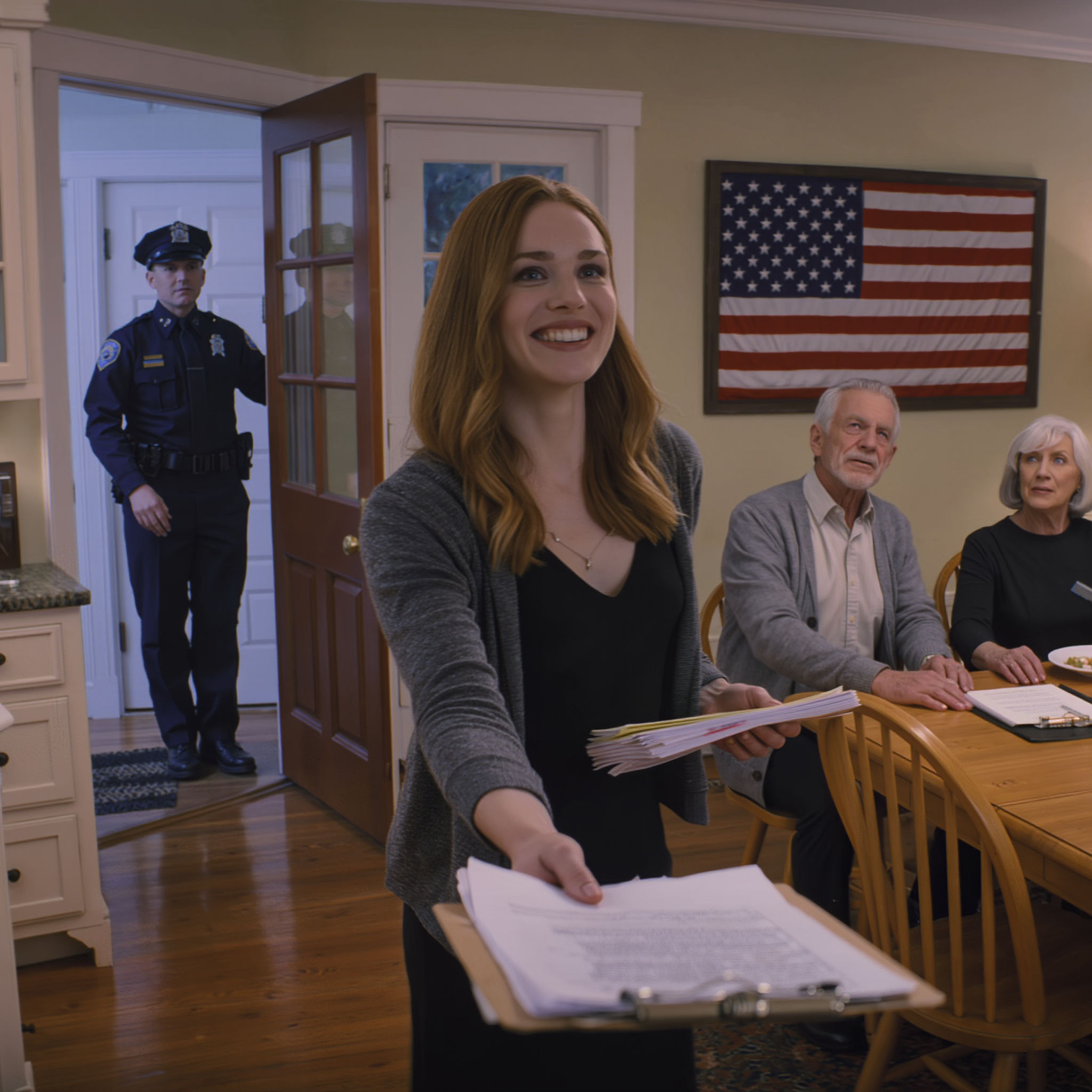
The lights were already on when I pulled into the driveway. That was my first warning. I remember pausing on the porch, key halfway to the lock, when I saw the faint silhouettes through the curtain. Two figures. Familiar. Too familiar.
When I stepped inside, the air was thick with something I couldn’t name. My parents sat on the couch like they’d been waiting for me. My mother was smiling—the kind of smile that doesn’t reach the eyes. My father leaned back, his hand resting on a folder on the coffee table.
“Welcome home,” my mother said softly. “We thought we’d surprise you.”
I glanced around. My paintings were gone. My shelves rearranged. The house didn’t feel like mine anymore. It felt occupied.
“It’s a family property now,” she added, tone casual, rehearsed.
My father nodded in quiet agreement.
I didn’t argue. I just said evenly, “I know.”
They thought I was stunned. I wasn’t. I’d been expecting this. Two months earlier, I’d called to tell them I’d bought my first house. A modest two-story with a garden and a leaky fence, but it was mine. Finally mine. After years of working through college, balancing two jobs, and saving every spare dollar, I’d done it.
They were proud at first, then curious, then oddly involved. My mother asked about the deed, the title, the mortgage terms—questions that sounded like small talk at the time. I should have seen it then. I grew up watching them fight over money, over land, over wills, and who deserved what. When my grandparents passed, I saw what greed did to love. I told myself I’d never let it near me.
But blood doesn’t warn you before it bites.
It started with help. They offered to co-sign a small renovation loan “just to speed things up,” my mother said. Then came the papers—bank “forms,” she called them. I signed them. My mistake. Weeks later, my father asked for a spare house key “in case of emergency.” Another mistake. By the time I noticed the property had been reclassified as a shared family asset, it was filed, sealed, and approved. My mother’s signature sat neatly beside mine.
I didn’t sleep that night. Not out of anger—out of clarity. That’s when the planning began. Revenge isn’t about rage. It’s about control.
I started small. I transferred every personal bill, utility, and tax account solely under my name, quietly, legally. I documented every receipt, every payment. Then I stopped paying the mortgage from the “family” joint account they’d talked me into opening. Instead, I funneled my payments through a private escrow my lawyer set up for me.
It took weeks of pretending—Sunday dinners, polite texts, the occasional “Love you, Mom.” I gave them calmness, the one thing they couldn’t read. Meanwhile, I gathered every piece of evidence. The forms they’d slid under my nose on a Sunday after church. The notary who skipped stamps and took cash envelopes. The digital trail from her email. I didn’t threaten. I waited.
Then I invited them over for a talk.
My father opened the folder on the coffee table. “We’ve decided to list the house for sale,” he said. “It’s better for everyone.”
My mother reached for my hand. “You’ll get your share, darling. Of course.”
I sat opposite them. “You’re right,” I said quietly. “It is a family property now.”
They relaxed. My mother exhaled—relief mixed with victory.
Then I slid my own folder across the table. It was thicker, neater, labeled on the inside flap in my handwriting: property fraud—case notes.
Her smile faltered first. My father frowned. He started flipping pages—photocopies of signed forms, timestamps, screenshots, and a forensic report from my investigator showing the IP logins on her email account and the notary’s calendar that contradicted their story.
“You filed without my consent,” I said evenly. “You used my signature on documents that weren’t disclosed to me. That’s criminal fraud.”
My mother’s lips parted. “We were just protecting—”
“Like you protected your siblings when you forged Grandma’s will,” I finished for her.
Silence dropped heavy. I leaned forward, my tone calm and deliberate. “I’ve already recorded the revocation at the county. The title is back under my name permanently. Tomorrow you’ll receive notice of the filing. I’ve also prepared an affidavit. If you contest it, every email and calendar entry goes into the public record.”
My father looked pale. My mother’s eyes glistened—not with guilt, but with fear.
I stood. “You taught me how to survive family politics,” I said. “You just forgot who you were teaching.”
They left quietly. My mother tried to speak at the door, but I didn’t let her finish.
When their car pulled away, I stood in the foyer for a moment—no triumph, just stillness. The house was silent again. Mine again. The living room light flickered once before stabilizing. I sat where they’d been and exhaled. It wasn’t the house I’d fought for. It was peace.
I took out my phone and opened a note titled “Rules.”
Never sign on a Sunday.
Never let the person who benefits drive the process.
When people say protect, ask who they’re protecting from whom.
I slept with the porch light off for the first time since moving in. In the morning, with coffee steaming in my favorite mug—the one with a chipped lip that reads YOU GOT THIS, BUNNY—I called the county recorder, the tax assessor, the utility companies. I called my friend Kelsey at the credit union who knows half the county because her mom taught elementary school for thirty years. I called the notary board and filed a complaint. I sent a public records request for the notary’s log and the raw metadata of the filing. I wrote the reference numbers on a Post-it and stuck it to my refrigerator next to the magnet that says MAKE GOOD CHOICES.
Mr. Alvarez from next door knocked on my back gate when he saw me kneeling in the garden cutting brown rosemary back to a hopeful nub. He’s the kind of neighbor who wheels your trash can back down the driveway without a word.
“You look like you’re trying to kill a plant,” he said.
“I’m trying to save it,” I said. “Just the ugly parts have to go.”
He leaned on the fence. “If you need me to sit on your porch some nights, I’m a retired man with a lawn chair.”
“Thank you,” I said, throat thick. “I might take you up on that.”
I biked to the county complex with a folder of originals in a zipping pouch like I was moving gold bars. The clerk at the recorder’s counter, Jolene, wore pink nail polish and a smile that made me think she sang in a church choir.
“Hi, Jolene,” I said. “I’d like to record a corrective deed revoking an erroneous reclassification. And I need certified copies.”
She read my papers like a surgeon reads a scan, stamped where stamps should go, slid a receipt across the counter, and lowered her voice. “Honey, you would not believe how many daughters stand here because somebody’s mama got too comfortable with a pen.”
“I can believe it,” I said. “I brought lemon cookies for your break room.”
She grinned and tilted her head toward the door. “We don’t take bribes. But we take gratitude.”
By the time I pedaled home, the revocation had a recording number and a bar code. I could breathe again, almost.
That evening, my mother’s Camry idled across the street, headlights thief-bright. I didn’t go outside. She texted: WE NEED TO TALK. I didn’t respond.
At midnight, a truck I didn’t recognize cruised by twice, slow. Mr. Alvarez’s porch light snapped on. He stepped out with his lawn chair, set it at the edge of his driveway, and cracked a can of something fizzy.
“Evening,” he called to the truck like he knew them. The truck rolled on.
I slept with the bedroom window cracked and a baseball bat under the bed like every woman I know who lives alone and remembers middle school softball.
At 7:02 a.m., a text from my uncle Gene—the one who sells boats nobody can afford and thinks life is a poker game because he keeps trying to bluff his way out of debt. COME TO BREAKFAST. WE CAN WORK THIS OUT. His version of working things out always requires my wallet.
I didn’t go. I walked to the diner on Maple where Ellen knows my order without asking and refills your coffee before you realize you want more.
“Over-easy and wheat?” she said, pencil tapping her pad.
“You’re an angel,” I said, sliding into a booth.
“Angels get better tips,” she said, pouring.
While I ate, I pulled up the county’s public portal on my phone. My revocation showed up in the queue. Under “related documents,” the original reclassification glared at me like the wrong answer circled in red on a test. I tapped it open and screenshotted everything: file time, clerk initial, instrument number. None of it lied. Jolene had told me the truth: the system works, but only if you drag it into daylight.
At 10:16 a.m., my phone rang. Unknown number. I let it go to voicemail. A minute later, a man’s voice played in my ear—measured, crisp, selling trust for a living.
“Ms. Walker,” he said. “This is David Kahn with Kahn & Fitch. I represent your mother and father. We’d like to propose a compromise that avoids further… publicity.”
I saved the message. I didn’t call back.
The next week was motions and counters and a notation on the public docket that said: DECLARATORY JUDGMENT—QUIET TITLE. The week after that was a hearing.
The courtroom looked like every American courtroom in every American town: flags, seal, pews that turn knees into discipline, a judge who could be anyone’s uncle until he isn’t. My parents sat at the defendant table. My mother wore the pearl earrings she saves for graduations and funerals.
The judge read my papers, asked me to explain my affidavits, asked the notary to explain her missing log entry, asked my father why his name appeared on a wire transfer request three hours after the reclassification was recorded. He asked my mother who opened her email at 10:34 p.m. on a Sunday to confirm a filing and why the IP address matched their Wi-Fi. His voice was not unkind. It was firm. Like a door that closes because it has to.
“This reclassification is void,” he said. “Title is quieted in the plaintiff’s name. Costs to the plaintiff.”
My mother made a small sound. My father looked down at his hands.
After court, my mother reached for me in the hallway.
“Ruth,” she said. “You wouldn’t arrest your own mother, would you?”
“I didn’t,” I said. “I asked a judge to tell the truth out loud.”
She flinched. “We’re family.”
“We are,” I said. “And you taught me—over and over—that in our family the person who speaks softly gets run over. I’m done.”
I left the courthouse and walked to the river because there are things only water knows how to hold. Joggers pounded past in shirts that made promises on their behalf. A dog leaned into a leash like hope. I tossed a pebble and watched the rings widen and fade. Even water needs a boundary to know where to stop.
At home, I made a list on a legal pad under the heading LIFE. Not a bucket list—this was maintenance, not fantasy.
Change locks. Done.
Revocation recorded. Done.
Utilities secured. Done.
Estate plan updated. In progress.
Teach three women how to read a deed. Next month.
Help Mr. Alvarez fix his fence. Saturday.
Call Kelsey about a bill-pay clinic at the library. Friday.
The next morning, Kelsey and I pitched a free clinic to the library director—a Saturday workshop on house title basics, notary do’s and don’ts, how to set up bill-pay alerts on your phone so you can catch a stray charge before it becomes a storm. We called it Home Title Watch because we needed a name that fit on a flyer. The third Saturday of every month, we showed up with coffee and donuts and a printer that could make certified copies for people who needed them. Jolene came on her day off to explain the recorder’s office in a way people understood, which is to say she told stories.
Ellen from the diner sent pie. Mr. Alvarez sat in the back and asked the questions other men were embarrassed to ask because sometimes the most heroic thing you can do is say, “I don’t know. Tell me.”
At the second clinic, a woman stood up and said, “My brother is trying to take Mama’s house.” We sat with her after and drew a map of what to do: gather originals, call Jolene, file an affidavit, print a revocation form, breathe. She hugged me so hard my ribs remembered.
By summer, five women had recorded revocations with the county because somebody tried to sneak a paper under a door on a Sunday. By fall, the county board voted—unanimously—to require a transcript of the notary’s log to accompany any reclassification filing involving family members. It wasn’t everything. It was enough to make a dent.
In September, my mother mailed me a card with a robin on it. Inside she wrote in a hand I recognized from elementary school permission slips: I am sorry. I cried in the kitchen, then slid the card into the drawer with the others. Forgiveness, for me, is not forgetting what happened. It’s deciding what happens next.
In November, I hosted Thanksgiving for the first time in the house that was mine. There was too much food and not enough chairs and I burned the rolls because I was telling a story to Kelsey about Jolene shutting down a recording attempt by a guy who wore a bolo tie and smiled too much. Mr. Alvarez brought tamales. Ellen brought her husband, who turned out to be the kind of man who can fix a drawer without making you feel foolish for not knowing how. We set a long folding table in the living room and used mismatched plates. Before we ate, I stood with a glass in my hand, looked at the people who had helped me build a house that was mine all the way down, and said thank you. Not a speech. A sentence. The kind you can carry home.
After dessert, the doorbell rang. On the porch stood my father holding a foil-covered pan and a six-pack of ginger ale. He looked like a man who was trying to figure out if he was invited. I opened the door wider and didn’t move. He took a step and stopped.
“Your mother is at Aunt Lorraine’s,” he said. “She said she couldn’t face a crowd.” He lifted the pan. “Sweet potatoes. Too sweet, probably.”
“Put them on the counter,” I said. “Two forks left of the sink.”
He slipped in and set them down, then stood lost for a second in a kitchen he hadn’t been invited into in a year.
“Ruth,” he said. “I’m sorry.”
“I know,” I said.
“I should have said it sooner.”
“You should have.”
He nodded, throat working. “Can I… can I sit?”
“You can help wash dishes,” I said.
He laughed, surprised. I handed him a towel.
We did not solve thirty years in an evening. We stacked plates and wiped counters. We did a small, boring, American thing that felt like a hinge creaking in the right direction.
Around nine, when the house was loud with card games and late-night coffee, I stepped onto the porch to breathe. The air smelled like leaves and sugar. Across the street, a house I didn’t know had hung white lights along the porch rail even though it wasn’t December yet. In this country, some of our rituals are ridiculous, and some are lifesaving, and sometimes they are both.
My phone buzzed. A text from Jolene: Approved—ordinance updates posted. Effective Jan 1. Thank you for pushing.
I typed back, You did the pushing, and put the phone in my pocket.
I looked at my front door. It is plain—blue paint, three small windows, a handle that fits my hand. There is nothing fancy about it. I love it like a body part. It is not the kind of door you see in magazines. It is the kind of door you close gently behind people you love and lock against people who mistake proximity for permission.
I turned and went back in.
In the living room, Mr. Alvarez had convinced half the party to learn how to two-step. Kelsey had Ellen by the fingers and was laughing so hard she could barely move. My father sat on the edge of a chair holding a mug of coffee like a peace offering. I took a deep breath and counted three. On two, I felt something uncoil in my chest. On three, I exhaled.
There are stories that end with a courtroom speech. There are stories that end with a gavel. Mine ends with a sound softer and more stubborn: the click a good lock makes when it knows whose hand is on it.
It ends with a door that opens when I want it to and closes when I need it to and never, ever again opens for someone who thinks family is a free pass.
It ends with a rosemary bush on a front step, with a flyer for a title workshop taped to a library door, with pink nail polish on a clerk’s hand as she stamps truth into permanence.
It ends with me learning how to live in the kind of boring that is actually freedom.
And if it has to keep going—and all good American stories do—I know the route. I know the clerk. I know where the recorder’s office keeps the stamp. I know my name. I know my door.
The lights are on when I pull into the driveway. That’s not a warning anymore. It’s a welcome.
Snow came early, the heavy, wet kind that makes roofs look like someone frosted the town overnight. On the first morning schools closed, I pulled on boots and walked a shovel down the block like a good neighbor. Mr. Alvarez waved me off his driveway—“My heart needs exercise”—so I crossed to Mrs. Patel’s and started there, my breath clouding, the scrape of the blade steady as a metronome. There’s a particular peace to being the first set of ridges on a blank street. It felt like getting to lay down the lines before anyone else arrived with their plans.
By noon, the plows had carved canyons and the sky had gone the color of a bruise. Inside, the house hummed warmer than it had last winter, and I could name the sound: my furnace, new filters, a schedule I had set myself. I made soup, answered emails, and reviewed the layout mockups for our Home Title Watch flyer for January—bold font, a photo of a smiling clerk near a stamp, and a line that read BRING YOUR QUESTIONS, YOUR DEEDS, AND YOUR GOOD PEN.
We outgrew the library’s small meeting room in a month. By February, we were in the auditorium, then splitting sessions—morning for folks who preferred to be home before lunch, afternoon for those who worked nights. Jolene and the recorder’s deputy came to every one, their pink and red nail polish chips evolving like weather patterns. We created handouts we laminated because the pages lived in kitchens, and kitchens are moist. The sheriff’s community liaison stood in the back, listening, then asked whether he could start sending his deputies to our sessions on their days off to learn what to look for on the road in those quiet fights that walk into houses in envelopes.
That winter, we found out that “quitclaim” had become a verb in our county, the way bad ideas become grammar when enough people repeat them. A company called Homestead Relief mailed letters to every ZIP code that started with our three numbers and had a dollar sign in its history. The letters used words like “options” and “assistance,” promised cash this week, and slipped the phrase QUITCLAIM DEED into a paragraph in a font you needed a magnifying glass to read. At our February clinic, a woman in a brown puffy coat put a letter on the table like a confession.
“They’ll give me ten thousand today,” she said, tapping the first page, “and I’ll be out from under the taxes. It’s only a ‘temporary transfer.’ That’s what the man said.”
Jolene put her glasses on the tip of her nose. “Close your eyes with me,” she said. “Say out loud: There is no such thing as a temporary deed.”
We wrote a list of everything this company had promised and everything the law said such a promise was worth in court. The list did not match. The woman took a photo of the list on her phone. “Come back in two days,” I said. “Bring the letter. Bring the man if you want to bring him. We will read it to him out loud and see if his tongue keeps saying what it said when he thought you were alone.”
He did not show. She came alone, lifted a grocery bag onto the table, and pulled out a shoebox filled with letters. We spent an hour sorting them into piles: titles, taxes, correspondence, secrets. The secrets we slid back into the box and tied with string. The rest we walked across the street to the recorder’s office and filed the certificates that should have been filed two years ago because her husband had died quietly one afternoon after church and no one had told the county the truth.
When she left, she hugged Jolene. “You make me feel like my house is a person you know,” she said.
“It is,” Jolene said. “That’s what we file—people.”
In March, Homestead Relief sent three men to the back row of our afternoon session with legal pads and a kind of polite hostility. We kept talking. We put up a slide with a sample letter from them with a big red box around the dangerous parts and a smaller blue box around the bit that said you could call the attorney general’s office at this number if anyone pressured you. The men took notes. They didn’t come back. A week later, the attorney general did.
He showed up in a gray suit with the sleeves a hair too long, flanked by two staffers who looked like they were still deciding whether to call this a campaign stop or research. He sat through the morning clinic, asked three excellent questions, and grew quiet when a man in a work jacket stood and said, “I signed because my brother told me to. Now my sister-in-law lives in my house and says the couch is hers.”
The attorney general came up afterward, shook my hand, Jolene’s hand, Kelsey’s hand, Mr. Alvarez’s, too, because he resembled the county in a way the AG wanted to. He asked if we’d be open to partnering on a statewide education push. “We can bring you a budget,” he said. “We can bring you a stamp that makes people nervous.”
“Bring us a hotline people don’t get put on hold on,” I said. “Bring me the name of the person in your office who answers on Saturdays.”
He smiled like a person who had heard a thousand asks and liked this one for how small and stubborn it sounded. “I’ll bring you Sheila,” he said. “She answers every phone in my office before lunch.”
He brought Sheila. She wore flats, carried a spiral notebook, and wrote every name we gave her down like she was knitting a map. Within a month, the AG’s office had sent a letter to Homestead Relief on letterhead that made even my uncle Gene sit straighter. Within two, the letters stopped coming. I didn’t count that as victory. I counted it as breathing room. We had learned not to confuse the absence of a knock with the absence of a threat.
Spring ripened. The river parcel crossed its second milestone. The apprenticeship program graduated its first class of twenty, all twenty placed in jobs that paid enough to make rent and leave something to fold into a coffee tin on top of the fridge. We hung a bulletin board in the clinic hallway with a sign that said “GOT HIRED” and three dozen pins stuck into three dozen names. Esther, who had been a school secretary for twenty-five years, printed the names on cardstock and slipped them into the clear slots like sacraments.
Vivian’s health slid in fits and starts. Some days she had stories like a woman in a good bar. Some days she tilted her head in my kitchen and said, “I don’t like your ceiling color,” and then laughed because she had liked her own ceilings less. Darius started bringing groceries to my porch on Tuesdays. He’d leave a bag with eggs, two apples, a loaf of something sturdy, and a handwritten note that said “Driveway needs sealant this summer. D.” On his way back to the car, he’d scan the street like someone paid to notice.
When she could still climb the porch steps, Vivian handed me a folder without looking at me. “I put this together when I was bored,” she said. Inside—photocopies of the county’s land bank policy with sticky notes stuck to sticky notes; a list of ten city-owned parcels baked in red tape like lasagna; three foundation names scribbled in the margin with dollar amounts next to them; a drafting pencil marking up a pdf of the zoning map with the precision of a surgeon. “The land bank could save the city if it were allowed to,” she said. “But no one wants to touch it because it’s messy. You like messy.”
“Like is generous,” I said.
“You’re American,” she said. “The best American work turns mess into rules that work.”
We asked the land bank director to coffee. He showed up with a stack of folders and the kind of face that says I am doing six jobs and I am paid for one. We spent two hours drawing on napkins and left with an agreement to try something small but honest: the land bank would solicit proposals for two vacant lots that had been lots for so long they had become gardens by default. We would help write the RFP in language that didn’t require a law degree to understand. We would put the RFP in places where people actually were—barbershops, church bulletin boards, the store with the snow shovels in December and fans in June. We would accept proposals via email and paper and, if someone didn’t have a printer, by letting them handwrite it and sit with a volunteer to type it up. The development community sniffed at us. We sniffed back.
Half a dozen proposals came in, each handwritten to varying degrees. We chose two: one from a daycare owner with a twenty-year lease from a church that needed a playground, another from three neighbors who wanted to build three duplexes with one of the units deed-restricted at 60% AMI for thirty years because “that’s how we’ll keep Miss Jackie’s niece in the neighborhood even if she gets divorced.” We built in a clause requiring the buyers to come to our title clinic before closing. Jolene brought the stamps. The land bank director stood in the back and looked like a man standing on the first stone of a long road.
Our clinics became, without planning, the place where new rules touched old lives. A city councilmember showed up once and asked if he could say something at the beginning. I told him he could pass out flyers for his pothole hotline but that the microphone belonged to the people holding their deeds. He returned a month later with better shoes and a notebook. He didn’t take the mic. He listened.
In June, I gave a talk in a town two counties over. The room smelled like coffee and polyester, flags in the corners, a portrait of a mayor from the 1960s who looked like he had never sweated. I talked about records and recourse, about how to make the recorder’s office legible to the people who need it most. I told them about lemon cookies because sometimes stories go down better with sugar. After, a man came up in a cap with the name of a seed company on it and said, “My sister’s husband is a sonofagun. I’m going to tell her to go to your class.”
“Tell her to go to her recorder’s class,” I said. “Or her library. Or we’ll Zoom her in. Learning travels.”
And it did. By late summer, we were fielding emails from counties with names that sounded like postcards and counties whose names were only ever said by locals. We put our handouts online as PDFs and as Word docs because not everyone has PDF. We granted permission to copy them, paste them, carve them into stone if needed. The AG’s office added a tab called HOME FRAUD WATCH to its site. Sheila’s hotline answered on the first ring and occasionally the second when her lunch was in the microwave. On days when my day job needed more than one woman, I answered calls too. “Home fraud watch,” I’d say. “This is Ruth,” and felt the country shrink to the size of a voice and a question.
The fall election rolled in like a thunderhead. Two ballots in the county, three statewide measures, and a recorder’s race that would decide whether the office we had made our stage would keep its lights. People asked me to run again. I said no again. I helped a woman named Taiyu run, quietly and steadily. She had worked in the recorder’s office for fifteen years and knew the weight of the stamp like a wrist knows a watch. She knocked on doors and said, “Hi, I’m Taiyu, and I think records belong to you,” and people who didn’t answer doors for politicians opened theirs for her. She won on a Tuesday night with rain in the forecast and the kind of turnout that says people showed up for an office no one sees until it fails.
On the night she won, Jolene texted me a photo of three women in the back room of the recorder’s office, mascara smudged, holding paper cups of grocery store champagne, the stamp sitting in the middle like a guest of honor. I raised a glass of ginger ale at my kitchen table and toasted the room where paper becomes permanent.
Winter again. On the first snow of the year, my father called. “Your mother fell,” he said. She had tripped on a throw rug in the living room Aunt Lorraine had told her to get rid of three times. The fracture was small, repairable, but the rehab would be long. He asked if I would meet him at the house to help move furniture, to remove rugs, to staple down wrinkles. I said yes. He was there with two rolls of grip tape and a look I had only seen once when he had to tell me my grandfather had died. We worked in silence until he said, without looking at me, “I have started making lists.”
“Good,” I said.
“One of them is things I said that I wish I could take back. Another is things I didn’t say because I thought the wind would carry the meaning.” He looked up. “It didn’t.”
“No,” I said. “It doesn’t.”
We moved the furniture in reluctant inches the way old houses demand, negotiating with rugs like treaties. At the end, he sat on the arm of the chair and said, “Your mother asked if you would come see her at the rehab center. She is afraid you will give a speech.”
“I won’t,” I said. “I’ll bring cookies.”
I did. She picked at the lemon cookies, sipped her tea, and finally said, “Your door looks good blue.”
“Thanks,” I said. We watched a parade of walkers clack-clack past the open door of her room. “I’m teaching a class here next month,” I said. “Home Title Watch on Wheels. We’ll talk about powers of attorney so no one can sign away a house while somebody is under sedation.”
She looked at me, a shadow of the woman who had taught me to write my name under straight lines. “I’m proud of you,” she said. “Not because you fought me. Because you fought for yourself.”
I took the words and folded them like towels. I didn’t say I’d waited to hear them since I was eight. I didn’t say better late than never. I ate a lemon cookie and told her about Mr. Alvarez’s grandson making the high school baseball team and the rosemary that refused to die.
I went home through a dusk that looked like cotton on wire. I walked up the steps and put my hand on the door and thought about all the doors that had opened and shut for me in the last two years—some I had chosen, some I had learned to choose after someone else tried to choose for me. Inside, my phone buzzed. An email from the AG’s office: a draft for the Home Fraud Watch letter they wanted to send to every recorder in the state. The subject line read: “Your office and your neighbors.” I smiled. We had found a way to make the state sound like a porch.
That night, before bed, I wrote a list on a new legal pad. Not LIFE. Something else.
Teach: Saturday—deeds at the rehab center.
Write: How to say no without apology.
Ask: Taiyu about remote recordings for shut-ins.
Call: Sheila—tell her about the quitclaim guy setting up a new shop in the next county with a new name and the same font.
Fix: back step squeak.
Plant: rosemary in Mr. Alvarez’s yard for spring.
Remember: the day you thought you were alone.
Forget: the day you thought you were supposed to be.
On the anniversary of my revocation recording, I walked to the recorder’s office with a box of lemon cookies and a thank-you note for Jolene’s back room. I set the box on the counter and watched a woman at the front window clutch a folder with both hands like she was afraid the air would take it. The clerk smiled at her, took the folder, and said, “We’ll make it stick.”
I stepped back out into the cold and laughed into my scarf. The best American sound, I decided, isn’t the crack of a bat or the blare of a horn or even a gavel. It’s the sound a stamp makes when it affirms something true. It’s the click of a deadbolt that says welcome home to the right hands. It’s the rustle of paper at a clinic table, the coffee in styrofoam cups, the polite cough of a clerk before she says, “Next.”
I went home and opened my blue door. The lock clicked. The house breathed. I was, still, mine.
It would be easy to end here, to frame it as a story of a woman and a house and a good door in a country where those things matter more than most things. But it keeps going, because the work does. Because the mailbox is full again. Because the phone rings. Because Jolene’s nails need fresh paint and the stamp needs ink and Sheila goes home at five only to answer a text at six because a woman in another county is at a bus shelter in the last light and needs someone to tell her what to do next.
“Tell me where you are,” I say, and I think of Vivian’s cane tapping my step the day she told me I wasn’t a weapon anymore. “Do you have a pen?” I ask. “Write this down.”
She repeats my words out loud, practicing how they feel in her mouth. Somewhere, someone writes them on a napkin and pins it to a fridge. Somewhere, a clerk stamps a piece of paper and someone breathes for the first time in a week.
Somewhere, a door opens. Somewhere else, one closes. The country hums. The house holds. The rosemary tries again.
I am not done. I don’t expect to be. But when I turn the lock every night, I hear the sound it makes—the small, precise click that cannot be faked—and I think: this is what it sounds like when a life belongs to itself.