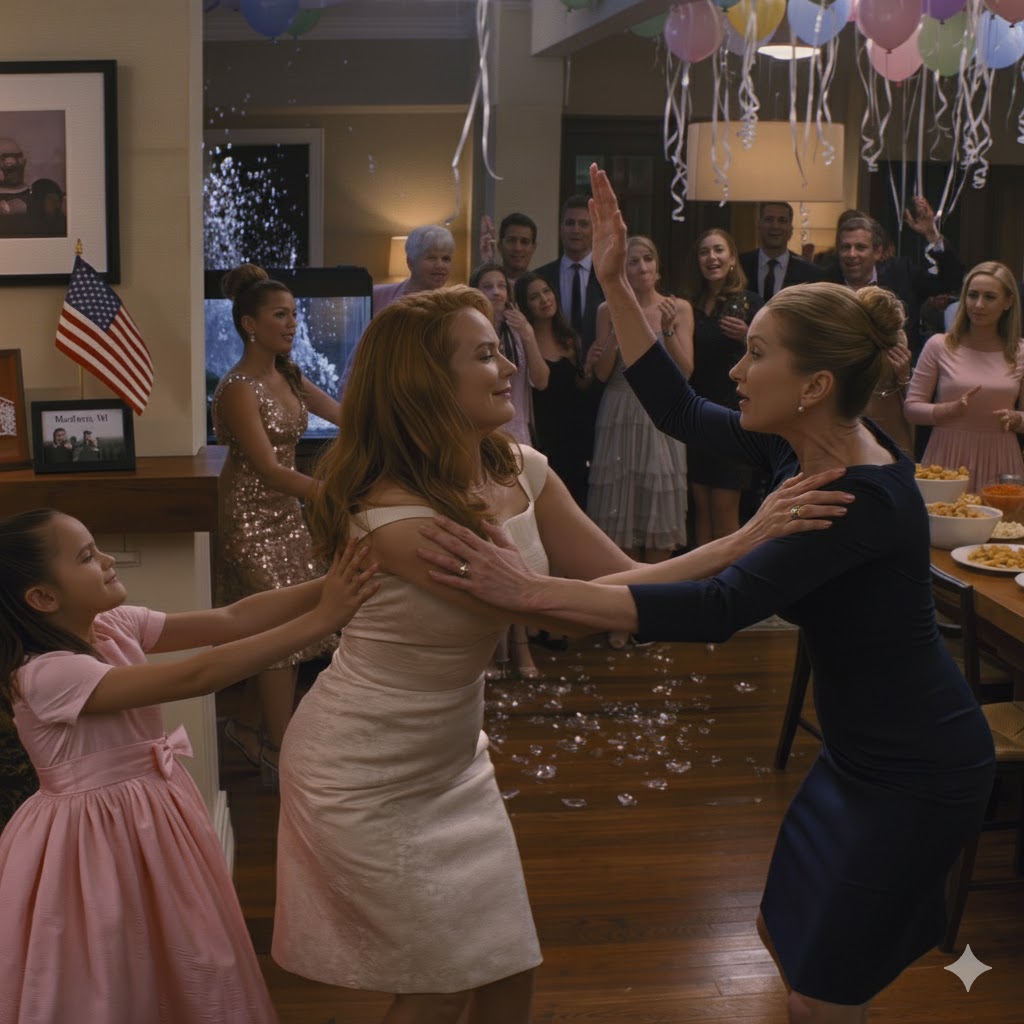
I walked into my parents’ house believing it was just an engagement party.
Within minutes, my daughter was crying on the floor, shaken and hurt, while my sister stood over her screaming that she was a thief.
I ran toward my child—and my own mother blocked my way.
Glass shattered somewhere behind me. Sirens wailed in the distance. And in that moment, the people who raised me chose a lie over a child.
That was the night everything I believed about family finally broke.
My name is Talia. I’m thirty-five, married to a man named Julian, and I’m the mother of a ten-year-old girl named Mila. Until that evening, I thought my life was safe. Not perfect—but steady. Predictable. Ordinary in the best way.
We live in Madison, Wisconsin, a city quiet enough to make you believe nothing truly terrible could happen inside a familiar home. Julian is calm, protective without needing to prove it. Mila is gentle, observant, the kind of child who hums when she’s happy and trusts adults because she’s been taught she can.
That trust nearly destroyed her.
The party was at my parents’ house—the same house where I grew up learning which emotions were acceptable and which were inconvenient. Decorations covered the walls. Guests filled the rooms. Everything looked celebratory on the surface.
But something felt wrong the moment we arrived.
My sister Sloan barely acknowledged us. Her eyes flicked to Mila, then away. No warmth. No welcome. Just calculation.
The center of attention was Sloan’s engagement necklace—an heirloom from her fiancé’s family. People admired it openly. Compliments poured in. Sloan soaked it up like fuel.
Mila noticed the necklace briefly, then lost interest. She stayed close to me, whispering about the music and the food, unaware of the tension tightening around her.
At some point, Sloan removed the necklace and disappeared into another room. When she returned without it, she brushed it off casually.
Minutes later, she froze.
“My necklace is missing.”
At first, people laughed nervously. Someone suggested she’d put it somewhere safe.
Sloan didn’t laugh.
Her eyes locked onto my daughter.
“I know who took it.”
The room went silent.
Mila squeezed my hand. “Mom?”
“That’s not true,” I said immediately. “Mila didn’t touch anything.”
Sloan tilted her head, smiling faintly. “Of course you’d say that.”
Then my parents stepped in—not to defend their granddaughter, but to contain the situation.
“Let’s stay calm,” my mother said coolly.
“Kids make mistakes,” my father added.
Mila started crying, shaking her head. “I didn’t take it. I promise.”
That should have stopped everything.
Instead, Sloan crossed her arms. “If she’s innocent, there’s no harm in checking.”
That was the moment I understood this wasn’t confusion.
It was intentional.
People stared. Whispers spread. Mila curled inward, humiliated and terrified. I pulled her close and told Sloan to stop.
She stepped closer and said quietly, “Thieves don’t get to decide when it’s enough.”
And then she moved.
Everything happened at once.
Sloan grabbed Mila and yanked her backward. Someone screamed. A chair scraped across the floor. Mila cried out as Sloan dragged her toward the fish tank near the wall.
There was a sharp impact.
Glass exploded. Water poured across the floor. Mila slipped, stunned and sobbing, surrounded by shards.
I ran toward her.
My parents blocked me.
“Stop,” my mother said, gripping my arm.
“You’re overreacting,” my father added, standing in my way.
My daughter was bleeding on the floor, and they treated me like the threat.
That was the moment something in me shut off forever.
Julian pushed through the crowd seconds later. He didn’t ask questions. He dropped to his knees beside Mila and called 911 immediately.
As paramedics arrived and police entered the house, Sloan repeated her accusation—still insisting Mila had stolen the necklace.
Then an officer searched the area.
The necklace was found inside Sloan’s purse.
A guest stepped forward and confirmed she’d seen Sloan hide it earlier.
The lie collapsed instantly.
Sloan was arrested for assault and for making a false accusation against a child. My parents were charged for interfering and endangering a minor.
No one apologized.
No one looked at Mila.
They only looked scared.
The courtroom came weeks later. Evidence spoke clearly. Medical records, witness testimony, photographs, police reports.
Sloan was convicted and sentenced to prison.
My parents were convicted too—not for what they did physically, but for what they chose to allow.
Justice didn’t feel triumphant.
It felt final.
Healing took time. Mila struggled with sleep. Loud noises frightened her. Therapy became routine. Music became her refuge.
Slowly, her voice came back.
Months later, she stood on a school stage and sang—soft at first, then stronger. Not perfect, but brave.
I cried the entire time.
They tried to silence her.
Instead, they taught her how powerful her voice could be.
Today, people ask if I miss my parents. If I miss my sister.
I don’t miss them.
I miss the idea of a family I never truly had.
What I have now is better.
A child who knows she is believed.
A husband who never hesitated.
A home where love doesn’t come with conditions.
I learned this without apology:
Family is not who shares your blood.
Family is who protects your child when the room turns cold.
And if they won’t—
you walk away.
Every time.