On a luxurious estate nestled in the hills of Delhi lived Aarav Malhotra—a young, charismatic industrialist who seemed to have everything. His wealth was so vast that no one had ever dared to say no to him.
He owned companies, luxury cars, and watches worth more than most homes. Yet there was one thing money had never brought him: peace.
After a painful and very public breakup with his fiancée, Aarav’s heart hardened. Trust no longer came easily. He began to believe that kindness was an act and that everyone around him was drawn only to his fortune.
Then Ananya Sharma entered his life.
She was twenty-two, quiet and well-mannered, with honey-colored eyes and a voice that carried an unexpected calm. She had come to Delhi from a small village in Uttarakhand. Orphaned at a young age, the job at Aarav’s mansion was not just work—it was survival.
The mansion felt unreal to her: towering ceilings, thick carpets, artwork worth millions. Yet Ananya never touched anything beyond her duties. She cleaned, arranged everything with care, and greeted everyone with the same gentle smile.
At first, Aarav barely noticed her.
One night, however, as he sat alone by the fireplace, he heard her humming softly in the hallway. It was an old lullaby—something a grandmother might sing to ease a child into sleep. Her voice trembled slightly, but it carried warmth.
That night, Aarav slept peacefully for the first time in months.
A few days later, a friend joked, “Be careful with your new maid. You never know what’s behind a sweet face.”
The words reopened old wounds. Suspicion crept back in.
Aarav decided to test her.
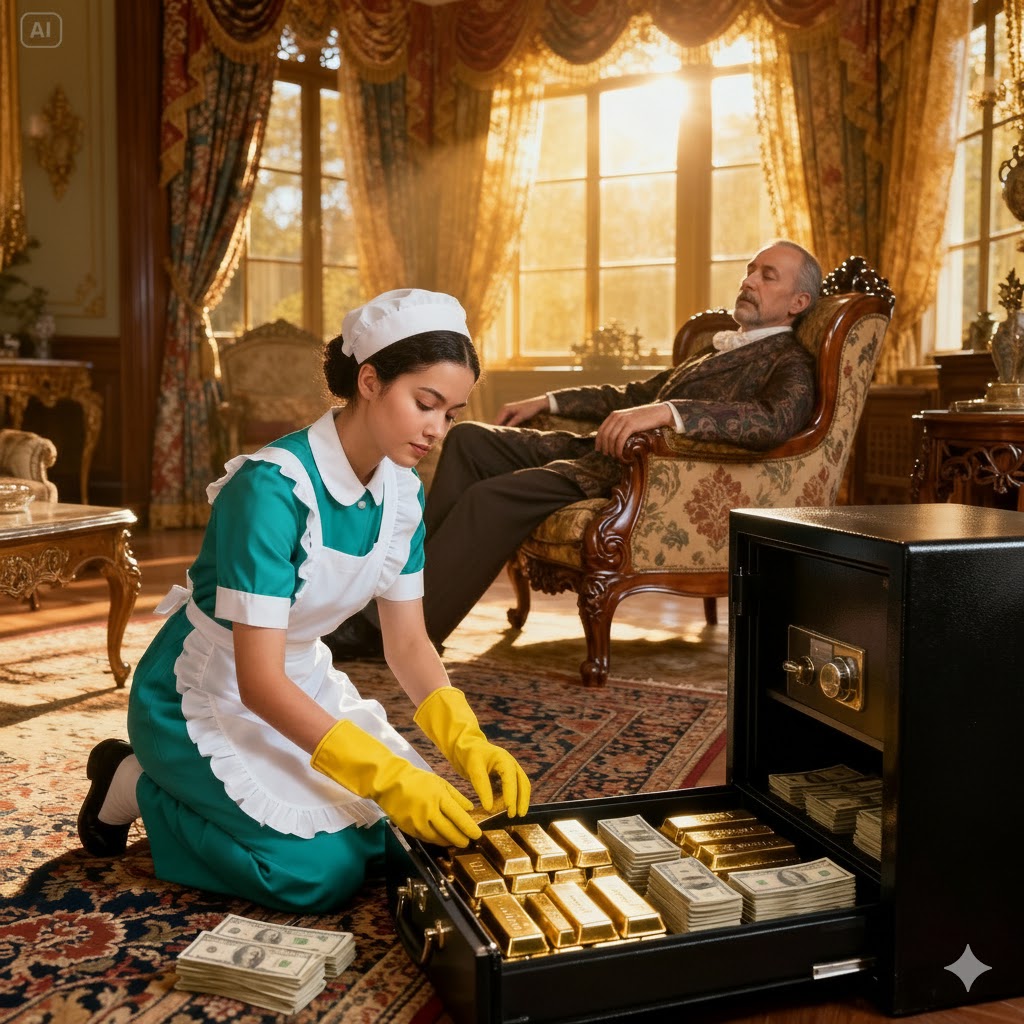
One night, he lay on the sofa pretending to sleep. He deliberately left his most expensive watch, an open wallet, and cash on the table. Late that evening, Ananya entered quietly—barefoot, hair tied back, holding a small torch. She moved carefully, as though afraid of disturbing the silence of the mansion.
Aarav watched through half-closed eyes, waiting for hesitation, temptation—anything.
But what he saw stopped his breath.
Ananya didn’t even glance at the money.
She walked straight to him, gently draped a shawl over his shoulders, and whispered, “I wish you didn’t feel so lonely…”
She picked up the watch, cleaned it carefully with her handkerchief, polished it, and placed it back exactly where it had been. Before leaving, she set something on the table—a dried marigold and a folded note.
After she left, Aarav opened the note.
“Sometimes, the people who have everything are the ones who need humanity the most.”
He didn’t sleep that night. The words echoed inside him, quietly dismantling walls he thought were permanent.
Days passed, and Aarav repeated the test night after night. Each time, Ananya did the same—covering him, turning off the light, leaving a kind word, and a flower.
One night, Aarav finally opened his eyes.
“Why do you do this?” he asked.
Ananya froze. When he admitted he had been pretending all along, her eyes filled with tears.
“So you tested me…”
Ashamed, Aarav lowered his head. “I thought everyone wanted something from me. But you only leave kindness.”
Ananya smiled softly. “Someone once told me—when people hide behind wealth, they’re surrounded by things, not people.”
That night, they talked for hours—about her village, the smell of rain, warm rotis, and quiet dreams. Slowly, the mansion lost its coldness. Aarav began smiling again. Trust grew, unnamed but undeniable.
Then came the storm.
A business partner planted doubt: “She’s after your property.”
For one brief moment, Aarav believed him.
The next morning, Ananya was gone. All she left behind was a letter thanking him for respect and trust—and saying goodbye.
Months later, during a work trip to Uttarakhand, Aarav saw a small bakery.
“Ananya’s Marigold.”
Inside, she stood with flour on her hands and the same gentle smile. This time, Aarav didn’t pretend to sleep. He was fully awake.
“You never took anything from me,” he said, holding out a dried marigold. “But you stole my fear.”
Over time, the city lost its hold on him. He returned often, helped in the bakery, watched children play, and learned the beauty of a slower life.
On the bakery’s third anniversary, amid laughter and sweets, Aarav gave Ananya a small box. Inside lay a marigold garland and a note.
“Let’s begin again—not as master and maid, but as two people who choose honesty.”
As oil lamps flickered at sunset, they sat together in silence, facing the mountains.
“Now I can finally sleep,” Aarav said.
“Because now,” Ananya replied softly, “you’re not alone.”
And in that quiet town, they proved that sometimes, the simplest flower is enough to awaken even the richest heart.