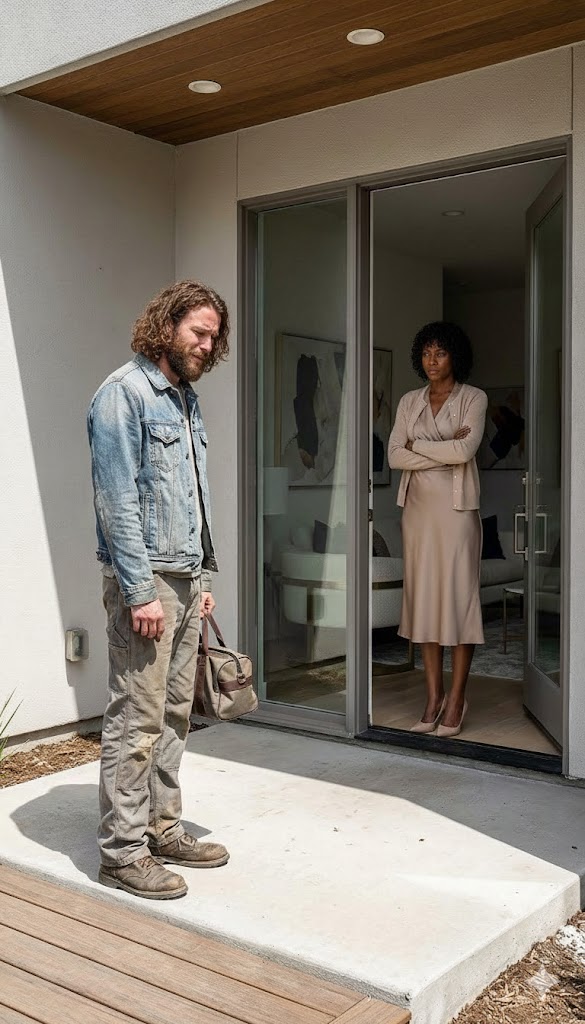
Freedom didn’t taste the way I’d imagined it would.
It tasted like diesel exhaust, burnt coffee, and cold morning air—like a bus station at dawn where the world keeps moving without noticing who’s been left behind. I stepped through the heavy iron gate clutching a clear plastic bag that held everything I owned: two flannel shirts, a dog-eared copy of The Count of Monte Cristo, and three years of silence pressed into my chest.
I wasn’t thinking about prison.
I wasn’t thinking about the noise, the injustice, or the years I couldn’t get back.
I was thinking about my father.
Every night inside, I pictured him the same way—sitting in his cracked leather armchair by the bay window, porch light casting soft yellow lines across his weathered face. In my mind, he was always there. Always alive. Always waiting. Holding on to the version of me that existed before courtrooms and headlines decided who I was.
I didn’t stop to eat, even though my stomach was hollow.
I didn’t call anyone.
I didn’t check the reentry paperwork.
I went straight home.
Or what I thought was home.
The bus dropped me three blocks away. I ran the rest, lungs burning, heart pounding like it was trying to outrun time itself. The street looked familiar at first—the cracked sidewalks, the old maple leaning at the corner—but something felt wrong as I got closer.
The house had changed.
The peeling white paint was gone, replaced by slate blue. My father’s overgrown flower beds were trimmed and landscaped with plants I didn’t recognize. New cars filled the driveway—sleek, polished, unfamiliar. The place looked occupied by a life that didn’t include me.
Still, I climbed the steps.
The front door was charcoal gray now, polished brass knocker gleaming. Where my father’s crooked brown mat used to be, there was a pristine coir one with perfect lettering:
HOME SWEET HOME
I knocked—not gently, not politely.
I knocked like a son who had counted every one of the 1,095 days he’d been gone.
The door opened.
Linda stood there.
My stepmother looked immaculate—styled hair, silk blouse, eyes sharp and measuring as they scanned me like I was a mistake that had wandered onto her porch.
“You’re out,” she said flatly.
“Where’s my dad?” My voice sounded wrong—too loud, too thin.
Her lips tightened.
Then she said it.
“Your father was buried a year ago.”
The words didn’t register. They hovered, meaningless.
Buried.
A year ago.
I waited for her to correct herself. To soften. To show anything resembling regret.
She didn’t.
“We live here now,” she added, gesturing behind her. “So you should go.”
My throat burned. “Why didn’t anyone tell me?”
She smiled—not kindly. Not fully.
“You were in prison, Eli. What were we supposed to do? Send a sympathy card?”
Behind her, the house looked wrong. No family photos. No hunting coat by the door. No work boots. No smell of coffee and sawdust.
My father was gone.
Erased.
“I need to see him,” I said. “His room.”
“There’s nothing to see,” she replied, already closing the door. “It’s over.”
She didn’t slam it.
She closed it slowly—deliberately—ending the conversation the way you shut a book you’re done reading.
The deadbolt clicked.
I stood there, hand still raised.
A year.
I don’t remember leaving. I just remember walking until the street tilted and the sentence your father was buried a year ago finally stopped echoing.
I ended up at the cemetery.
Tall pines stood like sentinels behind the wrought-iron gate. I didn’t bring flowers. I didn’t know where to go. I just needed proof.
Before I reached the office, a voice stopped me.
“You looking for someone?”
An older man leaned against a rake near the maintenance shed. Watchful eyes. Careful posture.
“My father,” I said. “Thomas Vance.”
He studied me, then shook his head.
“Don’t look,” he said quietly.
My stomach dropped. “What?”
“He’s not here.”
“I was told—”
“I know,” he said. “But he’s not.”
He introduced himself as Harold—the groundskeeper. Twenty-three years. Knew my dad.
Then he handed me a worn manila envelope.
“He told me to give you this. If you ever came.”
Inside was a letter, a card, and a key.
UNIT 108 — WESTRIDGE STORAGE
The letter was dated three months before my release.
My father had known.
I read it on a stone bench beneath the pines.
He explained the cancer. Why he hadn’t told me. Why he hadn’t visited.
He warned me about Linda.
And then he wrote the words that changed everything:
Everything you need—the truth, the proof—is in Unit 108.
Do not confront her before you go.
At the storage unit, I found an archive—not junk. Records. Bank statements. Medical files. A confession.
And a video.
My father’s face filled the screen—thinner, weaker, but steady.
“You didn’t steal that money,” he said.
“Linda’s son did. And she helped him.”
The truth cracked my world open.
I didn’t go back to the house.
I went to a lawyer.
What followed was slow, brutal justice—subpoenas, indictments, confessions. My conviction was overturned. My name was cleared.
But freedom didn’t feel like victory.
It felt like grief finally allowed to breathe.
I found my father’s real grave beneath an oak tree—private, quiet, untouched by lies.
“I found it,” I told the earth. “I found the truth.”
I didn’t keep the house. I sold it. Some places aren’t worth reclaiming.
Instead, I rebuilt my father’s business. Started a scholarship for people like me.
Because some people don’t just steal money.
They steal time.
And the only real revenge isn’t destruction.
It’s rebuilding something honest.
Now, when I sign my name, there’s no shame attached.
And when I visit the oak tree, I don’t feel abandoned.
I feel remembered.
The truth isn’t buried anymore.
It’s alive—every day I wake up free, every wall I build straight, every life I refuse to let be rewritten.
That’s a legacy no one can take.