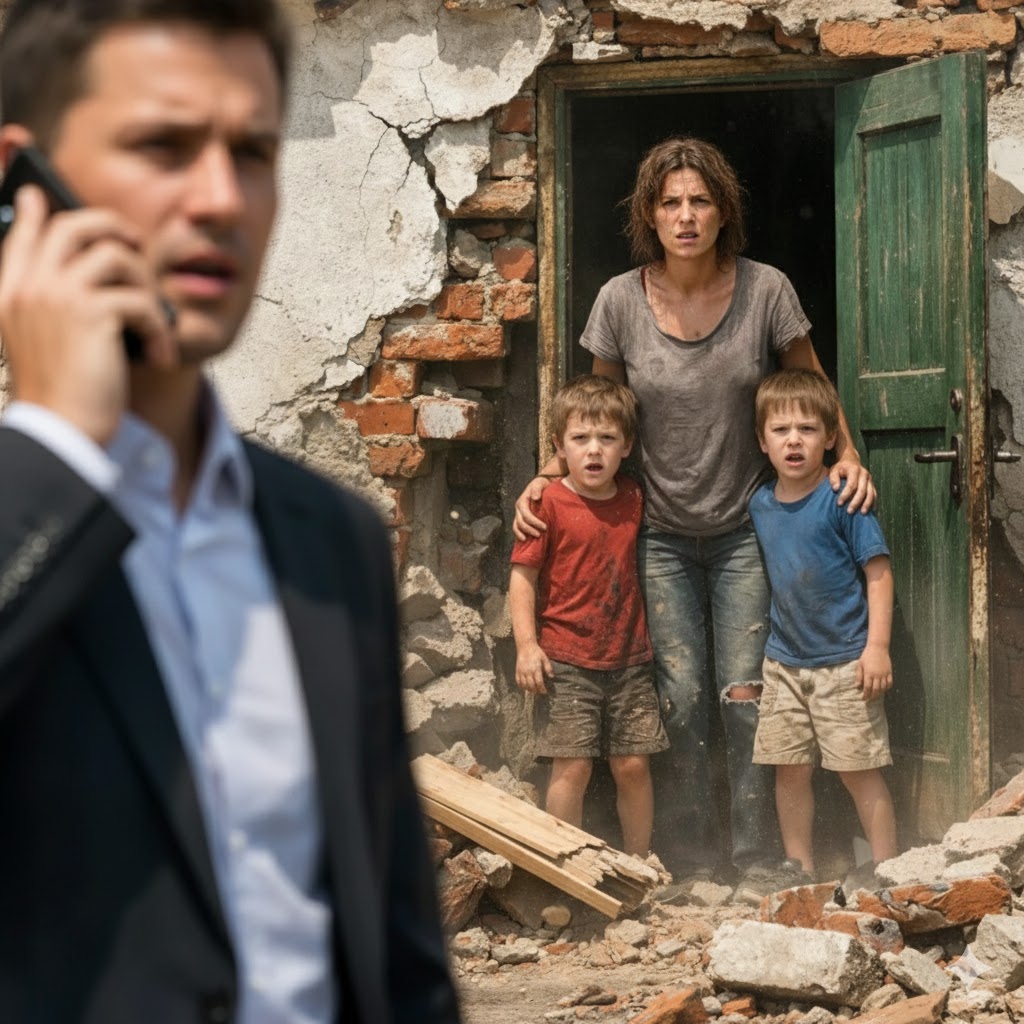
When Wesley Pratt pulled his rental SUV onto Juniper Lane in Redwood Springs, Colorado, the thin mountain air pressed against his chest like memory itself.
Twelve years had passed since he last drove this road, yet the street remained stubbornly the same. Weathered houses leaned into the wind, trees drooped like tired arms, and a stray basketball rolled lazily across the pavement, nudged by a breeze scented with pine and nostalgia.
At the end of the lane stood the Morales home—or what was left of it. The roof sagged like a defeated shoulder. Boards had rotted through. Portions of the porch were gone, as if time itself had taken bites from it.
Wesley stepped out, hesitated. He hadn’t even closed the car door when a startled voice reached him.
“Wesley.”
Juniper Morales stood in the doorway of the neighboring house, flour dusting her hands, apron tied tightly around her waist. Her dark hair was pinned up, though a few curls framed her face. Her eyes widened, caught between instinct to smile and instinct to shut the door.
“What are you doing here?”
“I came to see you… and the girls. If you’ll let me,” he said, his voice steady despite the knots in his stomach.
Two young voices cut in.
“Mom, who is that?” A freckled girl with a high ponytail tugged at Juniper’s skirt. Behind her, a smaller child peeked shyly.
Juniper swallowed. “Girls, this is Wesley. We… used to know each other.”
“I’m Wren,” the older one said with confidence. “She’s Poppy. Grandma calls her ‘Trouble,’ but only on weekdays.”
Poppy grinned, missing a front tooth. “Is it true you came from the big city?”
“Chicago,” Wesley nodded.
“That’s not very big,” Wren said seriously. “New York is bigger.”
Juniper cleared her throat. “Girls, could you go help Grandma Opal? The cornbread will burn if no one watches the timer.”
“Cornbread doesn’t watch itself, Mom,” Wren replied, narrowing her eyes. “The timer just beeps.”
“Exactly,” Juniper said. “It needs supervision.”
The girls left, whispering and giggling, leaving Wesley and Juniper alone. His heart tugged with hope and regret.
“Why are you here, Wes?” Juniper asked.
“Because I’m tired of running from the only good thing I ever had,” he said.
“That’s unfair,” she whispered. “You left. You built a life without us. You can’t just come back expecting a parade.”
“I’m not expecting anything. Except maybe a chance.”
She shook her head, eyes drifting to the ruined house. “There’s nothing left here for you.”
“Maybe I can rebuild something,” he said.
“You already broke it once. I will not let you break it again.”
They stood in silence. The wind shifted, carrying the girls’ laughter from inside, and Wesley thought he heard the old house breathe.
Finally, Juniper spoke. “Opal made lunch. Stay… just for the meal. Then you can go.”
Inside, the kitchen smelled of cinnamon and roasted chicken. Opal Moreno, her silver hair piled in a bun, turned from the stove with calm authority.
“I figured this day would come,” she said. “Sit. Eat. Don’t make me regret setting an extra place.”
Wesley felt small in this warm kitchen, surrounded by judgment and nostalgia. Between bites of cornbread, the girls peppered him with questions.
“Does Chicago have mountains?”
“Do you have a dog?”
“Do you live in a castle?”
“Have you met celebrities?”
“Why do you live alone?” Poppy asked.
His throat tightened. “Some mistakes take a long time to fix.”
Juniper’s eyes warned him—no fairy tales. Later, after the plates were cleared and the girls ran to the tire swing, Opal motioned him to help with the dishes.
“She’s frightened,” Opal said softly. “Not of you. Of herself. Afraid she’ll hope again.”
“What do I do?” he asked.
“Stay,” Opal said firmly. “Stay long enough that your presence isn’t a novelty. Stay until your shadow on the porch isn’t surprising. Let time decide if you earn another chance.”
That night, Wesley checked into the only motel in town, a turquoise building with rusted rails. He stared at the ceiling, rehearsing apologies he had never learned to say.
The next morning, a construction crew arrived at the collapsed house. Wesley had hired them from Chicago. He wore jeans and a flannel shirt, work boots replacing polished shoes.
Juniper ran across the yard in pajamas. “What are you doing?”
“Making sure no one gets hurt,” he said gently. “This structure is unsafe. If a storm comes, it could collapse into the road.”
“I didn’t ask for this.”
“It’s not charity. I bought part of the property years ago when you needed help with the mortgage. This is partly my responsibility.”
She froze. “I thought that was a loan I never repaid.”
“It was a gift. I should have told you then. I’m telling you now.”
One worker carried a dusty box from the ruins. Juniper opened it to find photographs: their wedding, first apartment, river picnics, letters tied with ribbon. Memories she had kept, even though it hurt.
“You kept them,” Wesley whispered.
“Keeping memories is not the same as forgiveness,” she said.
Weeks passed. Wesley worked from sunrise, carrying lumber, mixing cement, hammering until his palms blistered. Sometimes, Wren and Poppy watched from the porch, whispering conspiratorially.
One afternoon, Poppy offered him her popsicle. “Cherry. The best kind.”
He accepted. “Thank you. Very generous.”
Wren sat beside him. “Mom said you used to be our dad.”
“I used to be married to your mom. That made me something like a parent,” he said.
“Could you be our dad again?” Poppy asked.
“Being a father is more than being around. It means staying, even when it’s hard. I failed before. I want to do better now.”
Juniper, sweeping sawdust, stiffened at the girls’ words. That evening, she approached Wesley.
“You’re changing their lives,” she said. “And mine, too. What then?”
“Then we figure it out. Slowly. One morning at a time.”
She surprised him, letting their fingers brush. “I might still love you,” she confessed. “I wish I didn’t. It would be simpler.”
“I’m not asking for easy. I’m asking for a chance to prove I won’t run.”
Six weeks later, the house was finished: fresh paint, new windows, porch swing, a kitchen big enough for laughter.
Juniper stood in the doorway. “It feels like home again.”
Wesley exhaled. “What happens now?”
She glanced at Wren and Poppy, then back at him. “Now you stay. Not as a promise. As a choice. Every day.”
“I can do that,” he said.
Six months later, under strings of warm lights, they exchanged vows again. Mountains stood as silent witnesses. Opal cried. The girls carried wildflowers.
Poppy shouted, “Daddy and Mom, you may kiss!”
Laughter rose. Wesley kissed Juniper, tasting the future on her lips.
He understood now: success wasn’t a skyline or a corner office. It was a rebuilt porch. Two daughters who believed in him. A woman who held his heart gently.
It was a house at Redwood Springs. It was home.