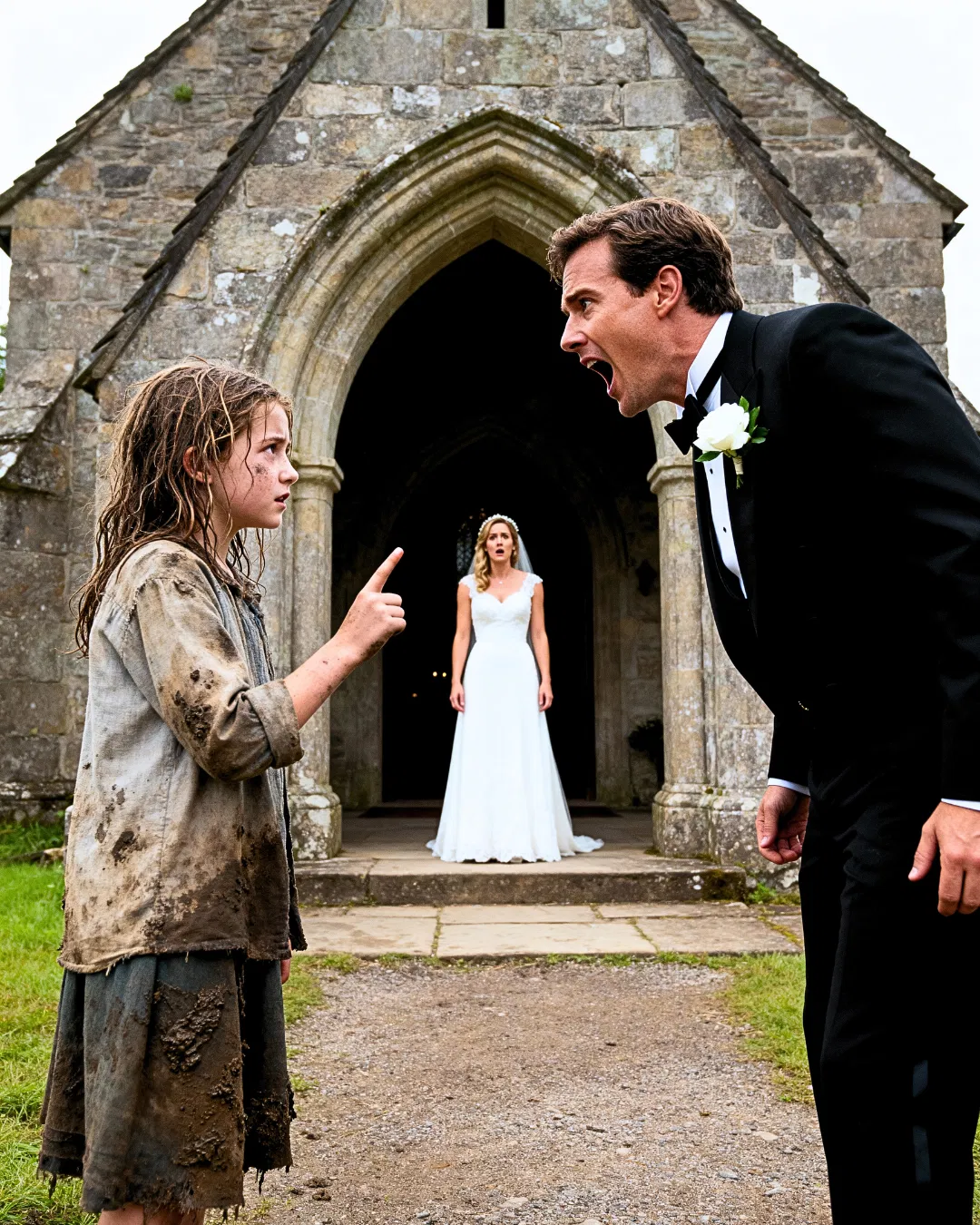
At the church doors, a homeless girl stepped into his path.
“Don’t marry her.”
Then she said a word only the bride and the lawyer were meant to know.
The church looked like a postcard brought to life—aged stone, silent bells, white flowers arranged with almost obsessive care. A pale carpet stretched to the entrance, guiding Lucas Moreno, the wealthy groom everyone had come to see. Not to celebrate—only to observe.
Phones hovered. Whispers drifted. Smiles looked rehearsed.
Lucas approached in a tailored black suit, his watch flashing briefly in the light. His posture was calm, practiced, the kind that assumed space would clear before him. Two security guards walked close at his sides. A black SUV idled behind them.
And then—disruption.
A thin girl in an oversized hoodie and worn sneakers stood pressed against the stone wall. She couldn’t have been older than twelve. Dirt darkened her hands; hunger had left its mark on her face. She had been invisible—until she chose not to be.
As Lucas stepped forward, she lunged.
“Don’t marry her!”
The moment fractured.
Gasps rippled through the crowd. Phones tilted higher. The guards moved instantly.
“Move,” one barked, grabbing her arm.
Lucas stopped. Not out of compassion—out of shock. That wasn’t a plea.
It was a warning.
“What did you say?” he asked.
The guard tightened his grip. The girl didn’t cry or struggle. Instead, she seized Lucas’s jacket with startling strength.
“If you go in,” she said, meeting his eyes, “you won’t come out the same.”
“That’s enough,” the guard growled.
“Let her go,” Lucas said sharply.
The hand fell away.
The girl didn’t hesitate. “It’s a trap. Don’t marry her.”
Lucas gave a short laugh. “And what could you possibly know about my life?”
“I know what I heard,” she said. “I know what they said.”
“Who?”
She nodded toward the church. “Her. And the lawyer.”
Irritation crept in. Cameras. Pressure. Contracts dressed up as love. This day was already heavy. Lucas pulled cash from his pocket and held it out.
“Take this. Eat. Go.”
She didn’t look at it. “I don’t want your money. I want you not to go in.”
The murmurs grew louder.
Then the church doors opened.
Valeria Cruz stepped out in a flawless white gown, her smile calm and polished. An older woman adjusted her veil. Beside them stood a man in a gray suit holding a leather folder—the lawyer.
“Darling,” Valeria said softly, “is everything alright?”
The girl stiffened, clutching Lucas again. “It’s her,” she whispered.
Valeria glanced at the child with carefully staged concern. “Poor thing. Can someone please take care of this? We don’t need a scene.”
“Wait,” Lucas said.
The girl spoke a single word. Quiet. Exact.
“Mirror clause.”
The cold hit instantly.
Not because of the phrase—but because it did not belong in a child’s mouth.
Lucas turned to the lawyer. The man’s face remained composed, but his eyes hardened. Valeria’s smile tightened.
“Who told you that?” Lucas asked calmly.
“She did,” the girl said, staring at Valeria. “‘Once he signs, we activate the mirror clause.’”
The crowd buzzed.
Valeria laughed lightly. “She’s a child. She probably heard something on television.”
The lawyer cleared his throat. “Mr. Moreno, this really isn’t—”
“Where did you hear it?” Lucas asked.
“In the sacristy,” the girl replied. “Yesterday. The door was open.”
Valeria snapped, “What was a child doing there?”
“Surviving,” the girl said.
A guard reached for her again.
“Don’t touch her,” Lucas snapped.
Valeria leaned closer. “Please. People are recording.”
She didn’t say it was false. She said don’t embarrass me.
“What’s your name?” Lucas asked.
“Eva.”
“What else did you hear, Eva?”
The lawyer tightened his grip on the folder.
“They said after the ceremony you’d sign with Attorney Rafael Montoya.”
Lucas felt the weight of it immediately. Montoya had been his father’s lawyer for decades.
“What does Montoya have to do with this?” he asked.
“Nothing,” Valeria said too quickly.
“I heard it today,” Eva insisted. “With the mirror clause.”
Lucas turned to the lawyer. “What is a mirror clause?”
Silence.
Valeria clutched his arm. “You don’t owe anyone an explanation.”
“If you go in,” Eva said urgently, “they won’t let you leave without signing.”
Lucas pulled out his phone and dialed. Speaker on.
“Mr. Moreno,” Montoya’s voice answered smoothly. “Congratulations. I’m ready for the signing.”
“What signing?” Lucas asked.
A pause.
“The post-ceremony confirmation.”
“The one that activates the mirror clause?”
Silence.
That was enough.
Chaos followed—guards shifting, a hooded man lunging for Eva, Lucas stepping in front of her. Accusations flew. Cameras captured everything.
“Take me to where you heard it,” Lucas said.
Eva led him down a narrow side passage. Cold stone walls. A small wooden door, dust disturbed beneath it.
She pulled a torn scrap of paper from her pocket.
Printed text. A partial stamp. Underlined words.
Immediate activation. Signature required.
And a name.
…Montoya.
That ended it.
Lucas left the church with Eva. No vows. No flowers. Evidence in hand, he went straight to an independent lawyer.
The trap collapsed quickly once exposed—documents, recordings, proof.
Valeria’s voice played back cold and clear:
“If he resists, we’ll use the foundation. No one cries for a millionaire.”
This time, people listened.
That night, Lucas sat beside Eva in silence.
“Am I alone now?” she asked quietly.
“No,” he said. “Not anymore.”
And for once, truth stood taller than spectacle.