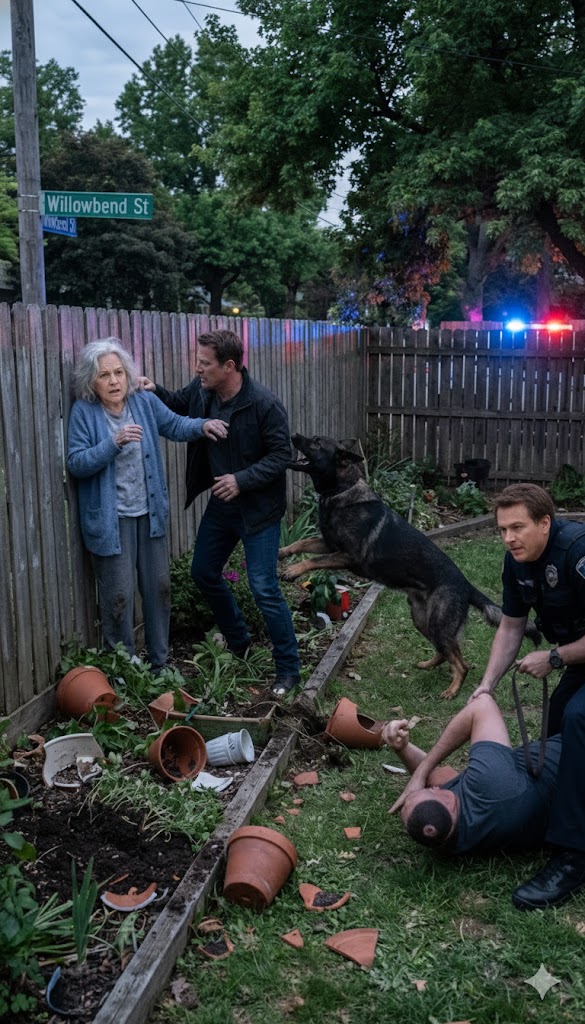
They called him a monster for stepping in to save her. Labeled it a “dog attack.”
But the truth my own precinct tried to bury was far uglier—and exposing it would cost careers, dismantle reputations, and rewrite the version of justice we’re told to trust.
The official report still sits on my kitchen counter, folded once, creased where my thumb pressed too hard when I realized the story it told had nothing to do with reality. According to the city—and according to my own department—the incident on Willowbend Avenue was a simple misunderstanding: an elderly woman, two “concerned civilians,” and a police K9 who allegedly lost control without provocation.
The report says Rook displayed unpredictable aggression.
It says I failed to maintain command authority.
It recommends corrective action and declares the animal a continuing threat to public safety.
What it doesn’t say—what the redacted bodycam footage no longer shows, what my lieutenant advised me to “let go if I wanted to keep my career”—is the sound a seventy-eight-year-old woman makes when her spine hits a wooden fence hard enough to drive the air from her lungs. Or the way her scream cracked midway, as if even her voice knew it was losing the fight.
My name is Caleb Morrows. Twelve years on the force. Nine of them partnered with a Dutch Shepherd trained not for gentleness, but precision—trained to act decisively, without hesitation, with a loyalty most humans only pretend to understand. Until that afternoon, I believed that if you followed procedure, if you trusted the badge on your chest, the truth would protect itself.
I was wrong.
Chapter One: The Moment Everything Broke
Margaret Ives had lived on Willowbend longer than I’d been alive. Her narrow blue house with white trim stood behind a garden that wasn’t a hobby so much as a memorial. Every rosebush, every stone, every ceramic bird had been placed by her and her husband after he came home from a war that never really let him return. When he died, the garden became the only place she could still talk to him without feeling foolish.
I was on routine patrol when I heard the crash—not glass, not metal, but clay shattering—followed by laughter that didn’t belong there. It was wrong the instant it reached me. Before my brain caught up, my body was already moving. Rook moved with me, leash slack, reading urgency through the tension in my wrist.
Two men had her pinned against the fence. Younger than me. Built like men who’d never learned restraint. Their boots ground broken flowerpots into the dirt like destruction was entertainment. One had his hand around Margaret’s throat, squeezing just enough to terrify without leaving marks that couldn’t be explained away later.
“Where did he hide it?” the man snarled, breath thick with entitlement. “Your husband didn’t die broke, and you know it.”
Rook didn’t wait for a verbal command.
People who’ve never worked with real K9s think that makes them dangerous. What they don’t understand is that a properly bonded dog doesn’t act on rage—he acts on alignment. On shared recognition of threat that bypasses language entirely. When Rook launched, it wasn’t wild. It was surgical. His body slammed into the primary aggressor, snapping fence boards loose as his jaws locked onto the man’s forearm—not tearing, not maiming, immobilizing.
The second man stumbled back, shouting. I was on him instantly—grounded, cuffed. Margaret slid down the fence, gasping, her hands shaking too badly to reach for me.
Fifteen seconds. Maybe less.
It should have ended there.
Instead, that’s when everything unraveled.
Because the man Rook took down wasn’t just anyone.
He was Lucas Harland—nephew of Deputy Commissioner Victor Harland. A name that carried weight the way gravity does: invisible until you try to defy it. Within hours, the narrative shifted so fast it made my head spin.
The assault disappeared.
Margaret’s broken ribs became “a fall.”
The smashed urn holding her husband’s ashes was never mentioned.
All that remained was the dog.
Chapter Two: The Silence That Protects Power
The precinct felt wrong the next morning—like a room where everyone pretends not to smell smoke while the walls are still warm. When I walked Rook through the hallway, eyes followed us, then slid away too quickly.
Lieutenant Franklin DeWitt called me into his office.
“This is bigger than you,” he said, tapping a manila folder.
Inside was my report—rewritten, sanitized, stripped of meaning. Margaret Ives was described as “confused.” The suspects were “local residents assisting with property maintenance.” Rook had “disengaged unexpectedly.”
“They were choking her,” I said. “You’ve seen the unedited footage.”
He didn’t meet my eyes. “That footage is… incomplete.”
“Meaning?”
“Meaning we have to consider liability. Optics. Escalation.”
“And Margaret?”
“She’s been advised to rest. At her age, her testimony wouldn’t hold.”
That’s when I understood.
This wasn’t about truth.
It was about containment.
I didn’t sign anything.
In the hallway, Detective Owen Pryce stopped me, smiling like a man who already knew the ending.
“K9s with a bite history don’t get second chances,” he said softly. “And partners who make noise tend to find themselves alone.”
That night, I went to see Margaret.
She sat wrapped in a blanket, bruises blooming along her neck like flowers she hadn’t planted. When Rook rested his head against her knee, she cried—quietly.
“They came,” she whispered. “Men from the city. Said if I kept talking, they might condemn my house. Said I should be grateful your dog didn’t kill anyone.”
I looked at her ruined garden.
That’s when it clicked.
They weren’t just attacking her.
They were searching for something.
Chapter Three: What Was Buried
Property records don’t lie. After hours of digging, I found it: a redevelopment plan acquiring every house on Willowbend—except one.
Hers.
Buried beneath the roots of her oldest rosebush was a sealed metal container she didn’t know existed. Inside: original deeds, offshore transfers, and a handwritten ledger tying Victor Harland to illegal land seizures going back decades.
They weren’t looking for money.
They were looking for evidence.
They came back that night.
With shovels.
Chapter Four: Exposure
I was already there.
Rook sensed them first. When they saw us, panic replaced arrogance. One lunged. Rook disarmed him. The other ran.
Then the cruisers arrived. Lights off.
Pryce stepped out. A gun came up.
Aimed at Rook.
I stepped in front of him.
“Do it,” I said. “Explain to the cameras why you shot a restrained K9 with witnesses present.”
Neighbors. Phones. Livestreams.
The silence wasn’t fear.
It was exposure.
Chapter Five: The Cost
Internal Affairs descended. Pryce was arrested. Harland resigned. The evidence surfaced.
Margaret kept her house.
Rook was deemed “unsuitable for continued service.”
I resigned before they decided what that meant.
I took him home on a civilian leash, badge heavy in my pocket, knowing I’d lost my career and gained something harder to reclaim.
Integrity.
The Truth They Didn’t Want You to See
Power doesn’t fear monsters—it creates them. Calling something dangerous is easier than admitting it was righteous. Systems don’t collapse when evil appears; they collapse when good people choose obedience over truth.
They called him a monster to hide their own shadows.
But the only creature in that garden who understood loyalty, restraint, and courage without condition was the dog they tried to destroy.