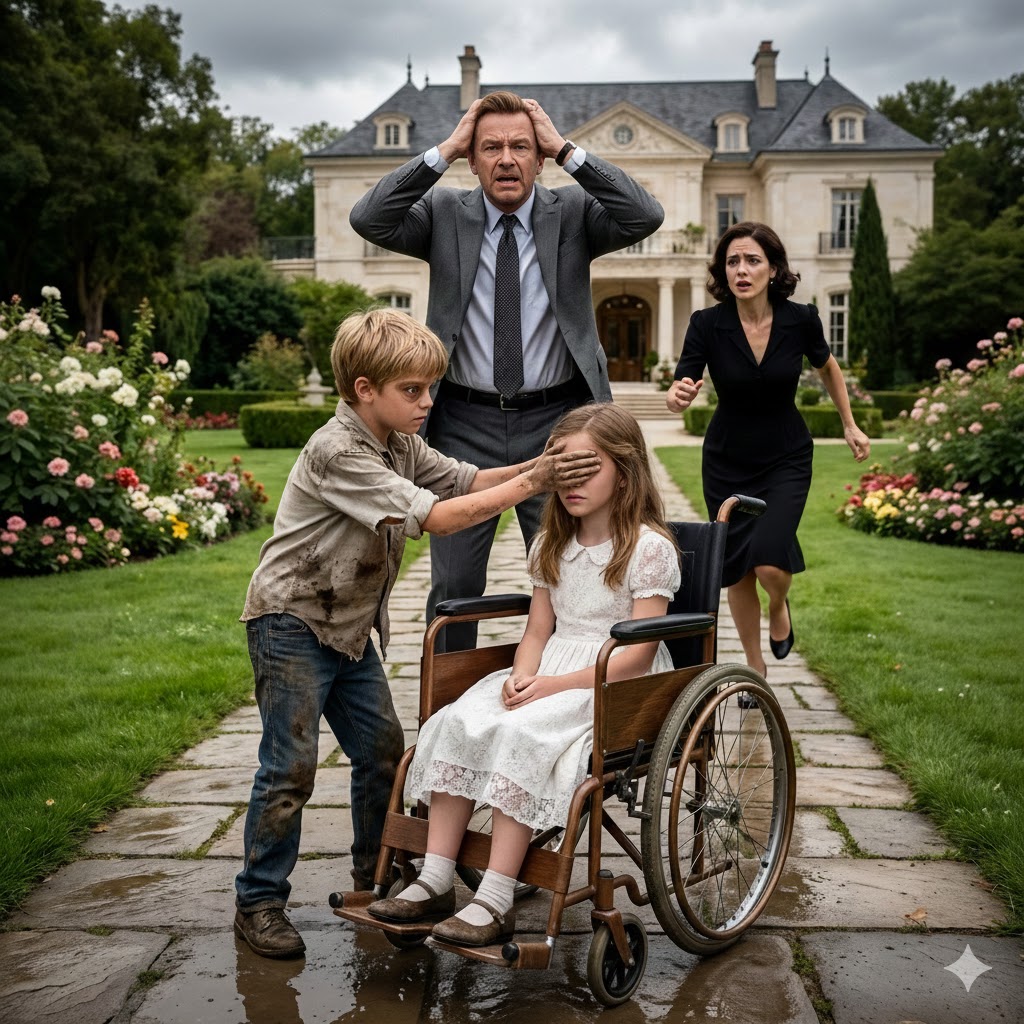
Victor Hale almost laughed when he heard the words.
They didn’t come from a doctor.
They came from a barefoot boy standing at the edge of the manicured garden of his mansion.
Victor Hale was one of the wealthiest men in the city. He owned hospitals, financed medical research, and personally consulted the world’s most respected specialists. And yet, every one of them had delivered the same verdict before sending his daughter home.
“There’s nothing more we can do.”
That was why Isabella was no longer confined to a hospital room.
She sat in a wheelchair beneath the old oak tree in the Hale garden—the place she had loved before the accident. Sunlight brushed her face, warm and gentle, but her eyes remained still.
Unseeing.
Blind.
And paralyzed.
Victor stood beside her with his arms folded, exhaustion and bitterness etched into every line of his face.
Behind them, the household staff moved quietly. Among them was Maria, the cleaning lady. She had worked for the Hale family for years—unnoticed, obedient, speaking only when spoken to.
That afternoon, Maria’s son had come with her.
His name was Noah.
He had been crouched near the flowerbeds, letting soil slip through his fingers, when fragments of the doctors’ words echoed in his mind.
“No chance of recovery.”
“Permanent damage.”
“Prepare for life as it is.”
Noah stood up.
“I’ll put mud on her eyes,” he said softly, “and she’ll see again.”
The garden fell silent.
Victor turned sharply, his expression hardening.
“Who allowed this child near my daughter?”
Maria rushed forward, panic flooding her face. “I’m so sorry, sir. I’ll take him away right now.”
But Isabella spoke first.
“Daddy,” she whispered. “Please let him stay. His voice sounds kind.”
Victor clenched his jaw.
He looked at the boy’s bare feet, his torn clothes, the dirt on his hands.
Mud.
After everything he had paid.
After everything he had lost.
It felt like cruelty disguised as hope.
“Do you know how many doctors I’ve hired?” Victor asked coldly.
“How much money I’ve spent trying to save her?”
Noah nodded calmly.
“My mom told me,” he said. “She said rich people trust money more than hope.”
Victor stiffened.
“That’s enough,” he snapped. “This isn’t a fairy tale.”
But Isabella reached out with trembling hands.
“Please,” she whispered.
Victor hesitated.
There was nothing left to lose.
“Five minutes,” he said at last. “Then you leave.”
Noah knelt beside her. He mixed clean water with soil from the garden, his movements slow and careful.
“This isn’t magic,” he said quietly. “My grandma used to do this.”
Victor scoffed. “Was your grandmother a doctor?”
“No,” Noah replied. “She was blind.”
Victor froze.
“She lost her sight after an accident,” Noah continued. “Doctors said it was forever. But one doctor told her to touch the earth—to remember that pain doesn’t always start in the eyes.”
Gently, Noah spread the cool mud over Isabella’s closed eyelids.
“Don’t be scared,” he whispered. “Just imagine light.”
Nothing happened.
Victor turned away, ashamed that he had allowed himself to hope.
Then Isabella gasped.
“Daddy…”
Victor spun around.
“I see… shadows,” she said. “It’s blurry—but I see something.”
Victor’s heart stopped.
Doctors were rushed back to the house. Tests were repeated.
It wasn’t a miracle.
It was neurological shock—trauma-induced blindness slowly reversing as the brain reconnected dormant pathways.
One doctor whispered in disbelief,
“Sometimes belief triggers what medicine cannot.”
In the weeks that followed, Isabella’s vision continued to improve.
Not completely.
But enough.
Enough to see her father’s face again.
That was when Victor uncovered the truth.
Years earlier, his company had cut funding for a small rehabilitation program, labeling it “inefficient.”
The doctor who once treated Noah’s grandmother had been part of it.
The treatment had worked.
It had simply been ignored.
Victor summoned Maria and Noah to his office.
“I looked down on you,” he admitted quietly. “And I was wrong.”
He restored the program.
Rehired the doctor.
And ensured that no patient would ever be turned away for lacking money again.
Victor still had his wealth.
But that day, standing in his own garden,
he gained something far more valuable:
Healing doesn’t always come from power.
Sometimes, it comes from the people we refuse to see.