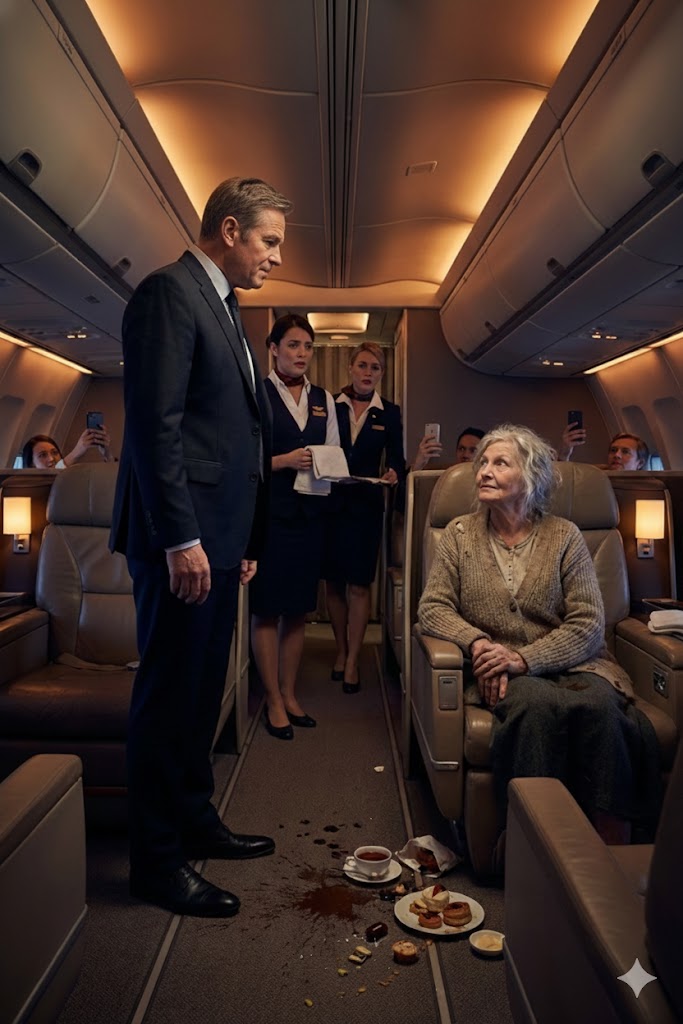
He Called Her a “Filthy Nobody” and Kicked Her Lunch Tray at 35,000 Feet — He Never Imagined She Owned His World
CHAPTER ONE: THE WRONG SEAT, THE WRONG DAY
The soft clatter of ice against crystal pulsed through Adrian Blackwell’s skull like a countdown he couldn’t stop. He stared into the amber liquid in his glass, fingers locked around it with unnecessary force, knuckles pale, veins raised. Beneath him, the aircraft vibrated steadily—an irritating reminder that he was confined, surrounded by strangers, stripped of control.
This was not how men like him traveled.
Adrian Blackwell—Chief Strategy Officer of Helios Consortium, a man whose approval alone could erase companies or resurrect dying industries—did not fly commercial. Not ever. Unless something had gone catastrophically wrong. And judging by the roiling thunderheads outside the window and the furious stream of unread messages lighting up his phone, that was exactly what had happened.
A sudden transatlantic storm system had grounded Helios’s private fleet across three continents. The result: Aurora Atlantic Flight 772, New York–bound. First Class. Seat 2A. A compromise he told himself he could endure—though the nearness of other people scraped against his nerves like sandpaper.
He checked his watch again.
Three hours.
That was all the time he had to finalize the most aggressive hostile takeover of his career. The deal was so complex even his own board barely understood its full implications. And yet his laptop, glowing uselessly, showed only a spinning Wi-Fi icon—endless, mocking, inert.
“Unacceptable,” Adrian muttered, lifting his glass.
Then he stopped.
The smell hit him without warning.
Eggs.
Not airline eggs. Not curated, overpriced brunch fare. This was unmistakably homemade—warm, intimate, domestic. The scent of kitchens and leftovers and people who packed their own meals.
Then came the sound.
Foil crinkling. Paper rustling.
Adrian turned slowly, irritation sharpening into disbelief.
The woman in seat 2B did not belong there.
She looked as though she’d wandered onto the plane by mistake—or stepped out of another decade entirely. Gray hair slipped loose from a modest knot. Her cardigan was faded, once blue perhaps. A canvas bag rested at her feet, frayed and overfilled. With careful, trembling hands, she unwrapped a foil-covered sandwich, entirely oblivious to the fury radiating beside her.
A piece of lettuce fell onto her lap.
She picked it up.
She ate it.
Adrian’s jaw tightened.
The smell grew stronger.
“This isn’t real,” he whispered, staring forward, as if ignoring it might reset the universe.
He had paid nearly fourteen thousand dollars for this seat—not to sit beside someone’s grandmother recreating home life at cruising altitude.
Then she reached into her bag again.
A thermos.
Scratched. Dented. Old.
She unscrewed it slowly. Steam rose, carrying the gentle scent of chamomile and honey. As she poured, her hands shook, liquid sloshing perilously close to the pristine leather console between them.
Clink.
Clink.
A spill.
Several drops stained the beige surface.
Something inside Adrian snapped.
He slammed his laptop shut. The crack echoed through the cabin. The woman flinched, startled, dropping the thermos lid. It rolled neatly across the floor and came to rest against Adrian’s polished shoe.
“Oh—oh dear,” she whispered, eyes wide behind thick glasses. “I’m so sorry. I didn’t mean—my hands—”
“Stop,” Adrian barked, standing abruptly, looming over her. “Just stop moving.”
The cabin went silent.
“I am handling business that determines the livelihoods of tens of thousands of people,” he said loudly. “And you’re pouring tea like this is your kitchen.”
“I can clean it,” she said quietly, already reaching for a napkin, humiliation coloring her voice.
Her elbow struck the tray.
The sandwich fell.
Egg salad met Italian leather.
Time fractured.
Adrian stared at his shoe as though it had personally betrayed him. Then he looked at her, something cold and merciless breaking loose behind his eyes.
“You filthy nobody,” he said.
And then, deliberately, he kicked the tray.
Food and tea splashed across her lap.
Gasps rippled through First Class.
The woman cried out as the hot liquid soaked into her sweater, her hands scrambling uselessly while Adrian stood rigid, breathing hard, smoothing his jacket—restoring order in the only way he knew.
“Get her out of here,” he snapped at the approaching crew. “She’s ruined my seat, my clothes, this entire cabin. Move her to economy.”
The lead flight attendant froze.
Her face drained of color—not with fear, but with something far worse.
Recognition.
“Sir,” she said quietly, kneeling beside the woman instead of addressing him, “Ms. Whitmore… are you hurt?”
Adrian frowned.
Whitmore.
The woman looked up, tears on her cheeks—but her gaze steadied, sharpening like steel beneath water.
“Young man,” she said calmly.
And everything began to unravel.
CHAPTER TWO: THE NAME THAT SHATTERED HIM
Adrian no longer heard the engines.
He didn’t hear the murmurs spreading through the cabin, nor the sharp inhale from the man across the aisle already holding up his phone, eager to record a public execution.
All he heard was the name.
Ms. Whitmore.
It struck him with the weight of something legendary—dismissed too long to be remembered until it suddenly stood before you, very real and very displeased.
“You just assaulted Eleanor Whitmore,” the attendant said, standing now, her voice steady with an authority no uniform could grant.
Adrian laughed, thin and brittle. “And?”
Silence answered him.
She pointed to the silver wing logo embroidered into the headrest behind him.
“She founded this airline,” the attendant said. “Forty-three years ago. She owns it outright. And she is the majority shareholder of Helios Consortium.”
The world tilted.
Blood drained from Adrian’s face. His ears rang as reality snapped into place with brutal clarity.
Eleanor Whitmore met his gaze then. The fragility vanished, replaced by the presence of a woman who had survived boardroom wars, economic collapses, and men who mistook cruelty for strength.
“You mistook humility for weakness,” she said quietly. “That mistake ends careers.”
The captain arrived.
Security followed.
Privileges evaporated.
Adrian was escorted—publicly, humiliatingly—to the back of the plane. The video went live before he reached economy.
The caption spread faster than the plane itself:
“Executive assaults elderly woman mid-flight. Turns out she owns the airline.”
By the time Wi-Fi stabilized, his career was already over.
And the worst part hadn’t even begun.
CHAPTER THREE: THE COST OF FAILING THE TEST
What no one aboard Flight 772 knew was that Eleanor Whitmore wasn’t merely an owner or investor.
She was the architect.
For twenty years, she had remained deliberately invisible, allowing men like Adrian to believe they were untouchable. She watched how they treated those beneath them. She waited.
Adrian failed spectacularly.
Before the plane landed, the acquisition he’d been racing to complete was terminated under a morality clause he’d forgotten existed. His accounts were frozen. His reputation dismantled with surgical precision.
He was arrested at the gate.
Photographed.
Broadcast.
By morning, he was unemployed, divorced, and professionally radioactive.
Sitting alone in a holding cell, clutching the napkin Eleanor had returned to him—embroidered with the words “Character Is Capital”—Adrian understood something far worse than loss.
He had never owned anything that mattered.
CHAPTER FOUR: TERMS OF ACCOUNTABILITY
Eleanor visited two weeks later.
No press. No cameras.
Just an old woman and a broken man across a steel table.
“I’m not here to forgive you,” she said calmly. “Forgiveness is cheap. Accountability is not.”
She slid a folder toward him.
Inside was not a job.
It was a sentence.
A year of anonymous service. Public restitution. Silence.
“You will spend the next twelve months feeding people you once dismissed,” she said. “Listening more than you speak. Learning how to exist without status.”
“Why?” Adrian asked, his voice raw.
“Because power reveals who you are,” Eleanor replied. “But humility decides whether you deserve a second chapter.”
He accepted.
Because for the first time, he understood what being wrong actually cost.
CHAPTER FIVE: WHAT ENDURES
Adrian never returned to corporate life.
A year later, a quiet nonprofit appeared—meals, job training, legal aid—funded anonymously, run without fanfare.
Only Eleanor knew who built it.
She never told.
FINAL TRUTH
Money buys silence.
Power buys obedience.
But character is the only currency that survives collapse.
One moment of cruelty.
One belief in superiority left unchecked.
And everything you think you own can vanish—revealing you never owned yourself at all.