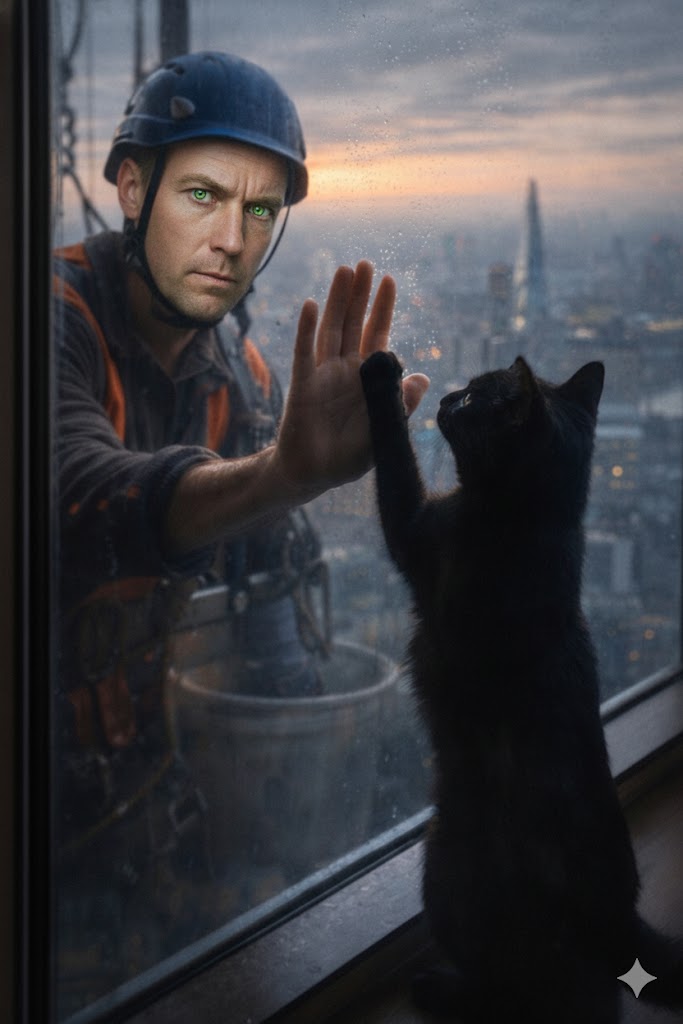
Guinness was a black cat who lived on the 30th floor of a London skyscraper. He knew nothing of asphalt, parks, or the raw roar of buses passing inches away. His world rose instead of stretched—white walls, vast windows, and a sky that felt closer than the street far below.
He was an indoor cat.
But he was never lonely.
From the time he was a kitten, Guinness learned to understand life through glass. He watched city lights blink like man-made stars, tracked birds slicing through distant air, and slept for hours in warm patches of sunlight, as if the height itself kept danger at bay.
His owner, Oliver, worked from home and spoke very little. He loved Guinness in quiet ways—full bowls, clean spaces, predictable routines. There were no dramatic displays of affection, only steady care. Many days, the cat’s only companion was the low, endless murmur of the city beneath them.
Until Stephen arrived.
Stephen was a window cleaner—forty-one years old, with rough hands and a laugh that had endured more than it should have. Every Tuesday, with near-ritual precision, he lowered his platform down the side of the building, suspended hundreds of feet above the ground as if fear had long since given up on him.
The first time Stephen reached the 30th floor, Guinness was asleep.
The gentle scrape of the squeegee against glass stirred him. One eye opened. Then the other.
And there it was.
A man hovering in midair.
Guinness padded closer and sat before the window, tail neatly wrapped around his paws. He watched as the man worked carefully, humming something the cat couldn’t hear—but somehow felt.
Stephen glanced up and met two golden eyes staring back at him.
“Well, hello there, buddy,” he said with a smile.
Guinness didn’t know the words, but he understood the kindness behind them.
Without thinking, Stephen drew a small smiley face in the soap suds. Guinness leapt forward and tapped the glass with his paw.
Stephen laughed.
That was the beginning.
Every Tuesday after that, Guinness was waiting long before the platform arrived. No matter how deeply he slept, something inside him knew the hour. He sat by the window, vibrating with anticipation.
Stephen played as though the rest of the world had faded away—moving the brush side to side, pulling exaggerated expressions, sketching hearts, circles, tiny shapes. Guinness followed every motion with serious concentration, jumping, spinning, stretching until he stood fully upright against the glass.
For ten minutes, London ceased to exist.
For Stephen, those minutes were an anchor. Years earlier, he had lost his wife in a sudden, senseless accident. Life had continued, orderly and functional—but hollow. Guinness never knew it, but once a week, he gave Stephen a reason to smile.
“See you next Tuesday,” Stephen always said.
Guinness didn’t understand time.
But he understood consistency.
Then one Tuesday, Stephen didn’t come.
Guinness waited anyway.
He sat by the window early. He paced. He meowed softly, uneasily. When another platform descended, his heart leapt and he rushed to the glass.
But it wasn’t Stephen.
It was someone else—young, focused, unsmiling. The man never looked inside. He cleaned the window and moved on.
Guinness remained still.
Then he turned away, tail hanging low.
The sun still shone that day, but something had fractured.
Stephen didn’t return for six months.
Not by choice.
A severe infection put him in the hospital—first days, then weeks. There were nights when the doctors weren’t certain he would survive. Stephen lay awake, staring at the ceiling, thinking of things he’d never known mattered: the scent of soap, the rush of wind thirty stories up, a black cat who looked at him as if he mattered.
“If I make it,” he wondered, “what am I making it back to?”
On the 30th floor, Guinness stopped waiting by the window.
Not because he forgot.
But because waiting hurt.
He slept longer. Played less. His spark dimmed. Oliver noticed the change but couldn’t explain it.
“Maybe he’s getting old,” he thought.
But Guinness wasn’t aging.
He was grieving.
When Stephen finally recovered, his body was weaker, his breath shallow. His boss urged him to rest longer.
“I need to go back,” Stephen said. “Even if it’s just once.”
That Tuesday, his hands trembled as he stepped onto the platform.
“What if he doesn’t remember?” he thought. “What if they’re gone?”
When he reached the 30th floor, the apartment was quiet. Guinness slept curled on the sofa, a perfect black circle.
Stephen tapped gently on the glass.
Tap.
Guinness’s head snapped up.
His eyes widened—shock, disbelief, recognition all at once.
Then he ran.
He hurled himself against the window, meowing so loudly Stephen could hear it through the glass. He rubbed his face against the pane, purring with a force that shook his small body.
Stephen broke down, tears streaming as he pressed his palm to the window.
Guinness placed his paw exactly there.
Oliver captured the moment in a photo.
He shared it online with a single line:
“After six months, my cat was reunited with his best friend.”
The image spread everywhere.
People shared it, cried over it, thought of someone they had waited for—or someone who had waited for them.
Stephen and Guinness became a symbol of something simple and profound.
That love doesn’t require words.
That friendship crosses species.
That glass, height, and time don’t always divide us.
Days later, Oliver received a message.
It was from Stephen.
He told him about the hospital, the illness, the quiet despair.
“I don’t think I would have gotten out of bed if I hadn’t believed someone was waiting for me,” he wrote.
Oliver read it through tears.
That night, watching Guinness sleep, he finally understood:
Guinness hadn’t just been waiting for Stephen.
He had been holding him together.
Stephen kept cleaning windows.
Guinness stayed on the 30th floor.
Every Tuesday, for ten minutes, the world paused.
And though they could never truly touch, they shared something many people forget:
Friendship doesn’t need closeness.
Only presence.
Because some bonds aren’t broken—
Not by time.
Not by distance.
Not by glass.