The desert highway unrolled endlessly beneath a bruised Arizona sky, heat wavering above the asphalt like a mirage. A line of motorcycles cut through the late afternoon stillness, their engines rumbling in disciplined formation—men riding with the quiet authority of those who no longer feared what waited at the end of the road.
At the front rode Caleb “Stone” Wilder.
His name still carried weight in outlaw circles, even though most believed he had faded into anonymity with age. Wind tugged at his steel-gray beard as his eyes stayed fixed on the horizon, as if movement itself were the only thing keeping his past from closing in.
At sixty-nine, Caleb no longer rode for rebellion or thrill. He rode because the open road was the one place his thoughts didn’t turn inward—didn’t circle the choices he’d buried beneath decades of smoke, asphalt, and silence. Choices that were never meant to resurface.
Then his phone rang.
The vibration against his chest felt wrong. Intrusive. Like a knock on a door that should have stayed sealed forever. He ignored it at first, letting it buzz until instinct told him this call wasn’t ordinary—that whatever waited on the other end would not be denied.
Caleb pulled onto the shoulder, gravel crunching beneath heavy tires. He cut the engine, lifted the phone, and answered with a voice sharpened by habit.
“Speak.”
“This is Desert Ridge Medical Center,” a woman said. Calm, but strained. “I’m calling for Mr. Caleb Wilder.”
His jaw tightened. “You found him. Now tell me why.”
A pause—careful, weighted.
“A woman was admitted after a serious accident,” the nurse said. “She’s in critical condition. She’s been asking for you. She insisted we contact you.”
“You’ve got the wrong man,” Caleb replied flatly.
“No,” she said gently. “She didn’t give us your name at first. She described you—the tattoos, the motorcycle, the scar on your left shoulder. She said you would know it was her.”
The desert suddenly felt cold.
Caleb closed his eyes.
“Her name is Marisol Vega,” the nurse added. “And before she lost consciousness, she said something else.”
A breath.
“She said you’re the father of her son.”
The world didn’t stop spinning—but something inside Caleb did.
Father.
The word struck places he’d armored long ago. Places he’d convinced himself were dead. Men like him didn’t get to be anchors. Didn’t get to leave anything soft or living behind.
“That’s not possible,” he muttered, though his voice betrayed him.
“She also said her son is here,” the nurse continued. “He’s three years old. And he’s been waiting.”
Caleb didn’t answer. He ended the call and sat frozen, hands gripping the handlebars until the leather creaked beneath his fingers. The sun dipped low as memories he’d refused to revisit rose without mercy—Marisol’s laugh, her defiance, the night she disappeared without explanation.
Without a word to his crew, Caleb turned back onto the highway and twisted the throttle until the engine screamed. For once, he wasn’t riding away.
He was riding straight into the truth.
The hospital was too white, too clean, too quiet. Caleb felt every inch the outsider as the automatic doors whispered shut behind him. Nurses glanced up—curiosity mixed with judgment—but no one stopped him.
A woman in blue scrubs approached. “Mr. Wilder. I’m Nurse Collins. Thank you for coming.”
“I didn’t come,” Caleb said gruffly. “I was summoned.”
She nodded, understanding more than she said. “Please follow me.”
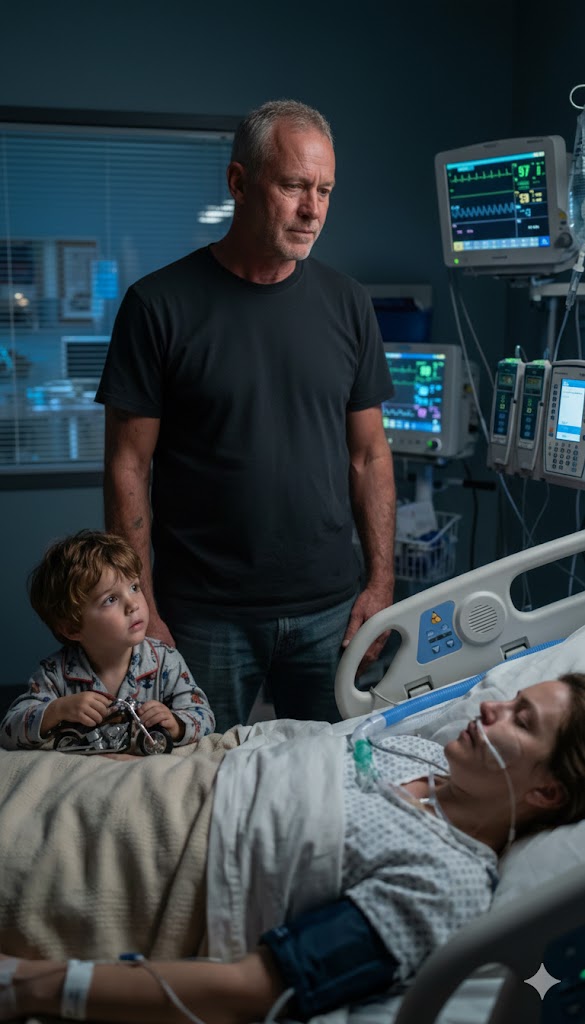
The hallway smelled of antiseptic and fear. Each step felt heavier than the last until they reached a room half-veiled by curtains and the steady beeping of machines keeping time with a fragile heartbeat.
Before entering, the nurse touched his arm. “She’s been through severe trauma.”
Inside, the past lay broken beneath sterile lights.
Marisol’s face was swollen, bruised, nearly unrecognizable—but unmistakably hers. Tubes and wires traced paths across her body like a map of survival.
And then Caleb saw him.
A small boy stood beside the bed, gripping the rail with both hands. His shoulders were squared in quiet defiance, his wide brown eyes lifting calmly to meet Caleb’s gaze.
Those eyes were his.
Not figuratively.
Literally.
“His name is Leo,” the nurse whispered.
The name unlocked a memory—Marisol once murmuring it beneath a sky full of stars, half-joking, half-dreaming of a future Caleb never believed he deserved.
Leo didn’t cry or hide. He simply watched Caleb, as if instinct recognized what logic could not.
Caleb stepped closer, knees unsteady, heart pounding with a rhythm he didn’t recognize. He stood beside the bed, staring at the woman he once loved, the child he never knew, and the life he unknowingly left behind.
Later, a doctor explained the injuries, the uncertainty. Caleb heard only fragments. His attention stayed on Leo’s small hand gripping Marisol’s fingers, on the way the boy leaned protectively against her bed.
“She never told me,” Caleb said hoarsely after the doctor left. “Why?”
Nurse Collins hesitated. “She said you were running. And she didn’t want to be the reason you stopped living the only way you knew how.”
That truth hurt more than blame ever could.
Hours passed.
Then Marisol stirred. Her eyes fluttered open, pain etched into every breath. When she saw Caleb, tears slid silently down her temples.
“You came,” she whispered.
“I’m here.”
She smiled faintly. “Good. Then I can say it.”
Her breathing faltered. Machines beeped faster.
“He’s not biologically yours,” she whispered.
The room tilted.
“Leo’s father died before he was born,” she said. “But you’re the man I trusted most. The one I knew would show up when it mattered.”
Caleb’s mind reeled.
“I taught him about you,” she continued weakly. “About loyalty. Strength. Choosing love even when it scares you.”
Her fingers tightened around his.
“I need you to be his father,” she said. “Not because you made him. But because you’ll stay.”
The machines screamed. Doctors rushed in. Caleb was pushed back as chaos swallowed the room.
Then—silence.
Marisol Vega was gone.
Leo stood in the hallway clutching a toy motorcycle, unaware of the permanence of loss. Caleb sat against the wall, undone, realizing that fatherhood was never about blood—but about staying when everything tells you to run.
There were interviews. Paperwork. Questions about his past and his life.
“I’m not perfect,” Caleb said. “But I won’t abandon him.”
That night, Leo slept on Caleb’s chest in a small, unfamiliar apartment cleared of ghosts and empty bottles. The child’s heartbeat grounded a man who finally understood that stillness could be purpose.
Years later, the Black Mesa Riders still thundered down desert roads. Caleb rode less now.
Some roads are meant to end.
Some lives begin quietly—in bedtime stories, scraped knees, and the steady presence of someone who chose to stay.
Lesson of the Story
True responsibility isn’t defined by blood or obligation. It’s found in the choice to remain when leaving would be easier—and in understanding that redemption doesn’t live on the open road, but in the quiet promise that someone is safe because you showed up.