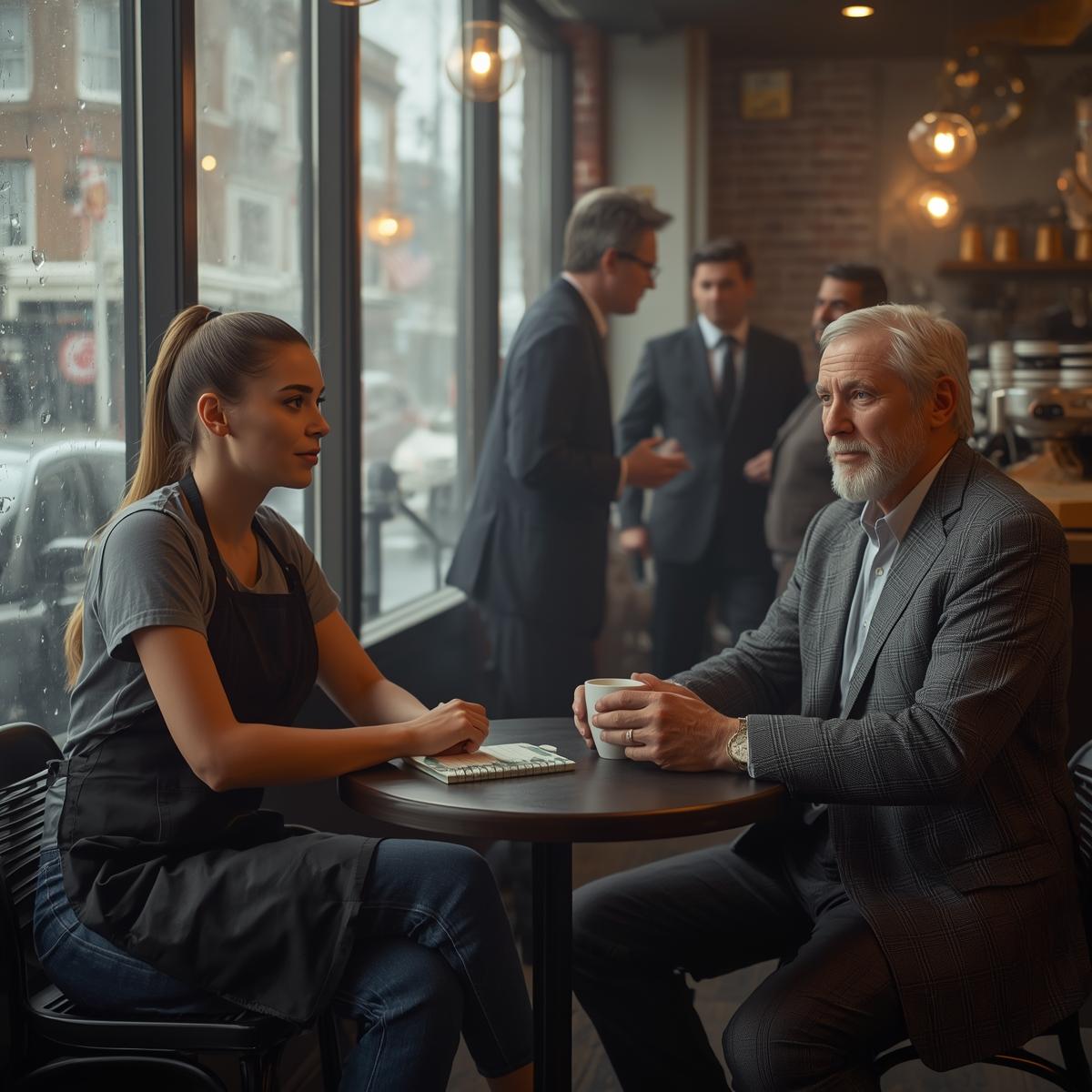
The Tuesday it happened, the rain in downtown Seattle looked like someone had taken a gray sheet and shaken it loose over the city.
I stood behind the counter at Riverside Café with a towel in one hand and a chipped mug in the other, watching the front windows fog over with the breath of strangers. The bell above the door kept chiming faster than the espresso machine could catch up. People crowded in, brushing water from their sleeves, stomping raindrops off their boots, craning their necks for an empty table like it might be the last lifeboat on the Titanic.
My name is Emma. Twenty-nine. Full-time waitress, part-time worrier, older sister by default, not by choice.
If you’d walked in that morning and seen me, you probably wouldn’t have noticed anything special. Brown hair in a ponytail, bangs pinned back with the same bobby pin I’d been reusing for three weeks. Black apron that smelled faintly of coffee and sanitizer. Sneakers with a split in the sole that let the cold in just enough to remind me they needed replacing—a reminder I ignored every time I opened my banking app.
“Table five is asking for refills, table three wants their check, and you’re a full minute behind on mobile orders,” my manager, Kyle, said as he slid past me, his tie already stained with a streak of chocolate from a misbehaving croissant.
“Got it,” I answered, because that’s what I always said. Got it. On it. No problem. As if saying it could bend time.
I balanced a tray with four steaming mugs, two ceramic, two paper, and headed for the back corner. A couple of tech guys in hoodies and thousand-dollar laptops barely looked up as I swapped their empty cups for fresh ones. They treated caffeine like oxygen and me like the person who managed the air supply.
“Refill?” I asked, and one of them nodded without meeting my eye.
I moved like that—refill, wipe, smile, repeat—for almost two hours straight. The café hummed its familiar symphony: the hiss of steam, the grind of beans, the thump of plastic lids snapping onto cups. Somewhere in the background the local radio station played songs I only heard in fragments. Thirty seconds here, a chorus there. My life was a playlist of half-finished melodies.
My phone was in my apron pocket, face down, on silent. I’d checked it at 6:15 a.m. before my shift started: one message from the clinic reminding me my sister had an appointment next week, one overdue notice from the landlord, and a balance on my checking account that made my stomach knot.
Rent overdue by five days.
Lily’s prescription bill due in two.
And the number in my account sitting there like a sad little joke.
I tucked the thoughts away the same way I tucked stray hairs behind my ear. Later. Think about it later.
At 9:37 a.m., the bell over the door chimed again, and the whole day shifted without anyone noticing.
The man who stepped in looked like trouble, at least to people who only see trouble in worn edges.
He was soaked through. The coat he wore might’ve once been a decent gray wool, but now it sagged heavy with rain and age. His shoes were cracked at the seams. The cuffs of his pants were dark with water. He carried a small plastic bag by its handles, twisted tight around his knuckles like he needed them to hold onto something.
He lingered just inside the door, blinking against the sudden warmth and steam, glasses fogging. The smell of coffee, sugar, and wet wool wrapped around him.
For a second, he didn’t move toward the counter or a table. He just stood there, shoulders slumped, as if the act of deciding where to sit required more energy than he had.
I was at the register, finishing up with a woman ordering a nonfat vanilla latte with extra foam and “just a drizzle” of caramel that always turned into a thick golden river.
“That’ll be five-fifty,” I said, forcing my voice into its polite hum.
She slid her card across without looking up from her phone.
“Next,” I called, eyes lifting toward the line.
The man in the worn coat took a tentative step forward, then another. He moved like someone afraid of being in the way.
“Can I help you, sir?” I asked.
His hands tightened on the plastic bag. I noticed, then, that his hair—silver and wild in curls—was plastered to his forehead. Deep lines bracketed his mouth. His eyes were the clear pale blue that always made me think of lakes in winter.
“I… I’m sorry,” he said, voice shaky but low, carrying more in it than the words. “I just needed somewhere to get out of the rain for a bit.”
I waited for the rest. For “and a black coffee” or “and a muffin, if you have blueberry.” Something I could ring up, something that fit the script.
He glanced at the menu overhead, eyes moving too quickly, like he was trying to translate prices into an unfamiliar currency.
“I can pay,” he added, almost too quickly. “Just… I don’t have much. Maybe just a small coffee, if that’s all right.”
Behind him, the line shifted. Someone sighed loudly. The woman with the latte snapped her lid more aggressively than necessary. A man in a navy blazer checked his watch pointedly.
“It’s fine,” I said. “We’ll get you—”
Kyle appeared at my elbow like a storm cloud.
“Excuse me, sir,” he cut in, his manager voice already loaded. “We’re very busy this morning. If you’re not ordering, you can’t just stand around here. This isn’t a shelter.”
The word landed hard in the steam-fogged air.
The old man flinched. His shoulders curled inward, protective. He took a half step back toward the door, rain still clinging to his clothes like another accusation.
“I was going to order a coffee,” he said quietly. “I just… I thought—”
“Then you need to decide and pay like everyone else,” Kyle snapped. “We’re not a charity.”
The words hit me in the chest with a surprising force. We’re not a charity. Technically true. Corporately correct. The kind of line that probably got you a gold star in some business manual.
But it sounded wrong, rubbing against everything in me that still believed small kindnesses mattered.
I watched the man’s throat move as he swallowed. His hand slipped into his pocket, fumbling. He pulled out a small wad of bills—one, two, maybe three dollars, damp from the rain. His fingers shook as he flattened them on the counter, eyes flicking from the menu to the money and back again, as if doing math under pressure.
A small black coffee was three dollars and fifteen cents before tax.
“Emma,” Kyle said under his breath, warning in my name. “We have policies.”
Policies. Rules. Margins. Loss prevention. All the words they used to wrap around decisions so they didn’t feel like choices anymore.
The man’s hand hovered over the money, embarrassed and hesitant. Something in his gaze—some quiet resignation—caught me off guard. It wasn’t just poverty. It was the look of someone deeply tired of being seen as a problem to move along.
I set the towel down. My fingers found the crumpled five-dollar bill in the pocket of my apron, the one I hadn’t had a chance to deposit in the tip jar yet.
Before I could talk myself out of it, I slid the bill across the counter.
“I’ll pay for his coffee,” I heard myself say. “On my tab.”
The line went quiet enough that I could hear the grind of beans.
Kyle stared at me like I’d grown a second head. The guy in the blazer let out a disbelieving snort. Somewhere behind them, a girl in a beanie whispered, “Seriously?” to her friend.
“It’s fine,” I added, trying to sound calmer than I felt. “Take the five, ring up a small coffee, and whatever’s left can go in the jar.”
“Emma,” Kyle said again, his tone edging toward the tone he reserved for rule-breakers and latecomers. “We’ve talked about this. You can’t just—”
“I said I’ll pay for it.” My voice surprised me by not shaking. “Out of my own money.”
The old man watched the bill, his eyes wide, as if I’d just set a diamond on the counter instead of a wrinkled five.
“You don’t have to do that,” he murmured.
“I know,” I said. “But I want to.”
We stood in a little triangle—me, the man, Kyle—with the bill in the center like a line in the sand.
Kyle exhaled sharply, the way he did when a latte came back because the foam was “too stiff” and he had to remake it. He snatched the five, punched in the order with more force than necessary, and slid a paper cup under the spout.
“This is coming out of your tips,” he muttered.
“Then I guess I’ll smile extra today,” I said, because sarcasm is one of the free things I can afford.
I filled the cup myself, hands steady. The smell of dark roast rose up, rich and grounding. I added a lid, set it on the counter, and pointed to the little station near the window.
“There’s cream and sugar over there,” I told the man. “You can sit as long as you like.”
He picked up the cup with both hands, as if it might break or disappear. He looked at me for a long beat, those pale eyes suddenly sharp and clear.
“Thank you,” he said simply.
“Don’t mention it.”
He moved slowly toward the window, leaving a faint trail of water behind him on the tile. I grabbed a mop without being asked.
Behind me, conversation started up again, like someone had pressed play after a brief pause. The line moved. Orders flew. Life resumed.
But not for me.
The rest of my shift felt a half step out of sync. Every time I glanced at the window, I saw him there, both hands wrapped around the cup like it was a small fire in a very cold world. He didn’t look at his phone. He didn’t pull out a laptop. He just sat, watching the rain, occasionally closing his eyes as if listening to something only he could hear.
I wondered how he’d ended up here, in this city, in this weather, in this moment. Once, when I was dropping off a muffin at the next table, my eyes met his. He gave me a small nod, gratitude still sitting quietly in his gaze. I nodded back.
That should’ve been it.
One kind gesture. One man who needed a warm drink and a place to exist for an hour without being shoved along. A tiny blip in the timeline of a life that had bigger, noisier problems: overdue rent, medical bills, an unreliable bus schedule, and a coffee shop manager who knew exactly how far he could push people without breaking labor laws.
By the time my shift ended, the man was gone. His cup sat empty on the table, lid inverted like a little hat. Underneath it, I later discovered, was a neatly folded napkin. On it, in a careful hand, three words: Thank you, miss.
I found it when I was bussing tables, halfway through my closing side work. I slipped the napkin into my apron pocket. I didn’t know why I kept it. Maybe because there weren’t many things in my life that said thank you in ink instead of assumption.
When I finally clocked out, the rain had lightened to a drizzle, the kind that felt less like a storm and more like the city’s sigh. I pulled my hood up, tugged my backpack against my shoulders, and stepped into the wet gray afternoon.
The bus ride home took forty minutes.
I spent every one of them trying to decide whether I’d just done something small and good or something small and stupid.
“You gave away your coffee money when you barely have rent,” the anxious part of my brain scolded.
“It’s five dollars,” another part argued. “You’ve wasted more than that on things that mattered less.”
At home—a one-bedroom apartment with thin walls and a view of another building’s bricks—I found Lily on the couch, knees tucked under a blanket, a mug of herbal tea on the coffee table.
“Hey,” she said, pausing the show she was half-watching. “You’re drenched.”
“Seattle,” I said, kicking off my wet shoes. “It’s in the contract.”
She smiled faintly. Lily is twenty-two, but illness has a way of curling time. Some days she looks younger, her face soft, eyes too big. Other days, when pain draws lines at the corners of her mouth, she looks older than me.
“How was work?” she asked.
I opened my mouth to say fine. To say the usual. To say you know, coffee, people, tips, feet hurt. The grab bag of nothing answers I usually gave her, because she had enough on her plate without also carrying my workday.
Instead, I heard myself say, “I got in trouble for buying a stranger a coffee.”
She blinked. “You what?”
I dropped onto the chair across from her, the springs protesting. “This older man came in. He looked… tired. Not just from the rain. Kyle basically told him to get out if he wasn’t buying anything, like this place was allergic to poor people. So I paid for his coffee.”
Lily’s eyebrows went up. “And Kyle actually got mad about that?”
“Kyle would charge us for the air we breathe if he could,” I said. “He said we’re not a shelter.”
“Well, he’s right,” she said slowly. “It’s not a shelter. But it’s not a fortress either. You did the right thing.”
“Yeah, until Kyle docks my tips or remembers this when he’s deciding people’s hours.”
“He’s not going to fire the only server who remembers everyone’s order by heart,” she said, trying to soften the edges. “Besides, if you hadn’t helped, you’d be sitting here feeling worse.”
She had me there.
Lily reached for the remote and hit play again, but she watched me over the top of the screen, her gaze gentle and sharp at once.
“You always were like this,” she added, a faint smile tugging at her mouth. “Remember the time in middle school you gave your lunch to that new kid for a week?”
“I forgot my lunch,” I protested weakly.
“You forgot your lunch every day conveniently after you saw him sitting alone.”
I shrugged, heat rising in my cheeks. “Maybe I just like carbs less than other people.”
“You love carbs,” she said. “You just like people more.”
I didn’t feel like anyone special. I felt like a person constantly one bill away from disaster, one broken appliance away from panic. But there were some lines I couldn’t cross. Telling a tired, wet old man he had to leave without a cup of coffee was one of them.
We ate dinner—cheap pasta with jarred sauce—and watched the kind of sitcom you forget as soon as the credits roll. Later, when Lily fell asleep early, side effects tugging at her, I stood by the window and watched the rain bead on the glass.
Somewhere in the city, the man with the worn coat was either in a shelter, under an overpass, or maybe sitting in another café where no one asked questions.
“Wherever you are,” I murmured, “I hope you’re warm.”
Then I turned off the light, crawled into bed, and let the exhaustion of the day drag me under.
I thought that was the end.
It wasn’t.
Four days slipped by in the measured chaos of routine.
Wake up. Bus. Shift. Coffee. Customers whose names I never learned but whose orders I knew like prayers: double shot, almond milk, no foam. Medium drip, one raw sugar, splash of cream. Pumpkin spice, extra whip, don’t judge me.
Between all that, I squeezed in phone calls to the clinic, quiet arguments with the landlord about “just a few more days,” and gentle reminders to Lily to take her meds on time. Life was a juggling act, and every morning I woke up surprised I still had all the balls in the air.
I almost forgot about the man in the gray coat.
Almost.
On the fourth day, the rain came back with a vengeance. The sky that morning looked like wet cement. By mid-afternoon, the café windows were so fogged the city outside was just a blur of color.
I was wiping down the counter, humming under my breath in the lull between rushes, when the doorbell chimed.
There are some sounds your body remembers before your brain can name them. That bell, in that moment, carried something different. It cut through the chatter, the hiss, the clink.
I looked up.
A man in a gray suit stepped into the café. Not the sagging, rain-heavy coat from last time. This was a steel-colored suit, perfectly tailored, falling just right on broad shoulders. His white shirt was crisp. His shoes shone even in the dim light, the kind of shine that comes from regular care, not last-minute polish.
His hair was still salt-and-pepper, but tamed now, brushed back neatly. His glasses were new, or at least different—thin metal frames instead of the thick plastic ones I remembered.
For a second, I didn’t recognize him.
Then he looked straight at me, and those pale winter-lake eyes gave him away.
My breath caught.
He walked past the line, past the menu, ignoring the subtle bristle that move always triggered in Kyle. He came to a stop at my register, resting his hands lightly on the counter.
“Good afternoon,” he said.
“Good afternoon,” I echoed, my voice a little slower than usual. “What can I get for you?”
“Nothing,” he said, with a small smile. “Not yet.”
“Sir, if you’re not ordering—” Kyle started from behind me.
The man glanced in his direction, not unkindly but with a steady gaze that made Kyle’s words falter.
“I won’t be long,” the man said mildly. “And I’m not here to take up space for free.” He reached into his pocket and pulled out a black leather wallet.
The wallet itself was unremarkable. The card he set next to the register was not.
It was thick, heavier than normal, with his name embossed in clean, sharp letters. Above it, a logo I’d only ever seen on the side of glass towers and in glossy magazine spreads: an abstract silver emblem, all angles and suggestion, known well enough in the city that most people didn’t need the name underneath to recognize it.
K. R. Holdings.
I’d seen that logo on the side of a sleek building on Fifth Avenue, the kind I passed on the bus and studied through fogged windows. I’d seen it in headlines about acquisition and expansion and record quarterly profits.
Kyle saw it now, too. I felt, rather than saw, his posture change.
“Of course, sir,” he said smoothly. “Take your time.”
The man turned back to me. “Miss,” he said, and there was that same respectful weight in the word as the day with the worn coat. “May I ask you a question?”
“Um,” I said brilliantly. “Sure.”
“Why did you help me the other day?”
The café seemed to recede then, like we’d stepped into some quiet pocket between heartbeats. The clatter of cups softened. The drone of the grinder faded. Even Kyle’s ever-present foot tapping went silent.
I knew what he was asking about. The wrong man wouldn’t have remembered. The proud man would have pretended it hadn’t mattered. But he asked, and he asked in a way that implied he really wanted to know.
“I don’t know if I can give you a fancy answer,” I said slowly.
“I’m not looking for fancy,” he said. “I’m looking for honest.”
Honest.
I looked down at my hands, at the faint coffee stains on my fingers that never quite washed out. I looked at the line waiting behind him, a parade of people with somewhere to be, something to hold onto, someone to answer to.
“You looked cold,” I said finally. “And tired. And like you’d already heard the word no more times than anyone should in one day. It was five dollars. I had five dollars.”
His eyes didn’t leave my face.
“That’s all?” he asked.
“What else is there supposed to be?”
“You didn’t think about the fact that your rent is overdue?”
Heat climbed my neck. “How do you—”
He lifted a hand. “I don’t know the details. I just know the look of someone doing mental math every time she breaks a five. You hesitated, very slightly, before you put that bill on the counter.”
I swallowed. “Maybe I thought about it for a second. But I know what it feels like to need help and to be told I’m an inconvenience. I couldn’t be the person who did that to you.”
“Even if it cost you something.” It was not a question.
“Yes,” I said.
He nodded, as if confirming something he’d suspected. “May I sit with you for a few minutes? On your break, perhaps?”
My break.
Technically, I had one coming. Realistically, breaks around here were as mythical as unicorns on busy days.
“I can cover the register,” Kyle cut in quickly. “Go ahead, Emma. Take ten.”
His tone was different now. Smoothed out. Respectful. The logo on the card had worked on him faster than any employee handbook.
I wiped my hands on my apron and stepped out from behind the counter, feeling the eyes of my coworkers on my back. Curiosity hummed in the air, sharp as static.
The man walked to the small table by the window—the same one he’d sat at in his worn coat—and pulled out a chair. I slid into the one across from him.
Up close, he looked older than he had from behind the counter, but not weaker. The lines on his face were deep, but they’d been carved by more than hardship. There was something deliberate about the way he carried himself. Not stiff, exactly, but contained.
“Do you always come back to test people you meet?” I asked lightly, trying to diffuse my nerves with humor.
He smiled, a flash of genuine amusement softening his features.
“No,” he said. “But I am here for a reason.”
“Which is?”
“To finish a conversation we didn’t start,” he replied.
That wasn’t an answer, not really. But I waited.
“You didn’t ask me why I looked the way I did the other day,” he said. “Most people would’ve been curious. Or suspicious.”
“I was curious,” I admitted. “But I figured if you wanted to tell me, you would. And if you didn’t, it wasn’t my business.”
“I spent the morning before I came here sitting in a boardroom on the top floor of the K. R. building,” he said, eyes drifting briefly toward the misted window as if he could see the skyline beyond it. “Three hours, twelve people, thirty-seven spreadsheets. At the end of it, they asked me to approve a restructuring plan that would have saved us several million dollars a quarter.”
“That sounds… good?” I ventured.
“It would have been, on paper,” he said. “In real life, it would have meant quietly cutting a program we fund in the south end that provides meals and job training for people coming out of long-term unemployment. People on the edge of losing themselves.”
I remembered Lily’s voice the week before, reading headlines aloud from her phone. Something about budgets and cuts and “hard choices.”
“I told them no,” he continued. “They told me it was just business. That the program is a drop in the ocean of need. That we have a responsibility to shareholders. I asked if we don’t also carry responsibility to the people whose lives our money touches when we choose where to point it.”
“What did they say?”
“They called it sentimental. Inefficient.” His mouth twisted slightly. “Later, one of them kindly suggested I take a day to ‘clear my head.’”
He shrugged. “So I did. I left the building. I took off my tie. I walked without an umbrella through the rain until my expensive suit looked like something pulled from a thrift store. At some point, I took off my jacket and gave it to a man shivering under an awning. By the time I reached this café, I looked like someone nobody in that boardroom would have recognized.”
I pictured him in that room, surrounded by polished wood and polished people, all of them speaking a language made entirely of percentages.
“I wanted to remember what it felt like to be seen as nothing,” he said softly. “When I was young, I knew that feeling well. It’s easy to forget, once the carpets get thick and the cars get quiet.”
He glanced at me, gauging my reaction.
“I guess you found out pretty fast,” I said.
“I did,” he agreed. “I walked into this place and asked only for a moment out of the rain. Your manager made it very clear what I was worth to him.”
I winced.
“I’m sorry,” I said. “He—”
“He did me a favor,” the man cut in gently. “He reminded me exactly what I’d been missing in that boardroom. And then you…”
He paused, the smallest smile touching his lips.
“You stepped in. You spent money you could not easily spare. You did it quietly, without fanfare, without an audience. You did not scold your manager, or make a speech. You simply made a choice.”
“It wasn’t a big deal,” I said, uncomfortable with the way he laid it out like something heroic. “It was coffee.”
“People like to say that,” he said. “Not a big deal. Just a small thing. Tiny acts of decency. Do you know what I’ve learned after forty years of watching numbers move across screens?”
“What?”
“Everything big is made from small things. Fortunes. Failures. Families. They all assemble themselves out of choices so small we almost don’t see them when we make them.”
His gaze held mine, steady and clear.
“I came back because I wanted to know if you remembered that moment, or if it was already filed away under ‘another day at work.’”
“I remembered,” I said quietly. “I kept the napkin.”
His eyebrows lifted.
“You did?”
I nodded. “You wrote ‘thank you, miss’ on it. Most people say thank you with the tone of their voice. You wrote it down. I guess that made it feel… heavier. Real.”
He chuckled softly. “I’m old-fashioned,” he said. “I like ink.”
He reached into his inner jacket pocket and pulled out an envelope. It was thick, cream-colored, with a seal stamped in deep green wax. The same logo I’d seen on the card—K. R. Holdings—gleamed faintly in the light.
He set it on the table between us.
“I have something for you,” he said.
My heart kicked. “What is it?”
“An invitation.”
“To what?”
“To a conversation that cannot happen over spilled sugar packets and the hum of an espresso machine,” he said. “I would like you to come to my office tomorrow afternoon. There are things I want to show you. And an offer I would like to make.”
Alarm bells rang somewhere in the back of my mind, clanging right alongside a wild, dizzy curiosity.
“Why?” I asked. “I mean—not to be rude, but why me? I’m just… I’m a waitress.”
He shook his head slightly. “You are a person who made a choice when no one was watching. I’ve spent the last decade trying to find people like that through résumés and references. It has not worked very well. So I decided to try something different.”
He pushed the envelope closer.
“You don’t have to say yes,” he added. “If this feels strange, or if your life is too complicated right now, you can walk away. But I hope you’ll at least open it when you’re somewhere quiet and decide with a clear head, not just a tired heart.”
My fingers itched to touch the paper.
“What if I come,” I asked slowly, “and you offer something I can’t accept?”
“Then you say no,” he replied simply. “And I promise you, if that happens, you will still leave with more than you arrived with.”
My practical brain raced: Is this a scam? Some weird rich-guy game? A recruitment trick? My exhausted brain whispered: What if it’s real?
His eyes didn’t look like a game. They looked like someone who’d walked through storms—financial, emotional, maybe both—and built a very high tower from which to watch the weather. Someone who had gotten used to the thin air and was, suddenly, restless.
“Can I think about it?” I asked.
“Please do,” he said. “I would be disappointed if you didn’t.”
He rose, sliding the chair back carefully, as if reluctant to disturb the small island of quiet we’d built.
“I’ll leave you to your work,” he said. “I’ve taken enough of your break.”
“You didn’t even order anything,” I realized.
He smiled. “Next time,” he said. “I hear the coffee is good.”
He nodded to Kyle on his way out, and for the first time since I’d known my manager, I saw him look genuinely nervous.
“Sir,” Kyle said, voice suddenly polished. “If there’s anything we can do, any way we can partner with your—”
“Take care of the people who work for you,” the man said calmly. “That’s partnership enough.”
The doorbell chimed as he stepped into the rain.
I stared at the envelope for a long moment before tucking it into my apron. The weight of it felt disproportionate to its size, like it carried something denser than paper.
“You okay?” one of my coworkers, Jenna, murmured as she slid past me with a tray of muffins.
“I don’t know,” I said honestly.
“For real, who was that guy?” she whispered.
“A customer,” I said, because saying billionaire out loud would have felt ridiculous, like I was trying to rewrite my own story mid-chapter.
The rest of my shift unfolded in a blur. My hands moved on autopilot: pour, ring, smile, wipe. But my mind kept circling back to the envelope, to his words, to the faint impression of that wax seal against my fingers.
On the bus home, I didn’t look out the window. I held my bag in my lap, one hand wrapped around the envelope inside, like someone might try to snatch it away.
At home, Lily was at the table, papers spread out in front of her, hair pulled into a messy bun.
“Hey,” she said, glancing up. “How was—”
I pulled out the envelope and set it on the table between us.
Her eyes widened. “Whoa. Did you rob a wedding?”
“Very funny,” I said, dropping into the chair opposite her. “A customer gave it to me.”
“This is not the kind of thing customers give people,” she said, dragging it closer to examine the seal. “This is the kind of thing that shows up in movies when someone’s about to be summoned to a reading of a will in a creepy mansion.”
“Terrifyingly, that sounds about right.”
“You going to open it?” she asked, eyes bright now, fatigue temporarily forgotten.
“I… yeah,” I said.
My hands shook just a little as I broke the seal. The wax cracked with a soft sound. Inside was a single sheet of heavy paper, folded in thirds with precise care.
I unfolded it.
Miss Emma Clarke,
If you are reading this, it means you did not throw this envelope away on your way home, which I take as a promising sign.
I would like to invite you to my office at K. R. Holdings, 43rd floor, tomorrow at 3:00 p.m. I understand that this may be inconvenient given your schedule, but I assure you the conversation will be worth your time.
Please present this letter at the front desk. They will escort you upstairs.
Come exactly as you are. Do not feel the need to change anything more than your mind.
Sincerely,
Kenneth Rowe
Underneath his signature was a phone number and a note: If you need to reschedule due to work or family obligation, call this number. We will make it work.
“Holy…” Lily breathed, catching herself before finishing the word she’d been about to use. “Emma, is this—”
“Real?” I finished.
“Yes.”
“I don’t know,” I admitted. “I met him first in a ratty coat looking like he’d just walked out of a storm drain. Then he shows up in a suit from a stock photo about ‘successful executives’ and hands me an invitation on paper that probably costs more than my shoes.”
I looked at his name again. Kenneth Rowe. Each letter carefully inked.
“I’ve seen that name,” Lily said slowly. “He’s in the news sometimes, right? Like, business stuff. Philanthropy. There was an article last year about him donating a ridiculous amount of money to build some new community center.”
“That was him?” I asked, the pieces shifting.
“I think so. I remember because people were arguing in the comments about whether billionaires can ever be truly generous or if it’s all just PR.” She shook her head. “Internet people love to argue.”
“So what do you think this is?” I asked. “Some PR stunt? A social experiment? Hidden cameras? ‘Watch a rich man test the kindness of the working poor’?”
“I don’t know,” she said. “But you don’t even have an Instagram. You’re the worst possible candidate for a viral stunt.”
“Wow, thanks.”
“You know what I mean.” She tapped the letter. “I think you should go.”
“And if it’s nothing?”
“Then you wasted an afternoon and have a weird story to tell,” she said simply. “You’ve had worse afternoons. Like that time someone threw their smoothie at you because it ‘tasted too purple.’”
“They said it tasted like sadness,” I corrected.
“Even worse.” She leaned forward. “But if it’s something, Emma…”
She didn’t finish the sentence. She didn’t have to.
If it’s something.
Something that could take the weight off my shoulders. Something that could make the words “rent overdue” and “outstanding balance” disappear from my daily vocabulary. Something that could mean Lily doesn’t have to ration her medications based on what we can afford this month.
“How am I supposed to stand in some shiny office next to people in suits and talk to a man who probably has a private jet?” I whispered, the magnitude of the difference between our worlds suddenly pressing in.
“Same way you stood in front of your manager and a line of impatient customers and told them you were going to spend your last five on a stranger,” Lily said gently. “You stand up straight, you tell the truth, and you remember that money doesn’t change the fact that you’re a person and so is he.”
“I wish I had your faith,” I murmured.
“You do,” she said. “You just loan it out to other people more often than you keep it for yourself.”
I laughed, a little shaky. “That sounded deep.”
“I’ve been watching TED Talks while you’re at work,” she said. “I’ve got material now.”
We sat there for a long moment, the letter between us like a doorway.
“Should I call the café and ask for tomorrow afternoon off?” I asked.
“Yes,” she said. “Right now. Before your courage takes a nap.”
So I did.
Kyle, to my surprise, didn’t protest.
“Sure, sure,” he said. “We’ve got enough coverage. Just make sure you’re here Saturday. We’re running that two-for-one special and it’s going to be nuts. And if this… thing… is about a partnership or sponsorship for the café, maybe mention we’re open to opportunities.”
“I’m not going to pitch your business while I’m trying not to faint,” I said.
“Worth a shot,” he replied.
When I hung up, Lily exhaled.
“You’re doing it,” she said.
“I guess I am.”
That night, sleep took its time finding me. My mind spun scenarios like a TV writer’s room: What if he offers you a job as his assistant? What if he wants you to be the face of some philanthropic campaign? What if he’s dying and wants to leave his fortune to someone “pure of heart”?
That last thought made me snort out loud.
“I am not a character in a fairy tale,” I muttered into my pillow.
But some stubborn, quiet part of me—a part I didn’t often listen to anymore—whispered back: Maybe you’re not. But life can still surprise you.
When I finally drifted off, I dreamed of elevators with no buttons, just a voice asking, “Up or down?” and my own voice stuck in my throat, unable to answer.
The next day, the sky cleared. Seattle remembered the sun exists sometimes, even in months when everyone forgets that.
I stood in front of my closet, such as it was, staring at my three categories of clothing: café, home, and “nice enough for a funeral or court date.”
“Come exactly as you are,” he’d written.
I doubted he meant in my stained apron. But I also doubted he expected designer anything.
I chose my plainest nice shirt—navy, no wrinkles if you squinted—and my only pair of black pants that didn’t have a fading grease stain on one leg. I brushed my hair until it lay as smooth as it ever would. I put on the small silver necklace my mom had given me when I turned eighteen, back when she was still around and hope wasn’t something we had to schedule around lab results.
In the mirror, I looked like a slightly upgraded version of myself. Still me. Just… ironed.
“You look great,” Lily said from the doorway, leaning heavily against the frame.
“You’re biased,” I replied.
“I am,” she said. “But I’m also right.”
“Do you want me to cancel?” I asked suddenly. “I can. I could call and say—”
“Emma.” Her voice sharpened, cutting through my spiral. “Go.”
“I’m just—”
“Scared. I know. But you can be scared and still do the thing. Besides, I’ll be fine. Mrs. Patel from next door is dropping by later with samosas and gossip, and you know both those things can keep me alive for hours.”
That made me smile. Our neighbor, a widow in her sixties, had adopted us somewhere around month three of living here, bringing food, advice, and pointed commentary about the building’s wiring.
“You sure you don’t need me—”
“I need you to go see what this is,” she said firmly. “Whatever happens, we’ll figure it out. Like we always do.”
I hugged her, inhaling the familiar mix of her shampoo and the lavender lotion she liked. She felt smaller in my arms than she used to.
“Text me when you get there,” she said into my shoulder. “And when you leave. And if anyone tries to sell you essential oils or a timeshare, run.”
“I promise.”
The bus ride downtown felt different this time. The city, those same streets, looked sharper. Buildings I’d never really noticed loomed larger. People in suits looked less like background characters and more like participants in some game whose rules I’d never been taught.
The K. R. building rose up from the sidewalk like something that had dropped out of a separate universe. All glass and steel, reflecting the sky and the smaller buildings around it, it looked both solid and somehow untouchable.
I stood on the sidewalk for a full minute, craning my neck.
“You got this,” I whispered, because sometimes you have to say it out loud for your legs to believe you.
Inside, the lobby was vast and polished, all marble floors and high ceilings. A fountain trickled softly in one corner. The security desk was staffed by a man in a navy blazer who looked more approachable than the architecture.
“Can I help you?” he asked as I approached.
“I… um… I’m here to see Mr. Rowe,” I said. The name felt unfamiliar on my tongue, too formal. “I have an appointment.”
“Name?”
“Emma Clarke.”
He typed it into his computer. The screen reflected in his glasses, lines of text I couldn’t see clearly.
“Do you have the letter?” he asked.
I slid it from my bag, suddenly grateful I hadn’t spilled anything on it.
He examined it, nodded once, and picked up a phone.
“Ms. Clarke is here to see Mr. Rowe,” he said into the receiver. “Yes. All right.”
He hung up and smiled. “Someone will be down to escort you in just a moment. You can wait over there.”
He gestured to a cluster of chairs near the fountain.
I sat on the edge of one, hands clasped, heart beating a little too hard. Five minutes stretched like taffy. Then the elevator dinged and a woman stepped out.
She looked like the distilled version of professional—sleek bob haircut, gray dress, a tablet in one hand.
“Ms. Clarke?” she asked.
“That’s me,” I said, standing quickly.
“I’m Olivia,” she said, offering a hand. Her shake was firm. “I work with Mr. Rowe. He’s looking forward to meeting you.”
Looking forward.
“This way,” she said, leading me toward the elevator.
Inside, she inserted a keycard and pressed 43. The button glowed.
“We don’t usually bring guests up this way,” she said conversationally as we began to ascend, the floor numbers blinking past. “But Mr. Rowe prefers to handle certain meetings personally.”
“Do you do this a lot?” I asked. “I mean—bring people like me up?”
She smiled slightly. “People like you?”
“People who… work in coffee shops and get mysterious letters,” I said.
Her smile grew. “Not as often as I’d like,” she replied.
The elevator doors opened onto a floor that felt quieter than the lobby, not in sound but in energy. The carpet softened footsteps. The walls were lined with large photographs—black and white images of the city in different decades. Street vendors in the seventies. Factory workers in the fifties. A small café from the thirties with a handwritten sign that read 5¢ Coffee.
I slowed to look at that one.
“Mr. Rowe’s grandparents ran a place like that,” Olivia said behind me. “According to him, anyway. I think that one’s from an archive, but he likes to pretend it’s theirs.”
“Is that how he started?” I asked.
“In a manner of speaking,” she said. “He likes to say everything he learned about business, he learned from counting nickels in a coffee tin.”
My chest tightened a little at the coincidence.
She led me to a set of double glass doors at the end of the hall. They opened into an office that somehow managed to be both large and uncluttered. Floor-to-ceiling windows looked out over the city, the buildings below arranged like a grid of possibilities.
Behind a wooden desk sat the man from the café.
He stood as we entered.
“Emma,” he said. “Thank you for coming.”
“Mr. Rowe,” I replied, trying to keep my voice steady.
“Ken, please,” he said.
That small adjustment helped. Mr. Rowe sounded like someone whose signature could topple economies. Ken sounded like someone’s uncle who told long stories at Thanksgiving.
“I’ll bring in the file,” Olivia murmured, and slipped out as quietly as she’d appeared.
“Please,” he said, gesturing to the chair in front of his desk. “Sit.”
The seat was soft, but my back stayed straight.
“You have a remarkable view,” I said, because sometimes you have to start with the obvious.
“It’s easy to mistake a view for perspective,” he replied. “But it does remind you how small most of us are, seen from far enough away.”
He settled into his chair. On the desk, there were only a few items: a laptop, closed; a leather-bound notebook; a framed photograph of a younger man standing in front of a small storefront with a sign that read Rowe’s Diner.
“So,” I said, more bluntly than I’d intended. “What is this?”
He laughed softly, not offended. “Direct. Good.”
“You wrote that you wanted to make me an offer,” I continued. “You also said I could say no. I’d like to know what I’d be saying yes or no to.”
“Of course.” He leaned back, steepling his fingers. “Let me tell you a story first.”
“I’m on the clock?” I asked.
“In a way,” he said. “But I’ll keep it under a thousand pages.”
I relaxed a fraction. If nothing else, he wasn’t humorless.
“I grew up over a small diner,” he began. “My parents worked from before dawn until after midnight most days. My brother and I learned to pour coffee before we learned long division. My job was to count the cash at the end of the day—nickels and dollars smelling of grease and sweat and exhaustion.”
He glanced at the photograph on his desk.
“We weren’t poor the way some people are poor,” he said. “We never went hungry exactly. But there was never a safety net. One broken refrigerator, one slow month, and everything was at risk.”
I nodded slowly. That tightrope felt familiar.
“One afternoon,” he continued, “a man came in who clearly couldn’t afford to eat. My father saw it immediately. The man ordered a cup of coffee, then apologized when he realized he didn’t have enough to pay even for that. My father poured him the coffee anyway. Made him a sandwich, too. When my mother glanced at the register, he shook his head and said, ‘Some debts don’t belong on paper.’”
I felt that phrase land in my chest.
“Later, I asked him if we could afford that kind of generosity,” Ken said. “He told me something I’ve never forgotten. He said, ‘If we can’t afford to be kind, we’re already broke. The numbers just haven’t caught up yet.’”
He spread his hands slightly.
“I built this company with those words rattling around in my head,” he went on. “For a long time, they fit. We grew. We hired. We paid people fairly. We gave. Then, slowly, things shifted.”
“Shareholders,” I said.
“And boards,” he agreed. “And expansion. And pressure. I watched as more and more of my time was spent justifying kindness as if it were a line item instead of a principle.”
He leaned forward slightly.
“Two weeks ago, we lost a bid on a contract,” he said. “We didn’t lose because we were too expensive, or because our product was inferior. We lost because another company promised faster returns by cutting corners I would not cut. My board called it a wake-up call. They said it’s time to play harder. Harder, in this context, meant colder.”
He looked tired suddenly, weariness showing in the slump of his shoulders.
“I told them we would not cut the program I mentioned to you,” he said. “They reminded me that without profit, there can be no philanthropy. I reminded them that without values, there is no point.”
He smiled wryly. “You can imagine how that went over.”
“I can,” I said.
“I left the meeting feeling like I was losing the company I built to the very forces I once swore I would never personify,” he continued. “I wanted to see if the world still contained the kind of quiet, stubborn decency my father had shown that day in the diner. I wanted to know if I was foolish to keep fighting for something that looks increasingly old-fashioned on a spreadsheet.”
He met my eyes.
“And then I met you,” he said simply.
“I’m not a saint,” I said quickly. “I’ve done my fair share of selfish things. I complain about customers under my breath. I drag my feet when the floor needs mopping. I once pretended not to see someone drop a five just so I could have bus fare.”
“Good,” he said. “Saints are terrible in business. I’m not looking for perfection. I’m looking for people who choose right when it is not convenient.”
He opened the notebook on his desk and turned it toward me.
On the page was a list of names, each with a brief note beside it. Some were crossed out. Next to my name, he’d written: Paid for my coffee when she couldn’t afford it. No audience. No agenda.
I swallowed around the knot in my throat.
“What I am about to propose,” he said, closing the notebook again, “comes with risk. It comes with responsibility. It comes with the possibility of failure. I want you to hear it all, ask every question your mind can invent, and then think about it before you answer.”
“Okay,” I said.
“I see two empires when I look at K. R. Holdings now,” he said. “The one my board imagines—endless growth, endless accumulation. And the one I still dream of—a structure that supports people on its way up instead of kicking them off the ladder.”
He took a breath.
“I want to create something separate but connected,” he went on. “A foundation with real teeth. Not a vanity project, not a naming-rights factory. A place where decisions about giving are made by people who know what it is to count every dollar and still choose generosity.”
He held my gaze.
“I want you to help me build it,” he said.
The room went very quiet.
“I don’t understand,” I said after a moment, my voice thin to my own ears. “I make coffee. I don’t know how to… build a foundation. I wouldn’t even know what paperwork to file.”
“That’s why I will also give you a team,” he replied calmly. “Lawyers, accountants, program officers. People who know forms and tax codes. But what they do not know—what money cannot easily buy—is the view from the ground. You do.”
“You want me to be… what? A consultant?” The word felt too small.
“In time, I want you to be its director,” he said. “But we will start with apprenticeship. Learning. Listening.”
“My rent is overdue,” I blurted out, because sometimes the truth leaks out of the most fragile places. “My sister is sick. I don’t have savings. I can’t just quit my job and gamble on… whatever this is.”
“I would never ask you to gamble with your sister’s health,” he said softly. “Or your home.”
He opened a drawer and pulled out a thin folder. From it, he removed two sheets of paper and laid them side by side on the desk.
“The first,” he said, tapping the left sheet, “is a job offer. Salary, benefits, health insurance for both you and your sister. A comfortable, not extravagant, salary by our standards, life-changing by yours. Enough that you will not have to choose between paying rent and filling prescriptions.”
I stared at the printed numbers. They swam a little, my eyes refusing to focus.
“The second,” he continued, “is an initial grant authorization for the foundation. Ten million dollars, earmarked for programs chosen in the first year by the person who accepts this role—subject, of course, to legal due diligence and board oversight. I am not irresponsible. But the direction, the priorities, the soul of it—that will come from you.”
“This is…” I struggled to find words that weren’t just shocked expletives. “This is insane.”
“Many worthwhile things sound insane at the beginning,” he said.
“You don’t know me,” I protested. “You met me twice. For all you know, I could be terrible with money. I could take this job and run everything into the ground. I could be… I don’t know… secretly cruel.”
He smiled faintly. “I have had you checked out, to a reasonable degree,” he admitted. “I know where you live. I know you are the primary caregiver for your sister. I know you have held two jobs at once in the past to keep things afloat. I know you have no criminal record, no trail of unpaid debts beyond what poverty forces.”
“So you’ve been spying on me,” I said, bristling.
“I have been doing due diligence,” he corrected gently. “If I am to trust you with something this large, I must know that you are who you appear to be. The fact that you find this intrusive reassures me, oddly. People who expect to be chosen for great things tend not to question the methods.”
“This isn’t fair,” I whispered. “You’re offering me a way out of drowning and telling me I can say no like that’s an actual option.”
“It is,” he insisted. “I want you to understand something, Emma. If you say no, I will not cut the program I told you about. I will not stop giving. I will continue to search for others who might take on this role. Your refusal would not doom anyone. I am not dangling people’s lives over your head as leverage. I am offering you a different way of living your own.”
I sat back, the chair cradling me as if it expected people to collapse into it under news like this.
“I don’t belong here,” I said quietly.
“Neither did I, once,” he replied. “The first time I came to this floor, I was delivering lunch from my parents’ diner because the standing catering company had messed up an order. I smelled like onions. My shoes squeaked. I wanted to disappear. The man in charge then looked at me like part of the furniture. I promised myself that if I ever sat where he sat, I would not forget the feeling of being unseen.”
He spread his hands.
“I built all of this,” he said, gesturing to the office, the view, the invisible network of power humming beneath the floor. “And somewhere along the way, I stopped being able to do what my father did without committee approval. I can’t pour coffee for every stranger who walks in out of the rain. But I can choose who sits at this table with me while we decide where the coffee goes.”
I stared at the papers again. Numbers. Letterhead. Legal language.
“How do you know I won’t lose myself?” I asked softly. “I’ve watched people change when they get a promotion at the café. They start talking like Kyle. How do you know I won’t get up here and forget what it felt like to count quarters for bus fare?”
“I don’t,” he said. “That’s the risk. But I saw something in your face when you paid for my coffee. Something that looked very much like the expression my father wore when he handed that sandwich to a man who could not pay. It wasn’t pity. It was recognition. I am betting on that.”
The word hung there. Betting.
“This… job,” I said. “What would it look like day to day?”
“In the beginning?” he said. “Listening. Visiting programs we currently fund. Sitting in rooms where decisions are being made about money that affects people who will never see this floor. Asking questions others don’t think to ask. Learning how the machine works so you can help me change how it runs.”
“And you really think someone like me can do that?”
“I think someone like you must do that,” he replied.
I thought about Lily on the couch, her meds lined up like little soldiers on the table. I thought about Mrs. Patel downstairs, stretching her pension check to cover her rent and her grandson’s textbooks. I thought about the man in the gray coat, hands shaking as he laid down his damp bills.
My throat burned.
“What if I mess up?” I asked.
“You will,” he said matter-of-factly. “Everyone does. The question is whether you learn better or double down to save face. That, too, is a choice.”
Silence settled between us, not uncomfortable, but full.
“I’m going to need time,” I said finally. “To think. To talk to my sister. To make sure this isn’t just me being dazzled by numbers.”
“Good,” he said. “Take it. Two days. Three, if you need them. Olivia will give you her card. Ask anything. Bring your sister by, if you like. Meet the people who would be your team. I’m not asking you to jump blind.”
He slid the papers back into the folder and closed it.
“One more thing,” he said. “Whether you say yes or no, I would like to settle your current rent and your sister’s outstanding medical bills. That is not payment for a decision. It is a thank-you for a kindness you already showed.”
“No,” I said reflexively, the word shooting out before I could stop it.
He looked… pleased.
“Why?” he asked.
“Because taking that before I decided would feel like I already said yes,” I said. “Like you bought my answer.”
“Would you feel the same way if I did it anonymously?” he asked quietly.
“Yes,” I said, then hesitated. “I don’t know. Maybe. I just… I’m tired of feeling like everything comes with a string attached.”
“This does not,” he said. “But I respect your hesitation. So here is my compromise. I will have Olivia prepare the paperwork to pay those bills. It will sit in my desk. If you say yes to the foundation, we will shred the part that names them as separate gifts and include them in your first signing bonus instead, if that soothes your sense of fairness. If you say no, and only then, I will file it as a gift made in gratitude, not obligation.”
“You’ve thought this through,” I said, bewildered.
“I’ve had a lot of time,” he replied.
He rose, and I followed.
“At the end of the day, Emma,” he said, “this is not about charity. Not in the way your manager meant it. It’s about choosing what kind of person you want to be when the world hands you more power than you expected to have.”
He walked around the desk, stopping a respectful distance from me.
“When you slid that five-dollar bill across the counter, you were that person,” he said. “Whether you accept this job or not, don’t lose her.”
I swallowed hard.
“I’ll think about it,” I said.
“That,” he replied, “is all I ask.”
Olivia met me outside the office with a card and a warm expression.
“Take the side elevator down,” she said. “It’s quieter.”
In the elevator mirror, I hardly recognized the woman staring back. She looked like someone who had just been handed a key to a door she never knew existed.
On the sidewalk outside the building, the city smelled like wet concrete and car exhaust. People hurried past, carrying coffees and briefcases, groceries and backpacks. None of them knew that on the forty-third floor, a man had just asked a waitress to help him redirect millions of dollars.
I walked to the bus stop in a daze, my legs operating on muscle memory. When the bus arrived, I climbed aboard, swiped my card, and took a seat by the window.
Only then did I let my head fall back against the seat and exhale.
My phone buzzed.
Lily: Are you alive or did they recruit you into a secret society?
I smiled for the first time in what felt like hours.
Me: Alive. No robes yet. Tell you everything when I get home.
Lily: Do I need popcorn for this story?
Me: Popcorn. Tea. Maybe a paper bag to breathe into.
Lily: Got it.
I slipped the phone back into my pocket and looked out at the city rolling by. Same streets. Same buildings. Same people huddled under bus shelters, same barista in a different café yelling orders over the noise.
Somewhere, a woman with overdue rent and a sick sister would clock in for the evening shift and pray for decent tips.
Somewhere, a man in a suit would stare out his window and wonder if it was too late to remember the taste of diner coffee.
And me?
I sat between those worlds, an envelope in my bag, a choice pressing at my ribs.
When I walked into our apartment, Lily was waiting on the couch, blanket pulled up to her waist, eyes wide.
“Well?” she demanded. “Did he ask you to marry him, adopt him, or become the face of his ethical coffee brand?”
“None of the above,” I said, dropping my bag and sinking into the chair opposite her. “It’s worse.”
“Worse?” she squeaked. “There’s a worse?”
“He offered me a job,” I said, and then the whole story began pouring out—the boardroom conflict, the worn coat, the foundation, the salary, the ten million dollars.
Lily listened without interrupting, her face cycling through more expressions than a reaction GIF collection.
When I finished, she exhaled a wordless sound that was half laugh, half gasp.
“Well,” she said. “That’s… casual.”
“I told you,” I said weakly. “It’s insane.”
“Insane good,” she said.
“Or insane impossible.”
She leaned forward, serious now.
“Emma,” she said. “Look at me.”
I did.
“Do you trust him?” she asked.
I thought about the way he’d told the story of his father. The way he’d respected my no about the bills. The way he’d seemed almost… relieved… when I didn’t just grab the offer with both hands.
“I think I do,” I said slowly. “More than I thought I would.”
“Do you trust yourself?” she asked.
That was harder.
“I’m afraid I’ll screw it up,” I confessed. “That I’ll get up there and drown in jargon and politics and I’ll make the wrong call and someone out there will pay for my mistake.”
“You’re already making calls that affect people,” she said. “Every day. You make decisions at work that change someone’s morning. You make decisions here that change my health. The scale is different. The fear feels bigger. But the muscle is the same.”
“I like making coffee,” I said, more wistful than I expected. “I like small, fixable problems. Spilled drinks. Mixed-up orders. You apologize, remake, move on. This… this wouldn’t be fixable if I broke it.”
Lily reached for my hand across the gap between us.
“I’m going to say something,” she said. “And I need you to really hear it.”
“Okay.”
“You have been holding my life together with tip money and bus schedules and sheer stubborn will for years,” she said. “You have sat in clinics arguing with receptionists so I could get squeezed in. You have called insurance companies and sat on hold until your ear went numb. You have juggled more grown-up decisions than most people with five times your income. If anyone is qualified to look at a pile of resources and ask, ‘How do we use this so people fall through fewer cracks?’ it’s you.”
Tears pricked my eyes.
“Lily—”
“I’m not saying say yes because of me,” she went on. “Though, trust me, the health insurance part is very attractive. I’m saying say yes if you want to. If some part of you hears this and feels that little click inside that says, ‘This is what I’m supposed to be doing next.’”
“I don’t know what I’m supposed to be doing,” I whispered. “Half the time I feel like I’m making it up as I go along.”
“News flash,” she said. “So is everybody.”
We sat in quiet for a long moment, just the hum of the fridge and the distant sound of our neighbor’s TV filling the space.
“What would you do,” I asked slowly, “if you were me?”
She frowned in mock contemplation.
“I’d take a nap,” she said. “But that’s my answer to most things.”
I snorted through my tears.
“After the nap,” I clarified.
“After the nap,” she said, sobering, “I’d think about how many times you’ve said, ‘If I had the money, I’d help…’ and fill in the blank. Mrs. Patel’s rent. The kid down the hall whose parents work nights. The shelter that always seems full. The little clinic we go to that’s always short on supplies. You say that a lot, Em. ‘If I had the money…’”
“I didn’t know you were keeping track,” I murmured.
“I keep track of you,” she said simply. “So I’d ask myself: If I say no to this, will I be okay living the rest of my life with the knowledge that my ‘if’ could have been a ‘when’?”
The room wobbled slightly in my vision.
“You’re really good at this,” I said.
“I’ve had a good teacher,” she replied.
I didn’t sleep much that night, either. But this time, the fear was braided with something else. Not quite excitement. Not yet. More like the sensation of standing on a cliff and realizing the ground behind you is just as uncertain as the drop in front.
The next morning, I went for a walk before the city fully woke. The air was crisp, the sky a fragile blue that looked like it could crack under the weight of noon.
I wandered without a plan, past the park where kids would soon be chasing soccer balls, past the bus stop where I’d spent so many cold mornings, past a small diner with a handwritten sign in the window: Coffee & Eggs Special.
An older man sat inside at the counter, nursing a mug, the steam rising in front of his tired face. The waitress poured him a refill without being asked.
I watched them through the glass for a second, feeling like I’d stepped sideways into someone else’s memory.
“Some debts don’t belong on paper,” I murmured to myself.
By the time I circled back home, my feet had made a decision my brain was still catching up to.
Lily was at the table again, pill organizer open, expression cautious.
“Well?” she asked.
“I’m going to call Olivia,” I said.
She nodded once, eyes shining.
“Before you do,” she said, reaching under a magazine. “I have something for you.”
She slid a folded napkin across the table.
I unfolded it.
In her messy, looping handwriting, she had written: Remember who you were before they told you who you had to be.
“Found that in one of my old journals,” she said. “Seemed relevant.”
I ran my thumb over the words.
“Thank you,” I said.
“Consider it my five-dollar coffee,” she replied.
My hands didn’t shake when I dialed Olivia’s number this time.
“Olivia Hart,” she answered.
“Hi,” I said. “It’s Emma. Emma Clarke.”
“Emma,” she said warmly. “Calling with questions or with an answer?”
“Both,” I said. “But mostly an answer.”
Behind me, the city moved through another ordinary morning, coffee brewing in a hundred kitchens, bus stops filling, rent notices being slipped under doors.
Somewhere in all that, a billionaire waited to hear whether the woman who had paid for his coffee would now accept something infinitely larger.
I took a breath.
“I’d like to talk about what day one would look like,” I said. “Because I think I’m going to say yes.”
And in the quiet before she responded, I realized that the choice that had felt impossibly large had been growing in me since the moment I pushed a crumpled five-dollar bill across a sticky café counter.
The world hadn’t changed yet.
But I had.
And sometimes, that’s where everything else begins.