The Grand Ballroom of the Pierre Hotel smelled like white lilies, expensive food, and quiet desperation—the kind wealthy people hide behind crystal chandeliers and forced laughter. It was a scent I knew well, though I usually encountered it in war zones, not on Fifth Avenue.
I stood near a marble pillar, half-hidden, holding a glass of sparkling water. Old habits die hard: back to the wall, eyes scanning exits, no surprises. My charcoal-gray suit was custom-made on Savile Row—perfectly fitted, deliberately plain. No shine. No labels. Nothing that drew attention.
That was intentional.
In my world, attention gets people killed. In this room, it would only invite ridicule.
Across the ballroom, my father, Robert Davis, basked beneath a chandelier the size of a small car. Sixty-five. Red-faced. Laughing too loudly as he slapped backs and swirled scotch like a man who believed he still owned the world.
He didn’t know his company was insolvent.
He didn’t know the bank had nearly seized his estate.
And he definitely didn’t know the foreclosure had been stopped three days earlier by a $2.4 million wire transfer from a shell company called Vanguard Holdings.
He walked past me without seeing me—then paused.
Recognition flickered across his face, followed immediately by irritation.
He leaned in, smiling for the crowd. “Try not to eat too much, Thomas,” he whispered. “We’re paying per head. And frankly, you’re not worth the plate.”
I met his eyes. I saw fear buried under arrogance. A man drowning who thought he was waving.
“Good evening, Father,” I said evenly.
“Don’t call me that here,” he hissed. “You’re only here because Michael insisted. If it were up to me, you’d still be rotting in whatever gutter you crawled into after you ran away.”
I said nothing. I watched him walk away—never knowing I owned the table, the wine, and the roof above his head.
I was here for Michael. My younger brother. He was ten when I was thrown out at eighteen—for refusing the family business and joining the Army instead. To my father, service was shameful. Only failures wore uniforms.
Michael never believed that. He stayed in touch. Quietly. Today was his wedding.
When the photographer called for immediate family, Michael spotted me and waved eagerly.
I stepped forward.
That was my mistake.
My aunt Linda intercepted me instantly, silk dress swishing like a warning.
“Step aside,” she laughed, placing a firm hand on my chest. Not guiding—blocking.
“We’re taking the family photo,” she said sweetly. “Only successful people. You understand. We don’t want… reminders of bad choices.”
Michael protested. My father cut him off.
“He chose a gun over a briefcase,” my father said loudly. “Let him stand where he belongs.”
The photographer hesitated. My brother looked torn.
I shook my head at Michael.
I stepped back into the shadows.
Flash.
The lie was captured perfectly.
Later, as the speeches began, Sophia—the bride—stopped in front of me.
“Are you leaving?” she asked quietly.
“I should,” I said.
“No,” she replied. “Stay.”
She walked to the stage and took the microphone.
“I believe in honor,” Sophia said. “And I believe credit belongs to those who earn it.”
She looked straight at me.
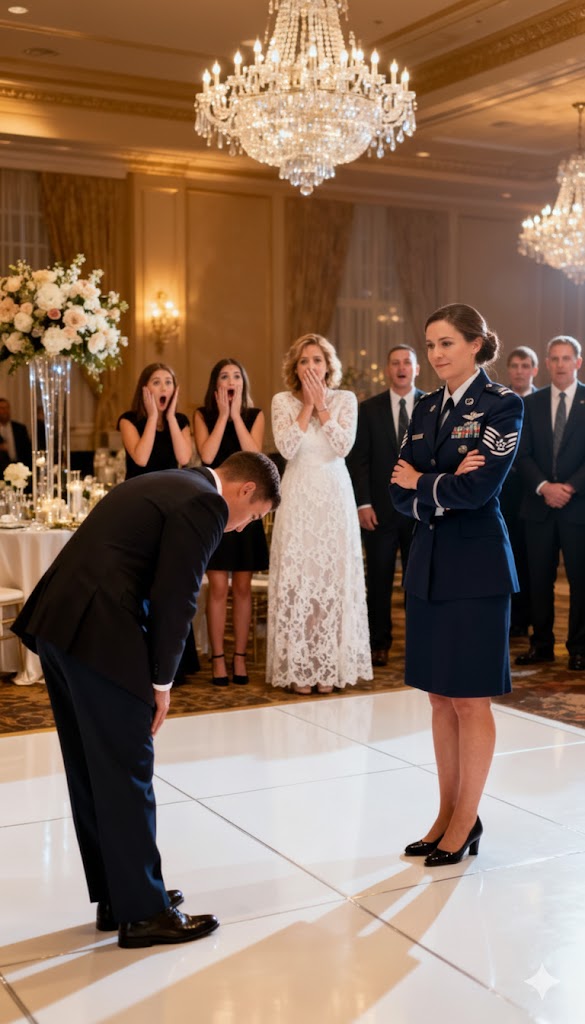
“Please raise your glasses—to the man who paid for this wedding. The man who saved the Davis estate. And the highest-ranking officer this city has ever produced.”
Silence.
“Major General Thomas Davis.”
The room gasped.
My father dropped his glass.
I stepped forward, posture shifting—no longer invisible.
I returned her salute.
And in that moment, everything they thought they knew collapsed.