Maya Calderon once believed disappearing required motion—leaving town, packing bags, slamming doors behind you. She learned the truth the hard way. Disappearance is stillness. It is staying put while the world edits you out. It is survival stretched thin over years until endurance becomes identity.
San Aurelio had long since decided who Maya was.
She was the cautionary tale repeated in softened voices at charity events and sharpened ones in executive offices: the personal aide who married into obscene wealth, lied about a pregnancy, and was exposed when the deception collapsed. The story was neat. Comfortable. It absolved everyone who told it from empathy and allowed power to remain unchallenged.
No one bothered asking who that story protected.
On the morning of the Calderon–Vargas estate hearing, rain clung to the courthouse steps, turning stone into mirrors for camera flashes and polished shoes. The city buzzed with restrained hunger. Sebastian Vargas—shipping tycoon, financial strategist, and one of the coast’s most quietly influential men—had died without publicly naming an heir.
And silence like that invites chaos.
Maya paused at the bottom of the steps, tightening her grip on the small hands tethering her to the present. Eli stood at her left, squeezing a faded stuffed turtle. Noah, on her right, pushed a toy truck along the cracks in the pavement. Twins, identical enough to confuse strangers, different enough to remind her they were two separate lives she had fought to protect.
“Stay close,” she whispered, bending low so her hair shielded them from watching eyes. “Don’t talk to anyone unless I say so. And whatever happens, don’t let go.”
Eli nodded, solemn beyond his years. Noah frowned. “Is this where the mean lady is?” he asked, his voice cutting too clearly through the crowd.
Maya swallowed. “This is where the truth is,” she said. Parenthood had taught her that even gentle lies grow teeth.
Inside, the courthouse smelled of cold air and old documents, a sterile performance of neutrality hiding decades of influence and leverage. When Maya stepped through the doors, the atmosphere shifted—not loudly, but unmistakably. People who had been erased were not meant to return.
Whispers followed her.
She recognized faces she hadn’t seen in years: executives who once pretended not to notice her, women who smiled now while quietly rewriting history. The version of Maya they remembered did not include her walking back in with children at her side.
In the front row sat Camille Roth.
Immaculate in black silk. Posture flawless. Grief worn like a tailored accessory. Her hand rested possessively on a leather folder, as if ownership could be asserted by proximity alone. When she turned and saw Maya, the composure cracked.
Disbelief flickered. Then calculation. Then panic—especially when her gaze dropped to the twins.
For a heartbeat, the courtroom forgot how to breathe.
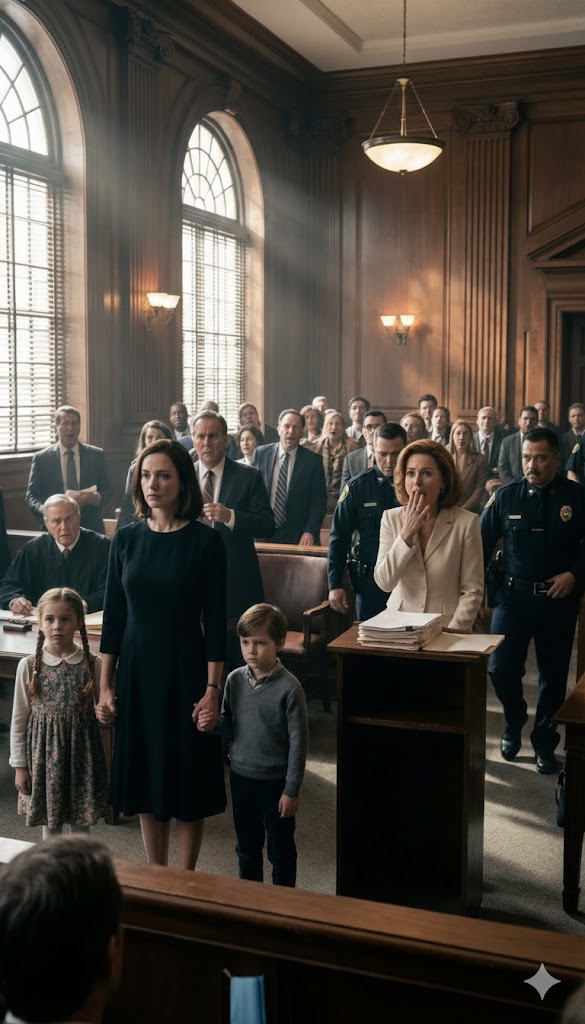
Maya walked forward without hesitation and took the seat she was legally entitled to, guiding the boys beside her. She anchored herself in their warmth, because she understood this moment would echo through the rest of their lives.
Camille leaned toward her, voice sharp and barely contained. “You don’t belong here.”
Maya met her gaze calmly. “I’m exactly where I should be.”
Camille laughed, brittle. “You vanished. You gave up your rights.”
“I didn’t vanish,” Maya replied softly. “I was erased. There’s a difference.”
The judge entered. Order was called. Thomas Hale, the estate executor, stood with a sealed document that seemed heavier than paper should be.
Camille straightened, stitching her confidence back together with the belief that money rewrites outcomes. Maya remained still. Fear had burned out of her long ago, replaced by something steadier.
When Thomas reached the relevant clause, the room leaned forward.
“This will,” he read, “is enforceable only in the presence of my lawful wife, Maya Calderon.”
Camille inhaled sharply.
The judge looked up. “Mrs. Calderon, records indicate no finalized divorce.”
“There wasn’t one,” Maya said evenly. “I was removed. Not released.”
Camille stood abruptly. “This is ridiculous. Sebastian said she lied. That the pregnancy wasn’t his. That she manipulated him.”
Maya’s voice hardened for the first time. “He was manipulated,” she said. “By you.”
Gasps rippled through the room.
Thomas continued, reading from Sebastian’s attached statement. “I was shown falsified DNA results. Fabricated recordings. I accepted them because they excused my fear of fatherhood and my need for control.”
Camille screamed, “He was ill! He didn’t know what he was saying!”
But the evidence moved forward without pause.
Bank transfers traced to Camille. A medical consultant paid to falsify reports. Deleted messages recovered. A systematic effort not only to remove Maya, but to ensure she had nothing to return to.
Then Thomas lifted a second envelope.
“Mr. Vargas amended his will after uncovering additional information,” he said.
The room froze.
“He discovered Ms. Roth had been siphoning company funds for years and planned to flee once the estate transferred.”
Camille’s composure shattered. “That’s a lie!”
The final clause fell like a verdict.
“To my sons, I leave everything. To Maya Calderon, full guardianship and control. To Camille Roth, I leave my apology for misplaced trust—and my evidence to the authorities.”
Security moved as Camille collapsed, screaming, clawing at a reality she could no longer bend.
Maya did not smile.
Victory didn’t restore the nights she counted change for formula, or the birthdays she celebrated alone, or the years spent shrinking herself to survive.
Outside, beneath a clearing sky, she held a small brass key—the last thing Sebastian left her—along with a letter that spoke not of money, but regret and accountability learned too late.
That evening, in a quiet house overlooking open water, Maya watched her sons sleep and finally allowed herself to cry—not for what she lost, but for what she reclaimed.
She didn’t win because someone else fell.
She won because she endured.
Final Thought
Truth doesn’t hurry, and justice rarely arrives on schedule. But lies collapse under their own weight, and those who survive quietly—who protect their children, their dignity, and their right to exist—inherit something far greater than wealth.
They inherit themselves.