My name is Olivia Carter, and I truly believed I knew everything about my thirteen-year-old daughter, Lily.
After my divorce two years ago, it had been just the two of us in our small home in a quiet Massachusetts suburb. Lily was responsible, bright, polite—never the kind of child who caused problems. At least, that was what I believed.
One Thursday morning, as I stepped outside with my work bag, my elderly neighbor Mrs. Greene waved me over.
“Olivia,” she asked gently, “is Lily skipping school again?”
I froze.
“Skipping? No… she goes every single day.”
Mrs. Greene frowned. “That’s strange. I often see her coming home during school hours. Sometimes with other children.”
My heart sank. “That can’t be right,” I said quickly, forcing a smile. “You must be mistaken.”
But during the drive to work, the unease wouldn’t leave my chest. Lily had been quieter lately—eating less, always exhausted. I’d blamed middle-school stress. Now I wondered if it was something far worse.
That night at dinner, she seemed normal—polite, calm, reassuring me that school was “fine.” When I mentioned Mrs. Greene’s comment, Lily stiffened for a split second, then laughed it off.
“She must’ve seen someone else, Mom. I promise—I’m at school.”
But something in her voice trembled.
I couldn’t sleep. My thoughts spiraled. What if she was skipping school? What if she was hiding something dangerous?
By 2 a.m., I knew what I had to do.
The next morning, I acted like everything was normal.
“Have a great day at school,” I said as Lily left at 7:30.
“You too, Mom,” she replied softly.
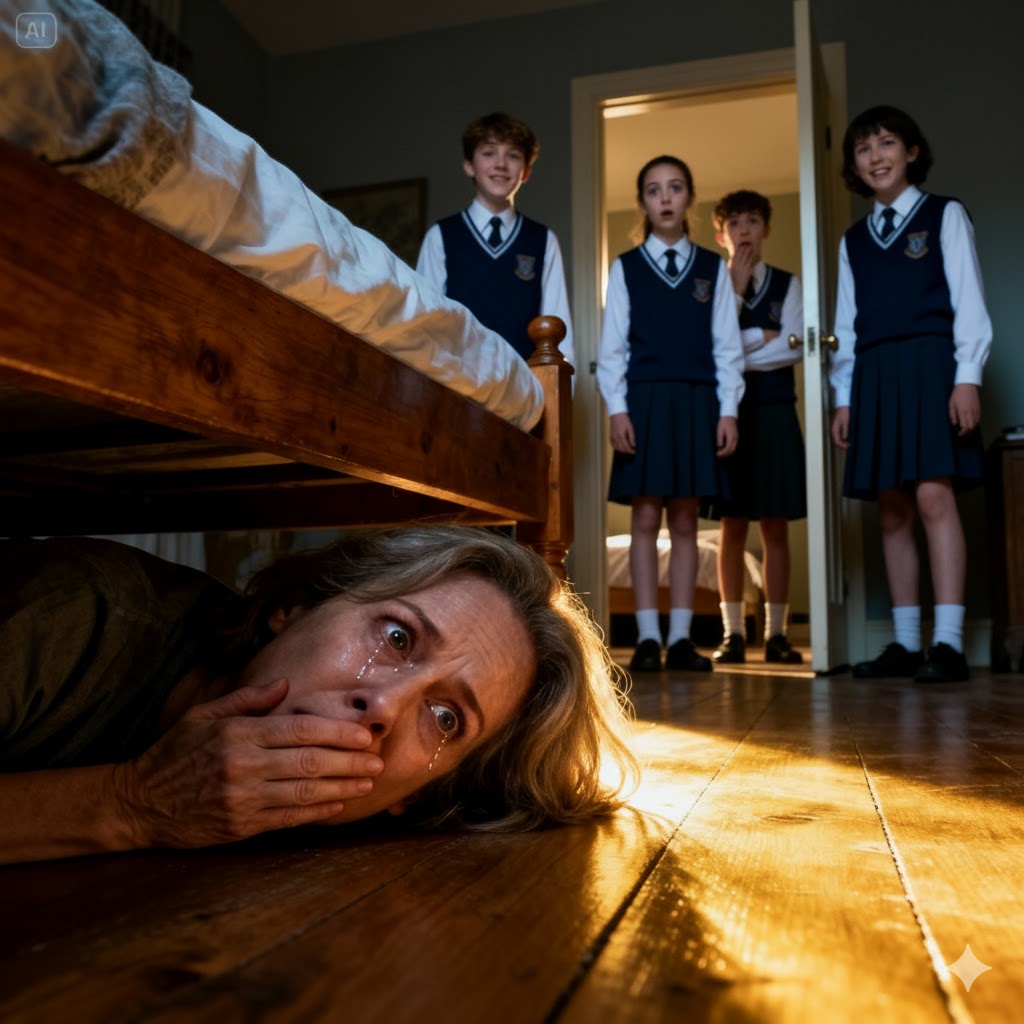
Fifteen minutes later, I drove down the street, parked behind a hedge, and quietly walked back home. My heart pounded as I slipped inside, locked the door, and went straight to Lily’s room.
It was spotless. Bed made perfectly. Desk neatly arranged.
If she was secretly coming home, she wouldn’t expect me here.
I lowered myself to the floor and crawled under the bed.
The space was cramped and dusty, the darkness pressing in. My breathing sounded loud in my ears. I silenced my phone and waited.
9:00 a.m. Nothing.
9:20 a.m. Still nothing. My legs went numb. Had I imagined it all?
Then—
Click.
The front door opened.
My body went rigid.
Footsteps.
Not one set—several. Light, hurried, whispering footsteps. Children trying not to be heard.
I held my breath.
“Shh, be quiet,” someone whispered.
Lily’s voice.
She was home.
She wasn’t alone.
And whatever was happening downstairs, I was about to learn the truth.
From beneath the bed, I listened as the footsteps moved through the hallway. Soft voices—three, maybe four children.
“Sit in the living room,” Lily said quietly. “I’ll get water.”
A trembling voice replied, “Thank you.”
That voice didn’t sound rebellious.
It sounded terrified.
I wanted to rush downstairs, but I forced myself to stay hidden. I needed to understand.
A boy whispered, “My dad yelled at me again this morning.”
A girl sniffled. “Someone pushed me yesterday. I almost fell down the stairs.”
Another voice broke into sobs. “They dumped my lunch tray. Everyone laughed.”
My stomach twisted. These children weren’t skipping school for fun.
They were running from something.
“You’re safe here,” Lily said softly. “Mom works until five. Mrs. Greene leaves around noon. No one will bother us.”
Tears filled my eyes. My daughter had been carrying this alone.
A boy asked quietly, “Lily… don’t you want to tell your mom?”
Silence followed—heavy, heartbreaking.
Finally, Lily whispered, “I can’t. When I was bullied before, Mom fought for me. She cried every day. I don’t want to hurt her again.”
I covered my mouth to stifle a sob.
“I just want Mom to be happy,” Lily said. “So I’m handling it myself.”
Another child spoke softly. “If it weren’t for you, I’d have nowhere to go.”
“We survive together,” Lily replied.
That was it.
I crawled out from under the bed.
The stairs creaked. Voices below fell silent.
I stepped into the living room.
Four frightened children huddled together—and Lily, staring at me in shock.
“Mom?” she whispered. “It’s not what you think.”
“I heard everything,” I said, tears falling.
She collapsed into my arms. “I didn’t want you to worry.”
“You never have to hide your pain from me,” I whispered.
The children stood frozen. I knelt in front of them.
“You’re safe here.”
They told me everything—bullying, threats, teachers who looked away, a principal who silenced reports to protect statistics.
Lily showed me the evidence: messages, photos, videos, ignored emails.
One teacher—Ms. Chloe Reynolds—had tried to help. She’d risked her job.
That day, I called every parent.
We went public.
Within a week, the truth exploded. News crews. Investigations. Testimonies.
The principal was fired. Teachers were suspended. Policies changed. Ms. Reynolds was promoted.
And the children were finally safe.
Six months later, Lily smiled again.
One night, she whispered, “Mom… real strength isn’t hiding pain. It’s sharing it.”
I hugged her tightly.
“And we’re stronger together.”
For the first time in a long time, our home felt safe again.
Because this time—
we didn’t fight alone.