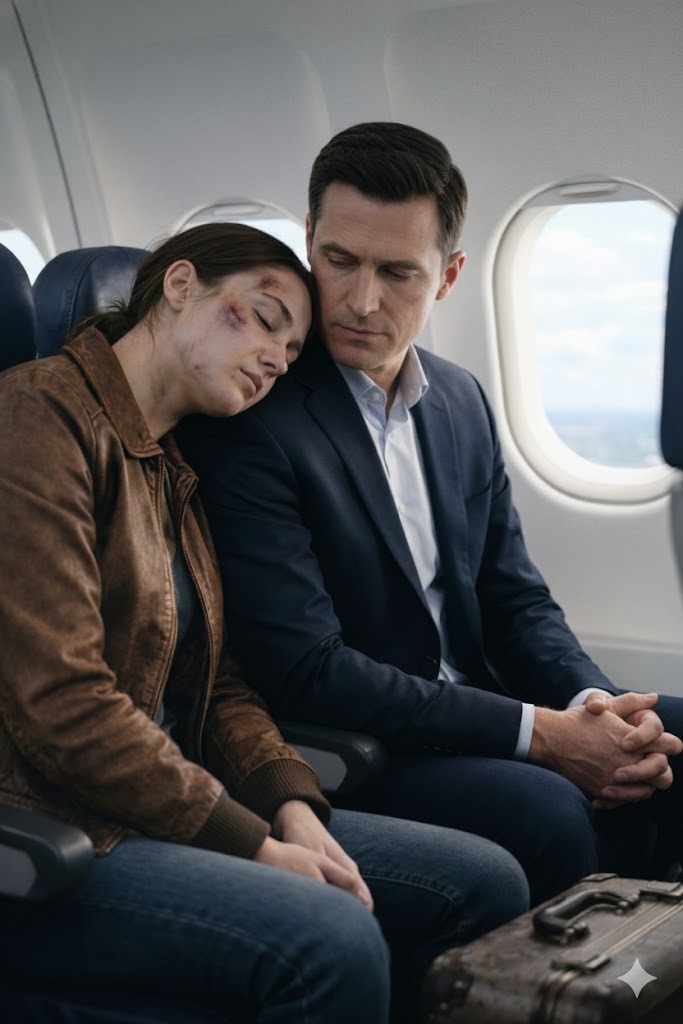
She fled her abusive marriage and boarded a plane, unaware that the man sliding into the seat beside her wasn’t just a stranger—but a powerful mafia boss, setting the stage for a dangerous and unexpected encounter.
It had taken Isabella Trent six months to plan her escape. Six months of pretending, of smiling through bruises no one would see, of counting every coin, every heartbeat, every second as if survival depended on it. Time had become both her enemy and her ally—ticking loudly within the walls of a mansion that looked like paradise but felt like a cage.
Her husband, Damian Voss, was admired by the world: billionaire, philanthropist, flawless smile, impeccable reputation. But behind closed doors, he was a storm. The first months had felt like a fairy tale—silk sheets, champagne, whispered apologies—but soon the truth revealed itself. The castle was a cage, every apology coming only after a blow, every “I love you” a warning in disguise.
By 4:15 a.m. on a frigid November morning, Isabella slipped from the bed that had become her prison. Her body ached from the previous night’s struggle; bruises throbbed deep purple reminders of her fragility. Yet her heart, for the first time in years, pulsed with hope.
She moved quietly, gathering essentials: a worn leather purse with hidden cash, a passport tucked into a cookbook, a small backpack. No luxury bags. No jewelry. Just survival. The grand piano downstairs seemed to watch her, a silent audience of ghosts and memories. She stepped into the night and felt, for the first time in years, what freedom might look like.
Through darkened city streets, she hailed a cab with a secondhand phone, muttering the first lie a survivor learns to tell: “I’m just visiting a friend.” By dawn, she stood at the airport, ticket in hand, the metallic hum of planes vibrating through her chest. The boarding call for Flight 732 sounded like both a promise and a dare.
When she settled into seat 12D, a man slid into the seat beside her. Tall, impeccably dressed in black, with eyes dark as the midnight ocean, he radiated authority without demanding it. She studied him briefly. He didn’t speak or glance her way, only scanned the cabin with quiet precision, as if he could read every thought around him.
The plane hit turbulence. Isabella flinched. Her sweater slipped slightly, revealing the constellation of bruises across her shoulder. The man beside her finally spoke.
“Are you all right?” His voice was low, even, careful—the kind of calm that made her want to trust him without knowing why.
“I’m fine,” she said automatically. A lie. Her eyes told the truth.
He shifted slightly, giving her space without intruding. “If you want, you can rest. It helps.”
Rest. The word felt foreign. She hadn’t slept freely in years. Slowly, cautiously, she leaned back. He did not move. He did not speak. And for the first time in what felt like a lifetime, she slept.
When she awoke, sunlight poured into the cabin. He was reading quietly.
“I’m sorry,” she whispered, embarrassed.
“No apology necessary,” he replied. After a pause, he added, “I’m Adrian Moretti.”
“Isabella,” she answered, hesitating. “Nice to meet you.”
He had a way of making the ordinary feel extraordinary. Every glance, every gesture was precise but effortless. He noticed the small things—the attentive compliment to a flight attendant, the subtle way he adjusted to turbulence. Slowly, she realized: he noticed everything.
Later, he asked gently, “Are you running toward someone… or away from someone?”
Isabella froze. The truth burned in her throat, but she said nothing. He didn’t press. He only asked quietly, “Do you have a safe place to land?”
“I… have a hotel for two nights. After that, mornings are mine,” she admitted, voice trembling.
“Good,” he said simply. “Mornings are a start.”
By the time the plane landed, he handed her a matte black card with only one word embossed: ADRIAN, and a number. “If you ever feel unsafe,” he said, “call me. Or don’t. Your choice.”
At baggage claim, two men in dark suits scanned faces. Isabella’s heart raced. Adrian stepped between her and them casually, a shield of confidence.
“Friends of yours?” he murmured.
“No. His men,” she whispered.
He snapped a discreet photo and muttered something in Italian. It sounded like a promise. Minutes later, a black sedan whisked them away.
“You want help?” he asked.
“Yes. But I want my life back, not just safety,” she said.
“That’s the plan,” he replied.
That night, Isabella found herself in a secure penthouse with a view of the city. A doctor treated her bruises while Adrian remained silent by the window, a sentinel in the shadows.
“Why are you helping me?” she asked.
“Because someone once helped my sister when I couldn’t,” he replied softly.
Days became weeks. Bruises healed, but nightmares lingered. Adrian was always present, never demanding, never touching—his presence alone spoke safety. Then came the news: Damian had filed a missing person report and offered a reward. He was hunting her.
“Running feeds fear,” Adrian said firmly. “We need him to believe you’ve disappeared.”
Adrian’s team worked silently. Bank accounts, hidden files, secret recordings—every lie Damian thought buried surfaced. Investors pulled out. News outlets whispered. And one morning, headlines screamed:
“Billionaire Damian Voss Accused of Domestic Abuse and Fraud.”
Justice unfolded without chaos. When Adrian handed her a flash drive with all the evidence, he said, “It’s time your voice mattered.”
Isabella went public. In a hotel lobby filled with cameras, Damian waited, smirking. Adrian stepped forward.
“She’s not going anywhere with you,” he said. “You laid hands on her. That makes you my business.”
Damian’s men reached for weapons. Adrian’s team was faster. Every lie Damian had built crumbled in real time. Police sirens blared. Damian was taken away, powerless.
That night, rain fell, but Isabella didn’t run. She stood on the balcony with Adrian, breathing freely for the first time.
“You did it,” he said softly.
“No,” she replied, tears glimmering. “We did.”
Weeks later, she rebuilt her life, spoke publicly, founded a shelter for survivors, and reclaimed her name. Adrian faded into the background—some said he returned to Italy; others, that he watched silently, ensuring monsters no longer hunted her.
Finally, at a charity gala, she stood under the lights. A familiar voice whispered:
“You still burn the toast when you cook.”
She turned. Adrian, in black, eyes quiet yet fiery.
“I told you,” he said, stepping closer. “I don’t run from light. I make sure monsters are gone first.”
“Then stay,” she said, heart full.
“If I stay, I stay for good,” he replied.
For the first time, Isabella counted blessings, not bruises. She had survived, reclaimed her life, and discovered that sometimes, the right stranger becomes the shield you never knew you needed.