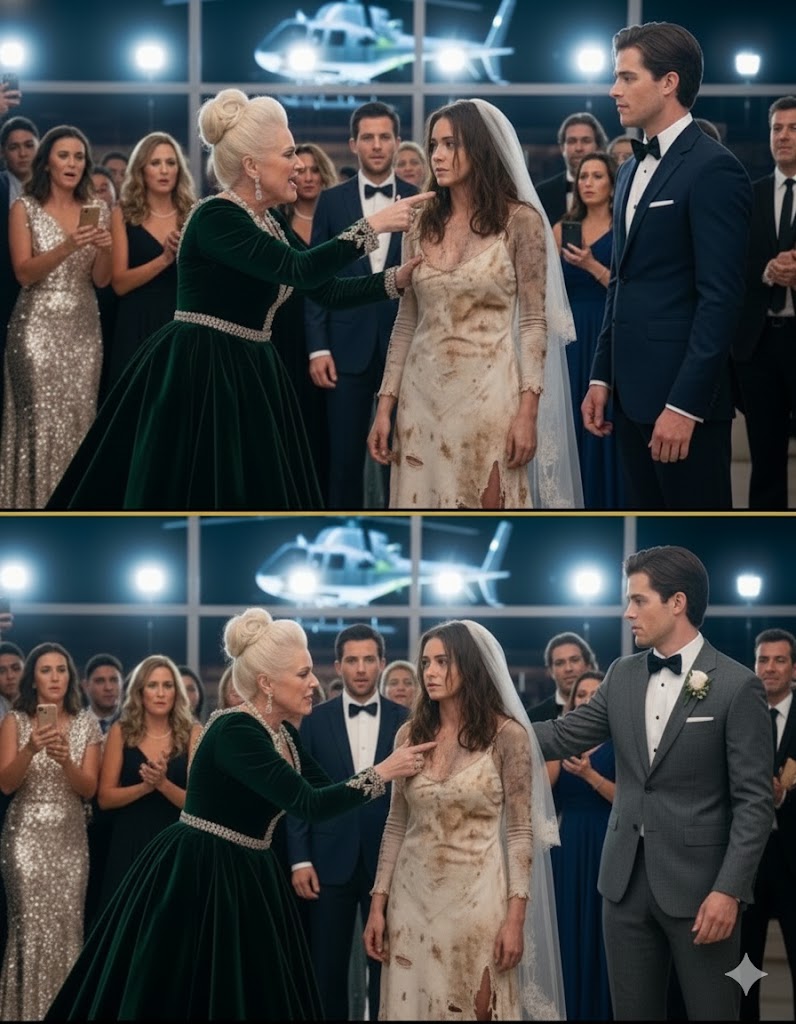
On the drive to the hotel, Brandon filled the car with nervous chatter.
“My mom is… particular,” he said.
“That’s a word,” I replied.
He laughed, awkward. “She’s intense. Likes things a certain way.”
“And your dad?”
“Traditional. Serious. But fair.”
“And your sister Natasha?” Brandon hesitated. “She can be… a lot. But she means well.”
Brace yourself. That’s what every one of those phrases translated to.
By the time we arrived at the Grand View Hotel, my stomach was doing somersaults.
The ballroom glittered with crystal chandeliers, white linens, and gold accents. Hundreds of guests shimmered like an Instagram feed come to life.
Women in gowns that could fund a semester of college. Men in watches that could buy a car.
And there was me, in my $39 dress, trying to look like I belonged.
The stares began immediately. Small, sharp, and persistent. Brandon squeezed my hand—not comforting, more like anchoring me to him so I wouldn’t float into embarrassment.
Then I saw her.
Clarissa Hayes.
Brandon’s mother, a vision of deep purple silk and diamonds that seemed to challenge the chandeliers for attention. Her smile for Brandon was warm; for me, it froze.
She approached with measured steps. Each heel click was a countdown.
“Brandon, darling,” she said, kissing his cheek, then turned her eyes on me.
“And who,” she asked, voice flat as a verdict, “is this?”
“Mom,” Brandon said too quickly. “This is Emma. My girlfriend. Emma, this is my mother, Clarissa.”
I extended my hand. “It’s wonderful to meet you, Mrs. Hayes. Brandon has told me so much about you.”
Clarissa looked at my hand like I had offered her a wet napkin. She didn’t shake it.
“Has he?” she said, her eyes dropping to my dress. “How… interesting.”
The air tightened. People leaned in without moving.
“Brandon,” she said, loud enough for the room to hear, “did you not tell her this was a formal event?”
“I did,” he said, jaw tight.
She tilted her head, predatory. “Then why,” she said slowly, “does she look like she dressed in the dark… at a thrift store?”
A few polite laughs, just enough to sharpen the humiliation.
I kept my smile. “Oh, I knew it was formal,” I said. “This is actually one of my favorite dresses.”
Clarissa’s eyes widened. “Your favorite?” she repeated, like I had confessed a crime.
Then Natasha appeared, young, beautiful, and trained from birth to judge.
“Brandon,” she said, loud and theatrical, “please tell me this is a prank. Did you bring a charity case to Mom’s party?”
The crowd turned. Phones raised. Attention shifted. Entertainment was live.
“Natasha,” Brandon said, forcing a laugh. “Stop.”
Clarissa leaned in. “You thought bringing someone like this was appropriate?” Her hand gestured toward me. “She’s not one of us.”
Not one of us. Like being wealthy was a species.
I drew a steady breath. “With all due respect, Mrs. Hayes, wealth doesn’t define a person.”
Clarissa laughed—sharp, cruel. “Darling, you’re clearly poor as dirt. I can smell desperation on you.”
Natasha circled me like inspecting a product. “That dress? Thirty bucks?”
“And those shoes,” a cousin added, “discount store?”
Laughter built. Phones filmed. The room’s delight in my humiliation was palpable.
Clarissa stepped closer. “Listen here. I know exactly what you are. A nobody. A nothing. Some poor girl who saw an opportunity. My son deserves someone with class. Breeding. Education. Someone who belongs in our world.”
Then she slapped me.
A sharp pop that silenced the ballroom.
Heat exploded across my cheek. The world tilted. I touched my face. Tears blurred the chandeliers into stars. Brandon stared at the floor. Not me. Not her. The floor.
Natasha yanked my dress. It tore. Laughter followed, but this time, the humiliation felt permanent.
“Security!” Clarissa barked. “Remove this trash from my party!”
I looked at Brandon one last time. He looked away.
Then the sound began: a low thrum, growing louder. The chandeliers shook. Glass rattled. The crowd turned.
A helicopter landed on the rooftop helipad.
And my father walked in.
William Harrison. Tall, silver-haired, built like a man who’d never been denied. Authority in a suit. Four bodyguards flanked him.
Every head turned. Phones captured him instantly.
He locked eyes on me. Saw my cheek, my torn dress, my hands clutching dignity. He draped his jacket over me.
“Are you all right, sweetheart?” he asked quietly.
I shook my head.
“Dad,” I whispered. “I’m sorry.”
“You have nothing to apologize for,” he said firmly.
He turned to the room. Clarissa, frozen.
“You,” he said, voice thunderous yet calm, “slapped my daughter.”
Knees buckled. Gasps. Phones shook.
“You only treat people with respect when you know their name has value,” he said.
I stepped forward. “I came tonight as just Emma. Not Emma Harrison. Not a billionaire’s daughter. Just me. A normal girl who wanted to be judged for her character, not her bank account.”
Brandon tried to speak. “Emma, I…”
“You stood there,” I said, voice cracking, “while they tore me apart. You said nothing.”
“I didn’t know,” he whispered.
I nodded. “And there it is. You’re sorry because of who I am, not because of what they did.”
My father pulled out his phone. “Howard, pull every Harrison Technology investment from Hayes Real Estate. Immediately.”
Kenneth Hayes panicked. “No! You can’t—”
“Check your records,” my father said. “We own thirty-five percent. Effective immediately. You should have thought of that before assaulting my daughter.”
Clarissa fell to her knees. Natasha sobbed. Phones recorded everything, but the laughter was gone.
I spoke softly. “Mrs. Hayes, the worst part isn’t the slap or the dress. It’s that you didn’t see me as human until you knew my last name.”
My father’s hand rested on my shoulder. “Come on. Let’s go home.”
We walked out. The crowd parted silently.
Brandon called after me. “Emma! Please! I love you!”
I didn’t turn immediately. Then, calm, I said, “You don’t love me. You love what you think I can give you.”
The helicopter hummed above. The night felt alive with lessons.
Three months later, I hosted a charity event for homeless families. Tyler, a volunteer with paint on his jeans and kindness in his eyes, didn’t care about my name or my past. He simply saw me.
And I realized: dignity doesn’t need diamonds, helicopters, or billion-dollar names.
It only needs a spine—and a heart that refuses to become cruel because the world was cruel first.