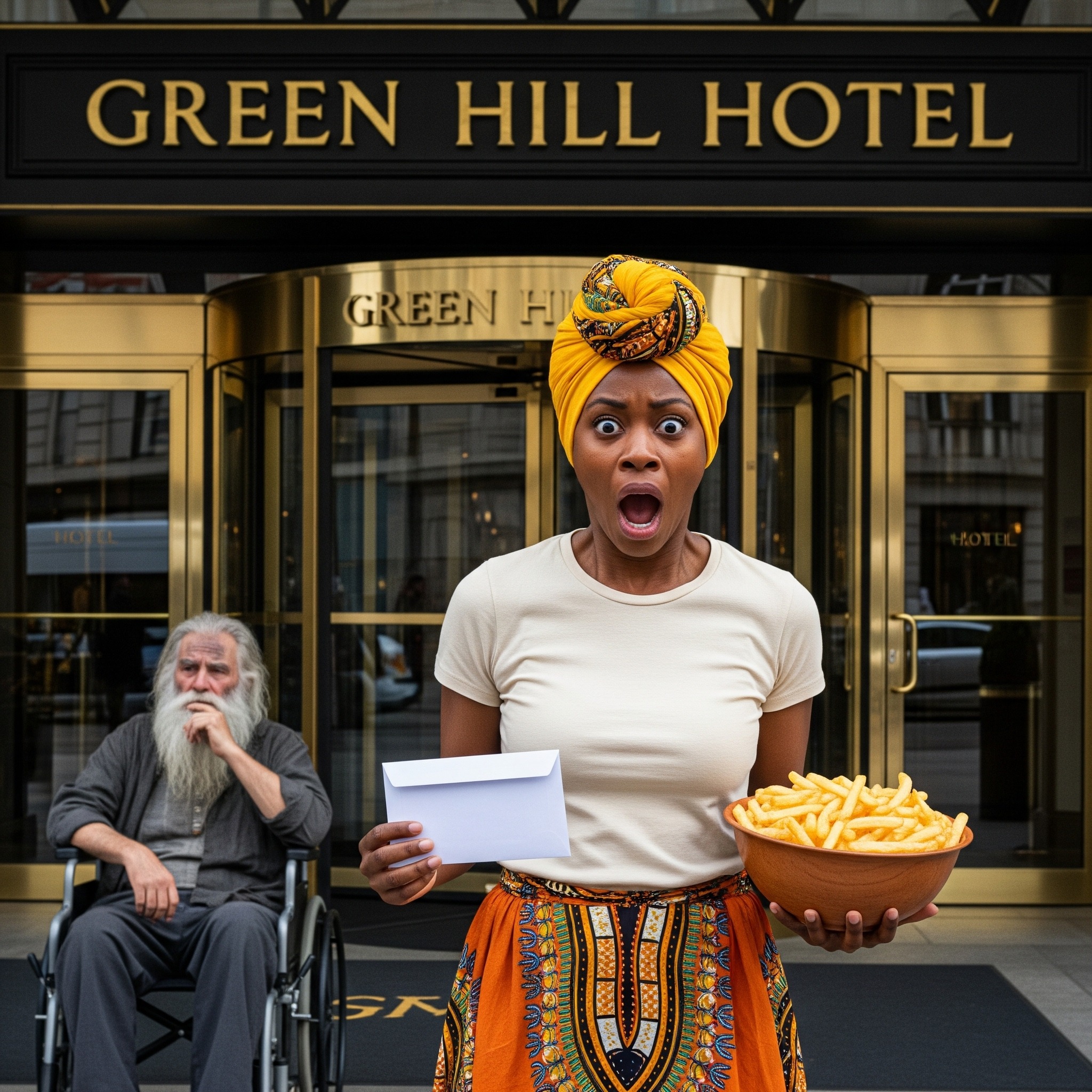
The Green Hill Hotel towered above the city like a monument to wealth and power. Its marble steps glittered under the morning sun as businessmen and tourists streamed in and out, never glancing twice at the man who sat just outside.
He was always there. Slumped in an old wheelchair, wrapped in rags, his beard wild, his skin darkened by the unforgiving sun. He never begged, never spoke, never moved much. People called him Mute Moses. To most, he was invisible — just another ghost of poverty on the city streets.
But not to Aisha.
Every day after selling her fried cassava balls at the market corner, Aisha would set one aside for him. She had little enough to live on herself, but something about the stillness in his eyes made her stop. Unlike the others who mocked, she didn’t see a beggar. She saw a human being.
“Here you go,” she whispered one morning, pressing the warm food into his hand. “I saved you the best one today.”
He didn’t reply, of course. Just nodded faintly, eyes tired yet strangely alive.
Her neighbors laughed at her behind her back.
“You’re wasting food on a man who doesn’t even thank you.”
“You can barely feed yourself, Aisha. Stop playing saint.”
But she kept feeding him. Something deep inside told her his silence wasn’t madness — it was grief, maybe even dignity. He was waiting for something.
Then one morning, everything changed.
When Aisha approached her usual spot outside the hotel, the man wasn’t staring at the ground. He was holding something — a white envelope.
He raised it toward her. His hands trembled but his gaze was steady. He tapped the envelope twice against his chest, then let it fall into her hands.
On the front were words written in careful handwriting:
“To the girl who fed me when no one else would.”
Aisha froze, her heart pounding. She looked up, but his gaze had drifted away again, distant, final — as if he had been waiting only for this moment.
Clutching the envelope, she ran home to her tiny shack. She tore it open with shaking fingers.
Inside was a letter that would upend her entire life.
Aisha barely slept that night. The letter from Harun lay on her wooden table like a spark of lightning that had struck her modest life. Could it be true? The ragged man outside the hotel — once the head of Okoye Holdings, a name she vaguely remembered from radio news years ago?
The letter explained everything. Harun had been betrayed by his younger brother, who staged an accident, bribed doctors, and declared him mentally unfit to lead. His fortune was seized, his reputation destroyed, and the world forgot him. Left in a wheelchair, discarded like trash, he chose silence.
But her daily kindness had kept him alive. He wrote that her food — simple fried cassava — gave him more dignity than the riches he had lost. “You reminded me I was still human,” the letter said. “And tomorrow, everything changes. Meet me at Green Hill Hotel at noon.”
The next day, Aisha’s heart raced as she approached the hotel. Outside stood a black SUV. Reporters lingered near the entrance. She stopped dead in her tracks when she saw him.
Not in rags. Not broken.
Harun sat in a sleek new wheelchair, dressed in a tailored suit, his beard trimmed, posture strong. He looked transformed — yet his eyes were still the same. When he saw her, he smiled, the first true smile she had ever seen on his face.
“Aisha,” he said.
Her breath caught. It was the first time she had heard his voice.
“You came.”
Before she could respond, he gestured for silence. Reporters turned their cameras on him as his lawyer stood nearby.
“Ladies and gentlemen,” Harun announced firmly, “today I reclaim my name. But I will not stand here alone. I must acknowledge the woman who saved me when I was nothing.”
He opened a folder and revealed legal documents.
“This is a signed transfer of ten percent of Okoye Holdings to Miss Aisha Kamara. From today, she is my partner. When I had nothing, she gave me food, dignity, and hope. And that is worth more than gold.”
Gasps rippled through the crowd. Cameras flashed. Aisha stood frozen, unable to breathe.
“W-what?” she whispered. “I can’t accept this.”
But Harun only looked at her gently. “You gave when you had nothing. And now, I give back because of everything you gave.”
The days that followed were a whirlwind. News headlines screamed:
“Street Vendor Becomes Business Partner After Saving Disgraced Tycoon”
“Harun Okoye Reclaims Empire — Honors Woman Who Fed Him in Poverty”
Aisha’s name was everywhere. Strangers recognized her on the street. Children called her “Auntie Aisha the Angel.” But inside, she remained the same woman who once gave her last cassava ball to a silent man.
Harun’s empire quickly rebuilt. His brother’s betrayal was exposed, and the company’s board restored him as CEO. Yet, when people asked what fueled his comeback, he only said one thing: “Kindness. Aisha’s kindness saved me.”
But Aisha had no interest in wealth or fame. When Harun asked what she wanted to do with her shares, she answered without hesitation.
“I want to build a shelter. For people like you — people who’ve fallen, but are still human.”
Harun’s eyes softened. “Then we’ll build it. Together.”
Months later, they stood side by side at the opening of the Kamara-Okoye Foundation. Behind them stretched a shelter with clean beds, warm food, and open doors for anyone in need. Reporters captured the moment, but Harun ignored the cameras. He looked only at Aisha.
“You gave me back my life,” he said quietly. “Now we give others the same.”
Aisha smiled, her heart swelling. For the first time, she truly believed her mother’s words: “Kindness always returns, even if it takes years.”
That night, as city lights glittered, Harun wheeled himself onto the rooftop garden of his office building. Aisha stood beside him. They looked out at the skyline not as billionaire and street vendor, not as savior and saved — but as two souls bound by fate.
And in that silence, they both understood.
The greatest fortune was not in money or power.
It was in the simple act of seeing another human being — and choosing kindness.