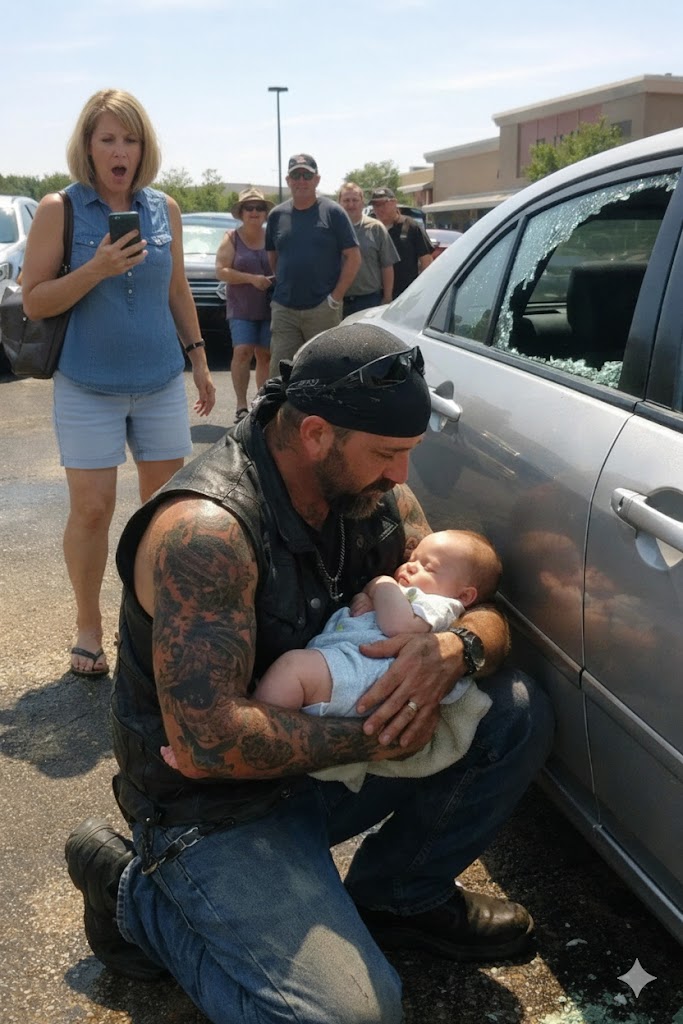
“Step Back. Move Away from the Vehicle.” — I Called the Police on a Tattooed Biker, Not Realizing He Was Saving a Baby
That afternoon, the heat felt oppressive, like the city itself was holding its breath. The Sunridge Mall parking lot shimmered beneath the Arizona sun, rows of cars sealed tight and baking quietly while shoppers hurried toward the entrances, arms loaded with bags, thoughts already drifting elsewhere. My dashboard flashed 103°F as I shut off the engine, and for a moment I just sat there, listening to the air conditioner die, wondering how something invisible could feel so crushing.
I had just lifted the trunk when the sound cut through everything—deep, rumbling, unmistakable.
A motorcycle.
The engine’s growl sliced through the stillness, rough and uneven, forcing conversations to stall and heads to turn almost in unison. From the far end of the lot, a large cruiser rolled in at an unhurried pace, chrome flaring under the sun. The rider was impossible to miss: tall, broad, shoulders set beneath a worn leather vest. Tattoos wrapped his arms, not decorative but deliberate, like a life written directly onto skin. Silver threaded through his beard, and every movement carried the calm confidence of someone who no longer needed to explain himself.
In that moment, I didn’t see a person.
I saw a biker.
Later I would learn his name was Thomas “Tom” Ridley. Right then, he was nothing more than a stereotype my mind filled in without permission.
Tom parked beside a spotless white Mercedes SUV that looked almost too pristine for the sun-faded lot. He killed the engine, the sudden quiet startling, then reached into a side compartment and pulled out a long metal bar.
A tire iron.
My chest tightened.
Before reason could catch up, he swung.
Glass shattered with a sharp, violent crack, spraying fragments across the pavement. Someone screamed. Another voice shouted for security. My hands were already shaking as I pulled out my phone.
“There’s a man smashing a car,” I rushed into the dispatcher. “He’s armed. I think he’s stealing it.”
As I spoke, Tom leaned through the broken driver-side window, his upper body disappearing inside. Every assumption I’d ever absorbed without question rushed forward at once—dangerous, reckless, criminal.
Then he straightened.
And he wasn’t holding anything I expected.
It was a baby.
She couldn’t have been more than a year old, her small body limp against his chest, skin flushed an alarming red, lips dry and parted. Time seemed to pause. The entire parking lot went still as reality struggled to catch up.
Tom didn’t hesitate.
He turned and moved fast—far faster than his size suggested—heading toward a shallow decorative fountain near the mall entrance. He knelt, placing his body between the child and the sun, lowering her into the narrow strip of shade cast by the stone ledge. His tattooed hands, rough and scarred, became astonishingly gentle as he cooled them in the water and pressed it carefully against her arms, her neck, her forehead.
“She’s overheated,” he said, voice calm but urgent. “Locked in too long.”
I dropped my phone and ran toward them, my pulse roaring in my ears.
“She’s breathing,” he added, more to himself than to me. “Shallow, but she’s breathing.”
Up close, I noticed details I’d missed before—how he angled her head to keep her airway open, how he avoided soaking her clothes all at once, how he spoke to her in a steady murmur, like a lifeline pulling her back.
“You’re okay, sweetheart,” he whispered. “Stay with me.”
“I—I called the police,” I said, barely able to hear my own voice.
“That’s fine,” he replied without looking up. “Did you call an ambulance?”
“Yes.”
“Good.”
Only then did he glance at me. His eyes were steady, focused, not defensive.
“I’m Tom,” he said. “Retired fire captain. Thirty-five years. Heat calls were… common.”
Sirens wailed in the distance.
A crowd gathered around us—people filming, people staring, all of us suddenly aware of how wrong we’d been moments earlier.
Then a sharp voice cut through the tension.
“My car—what did you do to my car?”
A woman pushed forward, designer sunglasses perched on her head, shopping bags slipping from her hands as she saw the shattered window.
“Are you insane?” she shouted. “Do you know how much that car costs?”
Tom looked up slowly, still cradling the child.
“Ma’am,” he said evenly, “your baby was locked inside a sealed vehicle in extreme heat.”
“I was only gone for a minute,” she snapped. “She was fine.”
“The engine’s cold,” Tom replied, nodding toward the SUV. “And one minute would’ve been enough.”
Her anger faltered as paramedics arrived and gently took the baby—later identified as Lily—from his arms. One of them met Tom’s eyes and nodded.
“You saved her,” he said quietly.
Police questioned witnesses, spoke to Tom, then to the woman, whose voice shrank with every answer. No charges were filed. The broken window became irrelevant compared to the life that had been spared.
I lingered as Tom brushed glass dust from his hands and slid the tire iron back onto his bike, as if this were just another task completed.
“I’m sorry,” I said before he left. “I judged you.”
He gave a small, knowing smile.
“We all do,” he said. “What matters is what we do after.”
The story spread fast—videos, comments, context filling in the gaps. People learned Tom wasn’t just a biker, but a volunteer, a mentor, a man who had quietly spent decades saving lives.
Months later, I saw him again at a child safety event. Lily was there too, laughing in her grandmother’s arms, unaware of how close she’d come to being a memory instead of a miracle.
Tom nodded at me.
“Still learning,” he said.
And I understood then that the shattered glass in that parking lot had broken more than a window.
It cracked open a reminder:
Courage doesn’t always wear a uniform.
Danger doesn’t always look dangerous.
And sometimes, the people we judge first are the ones holding everything together when it’s about to fall apart.