Everett Langston felt it before he could process it—a sharp constriction in his chest, a weight in his throat that made the air feel thin, heavy, as if the room itself questioned whether he still deserved to breathe.
“She lives there,” said Caleb Monroe, his private investigator, voice measured, calm, but carrying the force of detonation. “The house is in Brookhaven. Market value: roughly two-point-four million dollars. Registered to Marissa Cole. She lives there with her two sons. Both in private academies. Both driving cars worth more than most people’s annual income.”
Everett didn’t respond. His eyes fixed on the photograph on his desk, a simple print that felt heavier than any contract he had ever signed, heavier than every acquisition that built his empire.
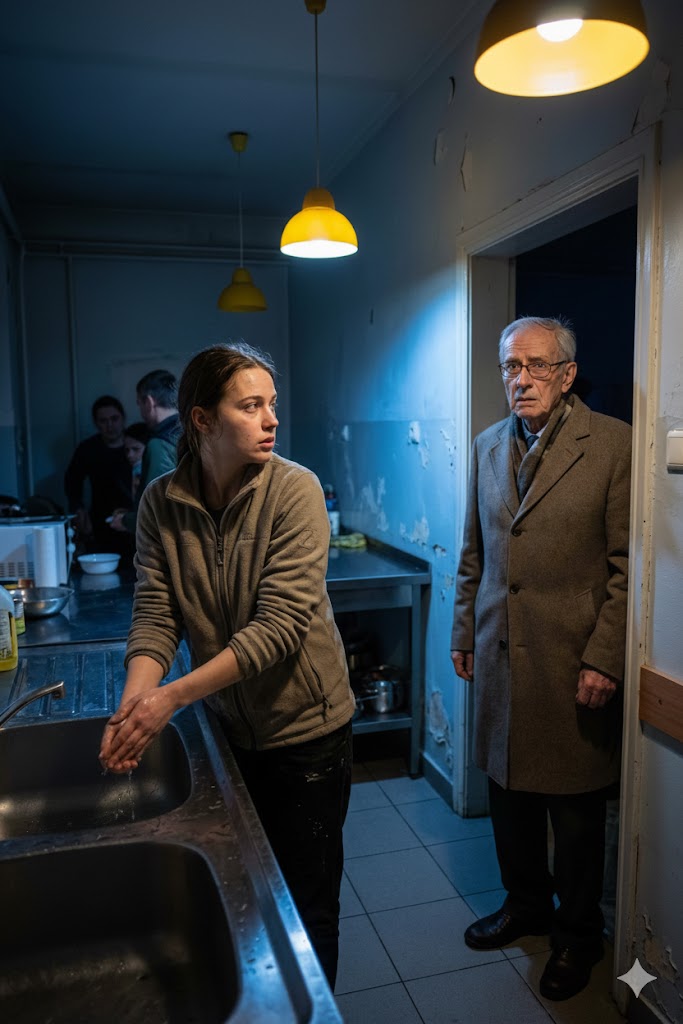
A young woman stood at an industrial sink, sleeves rolled up, hands submerged in cloudy dishwater, posture quiet, contained—as if she’d learned long ago not to take up space.
“And my granddaughter?” Everett asked, though it was a ritual, a formality his body demanded even as instincts screamed the truth.
Caleb hesitated, not theatrically, but with reverence. “Elara Langston. She’s been at Haven Row Shelter on the South Side for four months. Before that, a condemned apartment near West Fulton. No lease. No utilities. Her guardian left shortly after her eighteenth birthday.”
The room didn’t spin. Everett almost wished it would. Clarity this sharp was harder to endure than confusion.
For eighteen years, he had believed he was doing the right thing. Every month, ten thousand dollars transferred into her account—over two million in total. Not charity. Not a gift. A promise.
And now she was sleeping on a metal cot.
Everett pushed back his chair with a force that rattled the wall. His assistant appeared, concern etched on her face, but he didn’t look.
“Clear my schedule. Cancel everything.”
Caleb was already moving, coat in hand, accustomed to these reactions.
The city passed like a film reel—glass towers giving way to brick, then streets heavy with quiet exhaustion. Everett had built neighborhoods, cut ribbons, staged press events—but somehow this part of the city had never intersected with his vision.
“Haven Row used to be a church,” Caleb said softly. “Director’s name: Mrs. Okafor.”
Everett nodded, though his mind wandered back—hospital rooms, antiseptic and panic, the first time he imagined a child he could barely reach.
His daughter, Amara Langston, had been his light: laughter that disarmed strangers, conviction that children deserved dignity. She married Daniel Cole, a counselor who believed troubled teens weren’t broken, just unheard.
Daniel died six months before Amara gave birth. Three months later, Amara followed, hemorrhaging during childbirth while nurses carried away her newborn.
Everett stood hollow, too old, too unmoored for what lay ahead.
Then Marissa arrived—Daniel’s sister. Calm, efficient, persuasive. “I’ll raise her as my own,” she said. “She’ll have siblings, stability. You stay focused on work.”
Everett agreed, grief making him pliable, a man surrendered to expedience.
Haven Row smelled of disinfectant and soup. Walls were decorated with children’s drawings taped with care, bright attempts against fatigue. Everett felt exposed in his tailored coat, as though the building knew he didn’t belong.
“Who are you looking for?” asked Mrs. Okafor, steady, unflinching.
“My granddaughter. Elara Langston.”
Recognition flickered across her face—not surprise, but guarded understanding. “She’s helping in the kitchen.”
They found Elara washing dishes. Up close, Everett saw the resemblance to Amara, the quiet determination—but also the damage money could not reach: the way she startled at movement, the constant measurement of exits.
When Mrs. Okafor spoke her name, she turned, confusion giving way to caution.
Everett introduced himself, each word weighted with years of absence.
“You’re lying,” she whispered. “My aunt said my grandfather wanted nothing to do with me.”
The lie landed like a confession of guilt.
Everett showed her the records. Every deposit, every month. Her hands trembled.
“Then why was I hungry?” she asked. “Why did she throw me out?”
He had no defense. Truth, delayed, is a cruelty of its own.
He took her home that night. But trust did not arrive with wealth. Elara flinched at kindness, apologized for existing, ate like her next meal was uncertain. Safety had to be learned, not purchased.
A week later, forensic accountants uncovered the full scope. Marissa had not merely stolen the trust fund. She had taken out loans against it, leveraged it, falsified educational records, avoided medical care that could leave a paper trail.
It wasn’t greed—it was deliberate erasure.
When confronted, Marissa blamed, snarling, “She was never meant to have all that. She already took my brother from me.”
Courts did not forgive. She was convicted of embezzlement, fraud, identity theft, and child neglect. Every asset tied to Elara’s stolen childhood was seized.
Elara didn’t celebrate. She volunteered, studied social work, returned to Haven Row not as a resident, but as a bridge.
On the day Everett watched her hand acceptance letters to other girls who carried their lives in backpacks, he understood something fundamental:
Money builds structures. Presence builds foundations.
Lesson of the Story
Wealth without engagement is absence disguised as generosity. Trust without accountability invites harm. Love, when outsourced, can be stolen.
True care requires presence, vigilance, and the courage to ask hard questions before it’s too late.
Money can protect a future—but only people can show up for it.