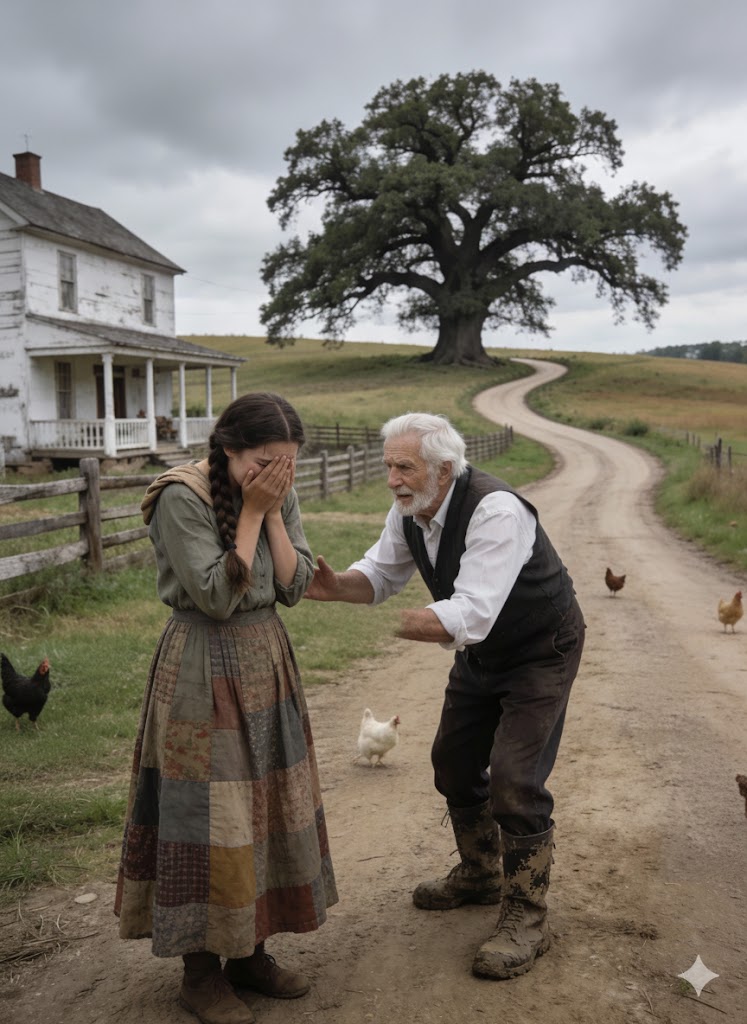
The old farmer said, “I have three months left—marry me, and everything will be yours.”
Her answer stole his breath.
At seventy-three, Don Alejandro Ruiz no longer expected life to surprise him. His days passed with mechanical sameness, echoing through the grand estate where laughter had died sixteen winters ago—when María, his wife, passed away, taking with her the warmth of shared meals, the reason to rise before dawn, even the small habit of whistling down the halls.
Since then, La Esperanza Final—The Final Hope—had lived up to its name: a shelter for a man who still existed but whose heart always lagged one step behind his body.
The town respected him, feared him slightly, and watched him with the curious reverence reserved for men who owned land, history, and silence. He was neither cruel nor warm. He was simply tired—tired of eating alone, talking to portraits, answering only his own thoughts.
Five years earlier, a young woman had arrived at his doorstep, seeking work. She was twenty-four, with eyes that seemed to have cried too soon. Lucía Moreno carried a small bag, a modest dress, and a dignity she clutched as if letting go would make her fall apart. Her father was dead. She had no family left—only need.
Don Alejandro interviewed her in the kitchen. He asked little.
“If you can cook,” he said, “and aren’t afraid of early mornings, you may stay.”
Lucía nodded firmly, like someone signing a pact with survival.
At first, it was purely practical: he needed meals that didn’t taste like dust, she needed shelter. But Lucía did more than cook. She opened long-sealed windows, placed flowers in forgotten vases, and one afternoon, a song slipped from her lips while she swept—and somehow, the house remembered how to listen.
Slowly, Don Alejandro found himself waiting for lunchtime—not for the food, but for her quiet greeting, her casual questions about the weather, the fields, the past. And without noticing, he answered.
The town began to whisper:
“Since the girl arrived, the house has light.”
Not even Don Alejandro understood what kind of light—until the city doctor, the only one with modern equipment and a voice like final judgment, told him the truth: advanced stomach cancer.
“Three months,” the doctor said gently. “Perhaps four, if fortune is kind.”
Don Alejandro left the clinic standing straight, like someone exiting a funeral—whole in body, broken inside. He did not fear death. He feared dying the way he had lived for sixteen years: alone.
That evening, Lucía cooked his favorite stew. She hummed while washing dishes. He watched her as one might watch a landscape for the last time.
“Lucía,” he said when the kitchen fell quiet.
“Yes, Don Alejandro?”
“Sit.”
The word carried weight. She obeyed, fear flickering in her eyes—the fear of those who have little to lose, yet risk everything.
“I have cancer,” he said plainly. “I have three months.”
The plate slipped from her hands and shattered on the floor.
“No,” she whispered. “It can’t be.”
“It is,” he said. “No treatment. Only time.”
She cried openly, deeply.
Then he spoke quickly, before courage abandoned him.
“Marry me.”
Lucía stared, as if he had spoken another language.
“I’m not asking for love,” he continued. “Only company. I have land, this estate… no children. When I die, it will go to a nephew who would sell it in days. If you marry me, it will be yours. Security. A future.”
She swallowed hard.
“And you?” she asked. “What do you gain?”
He looked down, ashamed of his need.
“That someone holds my hand at the end.”
Lucía stood, trembling.
“I need time.”
“I don’t have much,” he said softly.
Three days later, she returned with steady eyes.
“I accept,” she said.
“But not as a contract. If I am your wife—even briefly—I want it to be real.”
Hope—fragile, dangerous—flickered in his chest.
They married quietly in the village church. Lucía wore her mother’s simple white dress. Don Alejandro wore a dark suit meant for mourning. Their kiss was gentle, almost shy.
The town erupted with gossip:
“Gold digger.”
“Desperate old man.”
“She’s waiting for the funeral.”
Lucía heard it all.
Still, they became something real. They shared meals, conversations, plans. When pain struck Don Alejandro one dawn, Lucía held him through it, whispering, I am your wife. I am here.
And that terrified him—because her care felt chosen, not performed.
Then the truth surfaced, as towns always discover truths: Lucía carried heavy debts left by her father. Without payment, she would lose the last house tied to her family.
When Don Alejandro learned, doubt poisoned him.
“Did you marry me for the inheritance?” he asked.
“Yes,” she admitted softly. “I needed money.”
The days turned cold. Silence filled the halls again.
An anonymous letter followed—numbers, accusations, cruel suggestions. When confronted, Lucía answered honestly.
“Yes, men offered to pay my debts.”
“And you refused?”
“Yes.”
“Why?”
“Because they wanted to buy me.”
“And wasn’t I buying you?” he snapped.
Her hand struck his cheek—not in anger, but wounded dignity.
“How dare you,” she whispered.
She left.
Soon after, his health collapsed. The doctor returned with lowered eyes.
“Days,” he said.
That night, Lucía came back.
“I won’t let you die alone,” she said.
Holding his trembling hand, she confessed everything:
“Yes, I needed money. But I stayed because I love you. I fell in love years ago—quietly, shamefully. When you proposed, I chose three months beside you over a lifetime of silence.”
Don Alejandro wept.
“I loved you too,” he confessed. “I was afraid I was stealing your future.”
They forgave. They kissed—not out of time, but exactly on time.
Then the impossible happened.
The tumor shrank.
Months became years. Seven full years.
They remarried, this time with joy. They worked the land together. Lucía paid her debts herself, proudly.
When the cancer returned, there were no miracles left—but there was peace.
Don Alejandro died holding her hand.
Afterward, Lucía stayed. She built schools, a clinic, a fund for families in debt.
When asked why she never remarried, she answered simply:
“I already knew the sun. Why chase shadows?”
And so the town learned—slowly, humbly—that love does not count years or months, but the courage to choose each other when the world says it shouldn’t work.
And that was how a scandal became a lesson.