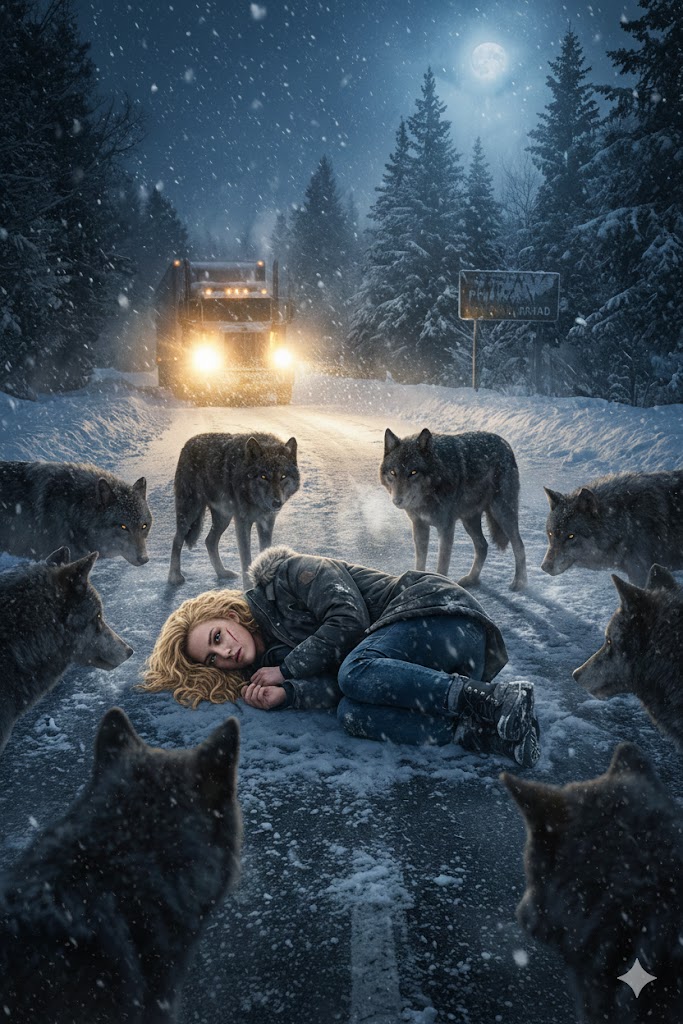
North Hemlock Pass hadn’t seen maintenance in decades. On nights like this, it ceased to be a road, reduced to a narrow ribbon of ice and snow, slicing through the forest like a scar. Towering pines swallowed every sound, creating a silence that wasn’t peaceful—it was watchful, patient, eternal, as though the land itself had learned vigilance long before humans had learned cruelty.
To Caleb Hartman and his companions, that silence felt like victory.
Caleb slammed the truck door, sealing himself from the cutting wind and the broken figure lying yards behind on the frozen gravel. The engine growled beneath his foot, and satisfaction settled in his chest like armor. Raised with money and influence, he had learned early that consequences were for other people.
“She should’ve stayed out of it,” he muttered, adjusting the mirror to avoid the dark shape in the snow. “You don’t poke at land deals you don’t understand.”
Aaron Pike’s knuckles were white from clenching his hands. His breath fogged the windshield in ragged bursts. “Caleb… she wasn’t moving when we left her. That cold—it’s not a warning. It’s a sentence.”
Caleb snorted, jerking the truck forward over crunching snow. “Relax. Nobody comes up here after dark. By morning, it’ll look like an accident. Or an animal attack. Or whatever makes people sleep at night.”
Noah Kline said nothing. His gaze clung to the shadowed forest, unease crawling up his spine. He’d grown up here, learned from his grandfather that stillness rarely meant emptiness. Silence in these woods wasn’t peace—it was attention.
As the truck disappeared down the bend, red taillights swallowed by snow and night, they didn’t notice the subtle shift along the tree line: shadows thickening, snow compressing under dozens of measured steps, coordinated and deliberate.
They believed themselves alone.
They were catastrophically wrong.
Mara Ellison lay twisted at the edge of the pass, blood seeping into the snow, bones broken, breath shallow and ragged. When Caleb had kicked her, pain exploded through her body, and consciousness had fled rather than endure it.
“Is she dead?” Aaron asked, voice a whisper lost in the wind.
Caleb pressed two fingers to her neck, felt the faint, stubborn pulse. A slow smile curved his mouth. “Not yet. But the cold will finish the job.”
They left her phone shattered, drove off, confident that distance and frost would erase her.
But the forest had already taken notice.
Mara surfaced just before 1 a.m., eyelids fluttering open to a fractured sky, stars smeared by frozen tears. The first sensation wasn’t pain—it was cold, alive, creeping into her bones, hollowing her from the inside.
Every breath burned. Every movement sent shockwaves of agony through her broken body. Broken ribs. Concussion. Numb leg. Hypothermia creeping close. Maybe ninety minutes, if she was lucky.
Her phone lay just out of reach. Three inches. A mile. Pain anchored her to the present, and memory to the past.
Her parents, gone in a winter crash before she understood permanence. Her aunt, gone too soon. The cabin she’d lived in alone, patched together with hope.
“No one’s coming,” she whispered. The wind stole her words. “Not in time.”
Sleep tugged at her consciousness, but she fought it, biting her lip until blood anchored her to life.
Then she heard it: movement.
Not human—too many, too synchronized, too deliberate. Amber reflections flared in the darkness, one by one, like embers igniting. Forty-seven pairs of eyes. Wolves.
Her heart hammered. Blood smelled of prey. Predators shouldn’t protect—shouldn’t hesitate.
Eight shapes emerged first, the lead wolf larger than the rest, gray-white with scars that spoke of survival. Mara forced herself not to move, to breathe shallowly, to obey rules learned from instinct: don’t run, don’t stare, don’t challenge.
The alpha stepped closer. Then stopped. Sat. Not tensely, not cautiously—deliberately.
Recognition.
Mara blinked, heart freezing and thawing at once. The scar on the wolf’s left ear hit her memory like a hammer: twelve years ago, orphaned pups, illegal hunters, sleepless nights of bottle-feeding. Release back into the wild.
“Iris,” Mara whispered, breath fogging in the cold. “It’s you.”
The wolf’s ears twitched, then lowered her head, pressing her muzzle gently to Mara’s frozen hand.
The world cracked open.
Other wolves relaxed. A fragile hope flickered. Maybe they’d shield her. Maybe they’d slow the cold.
But physics didn’t bend for recognition. She was still dying.
“I know,” she whispered.
Iris answered with a sound that shattered the night—long, aching, desperate. The rest joined in, the chorus spreading outward, echoing through the forest. The wilderness itself seemed to call for help.
Headlights cut through the darkness twenty minutes later. Caleb Hartman had returned.
The wolves formed a ring, guarding Mara. Calm. Lethal in their patience. Caleb’s smirk faltered, panic finally creeping in.
Gunfire erupted. Iris leapt. Caleb went down. The wolves froze, then vanished into the trees with their injured leader.
Mara’s heart stopped at 1:18 a.m.—for three minutes—but life returned on a stainless-steel table in a rural veterinary clinic, by hands that followed instinct, not protocol.
When she woke, frantic for Iris, the sheriff delivered quiet truth: “She survived. And she’s back where she belongs.”
Two days later, Mara returned to the forest, to a hidden den beneath stone and root. Iris was there, alive, recovering. Mara pressed her forehead to the wolf’s.
“We saved each other,” she whispered, laughing through frozen tears.
Lesson of the Story
Nature remembers, even when humans forget. Compassion, given without expectation, echoes far beyond the moment, sometimes returning in forms that challenge everything we think we know about power, survival, and loyalty. This story isn’t about animals becoming human—it’s about humanity remembering its place, and learning too late that cruelty leaves tracks the forest never stops following.