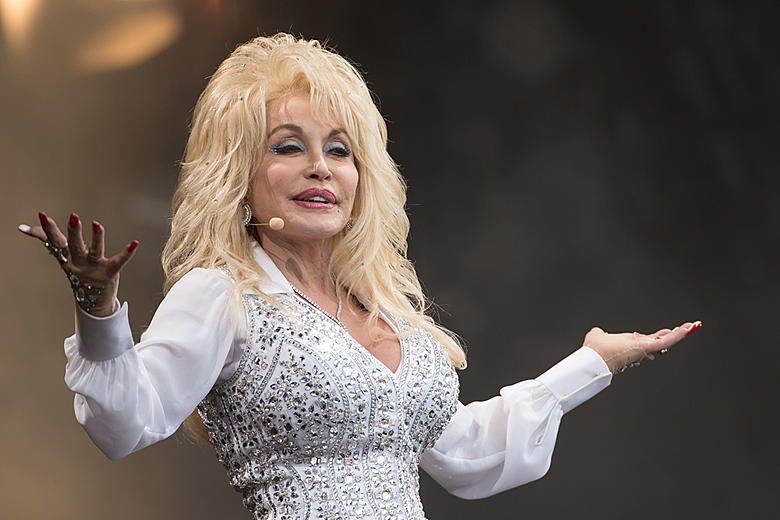
The stage lights flickered to life, casting a golden glow across the set as Dolly Parton stepped forward with a knowing smile. It was 1976, and the world was already beginning to understand that she wasn’t just a country singer—she was something far bigger. Her variety show, Dolly, had become a place where music felt alive, unpredictable, and just a little bit magical.
On this particular night, she had something special planned.
The band struck the opening chords of “Rhinestone Cowboy,” a song the audience instantly recognized—made famous by Glen Campbell, who had turned it into a chart-topping anthem just a year earlier. But this wasn’t going to be the version they knew.
Dolly never did things the expected way.
With a playful spark in her eyes, she took the song and reshaped it, weaving her own charm into every note. What had once been a story of lonely dreams and fading lights now shimmered with her warmth, her wit, and her unmistakable spirit. It felt less like a cover and more like a conversation—one legend tipping her hat to another, while still making the moment entirely her own.
Behind the scenes, though, the magic came at a cost.
The show was one of the most ambitious productions in Nashville at the time, backed by big money and even bigger expectations. Each episode demanded long days—sometimes stretching to 18 hours—leaving little room to breathe. Still, Dolly gave it everything she had, welcoming guests like Kenny Rogers and Ronnie Milsap, turning every episode into an unforgettable experience.
But even stars have limits.
As the weeks turned into months, the exhaustion began to show. Her voice—the very thing that carried her dreams—started to feel the strain. And so, at the height of its success, she made a choice few expected: she walked away.
In March 1977, Dolly aired its final episode.
The lights dimmed, the curtains closed, and the show became just a brief chapter in her ever-growing legacy.
But some moments refuse to fade.
Her rendition of “Rhinestone Cowboy” still lingers like a snapshot in time—a reminder of an era when music felt raw and real, and of an artist who never followed the rules because she was too busy rewriting them.
And somewhere in that performance, between the melody and the smile, you can still see it—
the quiet confidence of a woman who knew she was never meant to fit into someone else’s story.