The lunch bell echoed across Oakwood Elementary, and my second-grade students streamed back toward the classroom, the air still carrying the smell of chocolate milk and peanut butter.
I stood by the door, counting heads out of habit.
Nineteen. Twenty. Twenty-one.
One seat was empty.
Lily Parker.
Again.
I checked the clock. This was the third time that week she hadn’t returned from lunch with the others. The first two times, she’d claimed she was reading in the library—but the librarian had quietly confirmed Lily hadn’t been there.
“Katie,” I said, turning to my most responsible helper, “please lead the class in silent reading until I’m back.”
Katie straightened proudly. “Yes, Miss Collins!”
I stepped into the hallway, unease tightening in my chest. Since my husband’s death three years earlier, I’d developed a sharp awareness of absence—an instinct that something unseen was wrong. And something was very wrong with Lily.
I checked the bathrooms, the water fountain, then the cafeteria. The lunch staff was already cleaning.
“Have you seen Lily Parker?” I asked the manager.
She shook her head. “Not since lunch started. Come to think of it, she hasn’t been eating much. Just pushes her food around.”
Guilt pricked me. I had noticed—but I’d explained it away. Stress. Family changes. Normal childhood things.
Outside, the playground was nearly empty. Then I saw it: a flash of purple disappearing behind the building, toward the wooded strip bordering school grounds.
My heart skipped.
Students weren’t allowed there.
I hurried across the pavement and rounded the corner, slowing when I spotted Lily ahead of me. She walked with purpose, her purple backpack bouncing as she followed a narrow dirt path between the trees.
I texted the school secretary quickly—Checking on Lily Parker behind the school—and followed at a distance.
The woods weren’t deep, but thick enough to block out the school. Lily stopped near a clearing by a creek and knelt, unzipping her backpack. I hid behind a tree and watched as she took out her untouched lunchbox, checked its contents, then zipped it carefully into a front pocket.
My chest tightened.
She continued forward. I followed.
Then the trees opened.
I stopped cold.
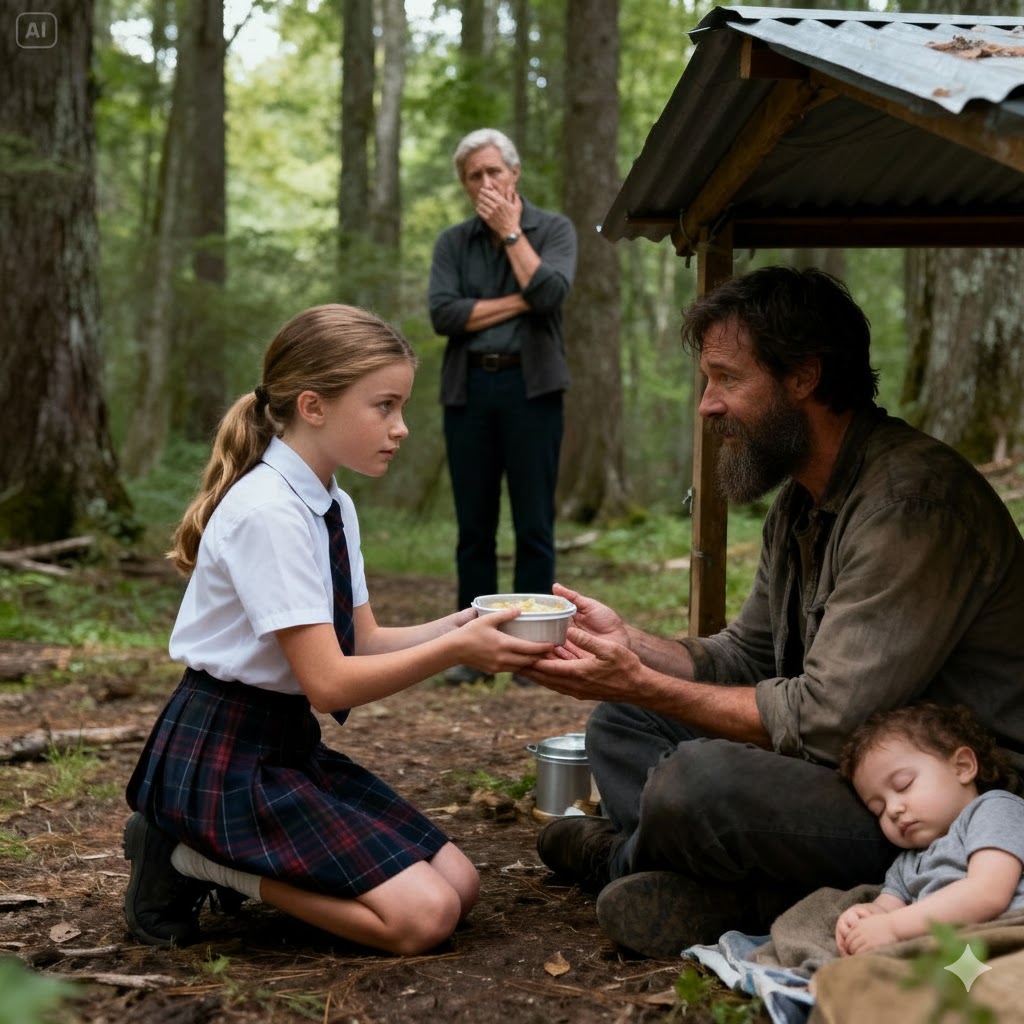
Against the embankment sat a makeshift shelter—tarps, scraps of wood, a collapsed tent. A man sat hunched on a milk crate, his face buried in his hands. Beside him lay a small boy, no more than four, asleep on a thin sleeping bag. His cheeks were flushed, his breathing shallow.
“Daddy?” Lily called softly. “I brought lunch. Is Noah any better?”
The man looked up, exhaustion carved into his face.
“Hey, pumpkin,” he whispered. “He’s still got a fever.”
Lily unzipped her backpack and pulled out her lunch. “They had pudding today,” she said brightly. “Chocolate.”
My heart broke.
I stepped forward, leaves crunching underfoot.
“Lily?”
She spun around, eyes wide. The man jumped to his feet, instinctively shielding the boy.
“I’m Rebecca Collins,” I said gently. “Lily’s teacher.”
“Daniel Parker,” he replied. “Her father.”
I knelt beside the sleeping child. His skin burned beneath my hand.
“He needs a doctor,” I said firmly.
Daniel’s voice cracked. “We don’t have insurance. Please—they’ll take my kids.”
I looked at Lily—thin, pale, dark circles beneath her eyes—and at Noah’s labored breathing.
“Noah needs help now,” I said. “I won’t let them take your children.”
I called 911.
The ambulance arrived within minutes. Noah’s fever was over 104. Daniel rode with him. I took Lily’s hand and promised not to leave her side.
At the hospital, the diagnosis came quickly: pneumonia. Severe, but treatable.
Child Services arrived shortly after.
They wanted emergency foster placement.
I refused.
I offered my home.
A spare bedroom. Safety. Stability. Time.
It cost me my standing at school. A formal warning. Lily reassigned to another class. Quiet disapproval.
But the family stayed together.
Weeks passed. Then months.
Daniel found work again. A legal settlement restored what had been wrongfully taken from him. Slowly, carefully, he rebuilt.
Six months later, I stood in the driveway of their new home, watching Lily and Noah chase a golden retriever across the lawn while moving boxes were carried inside.
“It already feels like home,” Lily said confidently.
She was right.
That day I followed a child into the woods to protect her.
What I didn’t know was that in doing so, I would also save a family—and find my way back to a life I thought I’d lost forever.
Sometimes, the most important call you make isn’t the one written in the rulebook.
It’s the one your heart refuses to ignore.