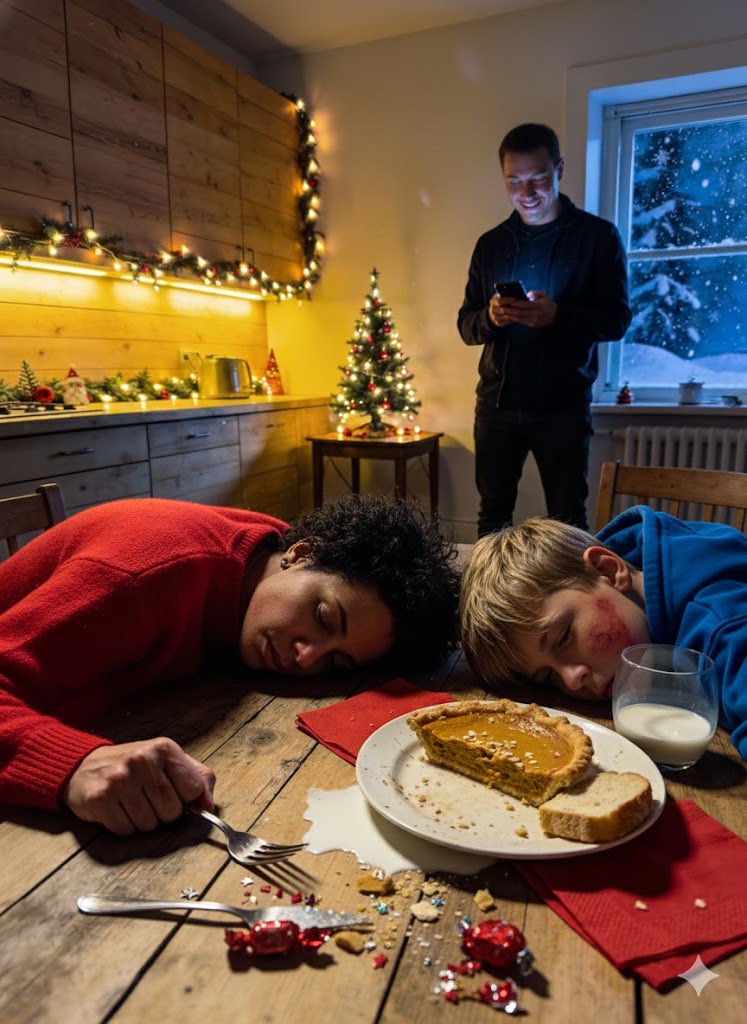
Julian cooked dinner that evening, and for the first time in weeks, the house felt as if it were pretending to be peaceful.
He moved through the kitchen with a practiced calm that didn’t feel natural—measured, deliberate. Not relaxed. Not happy. More like someone reenacting the idea of domestic comfort rather than living it. He wiped the same stretch of counter twice, stepped back to inspect it, then nodded, as if reassuring himself that everything appeared normal.
He had even set the table with our guest plates instead of the mismatched ones we used every day. He poured a small glass of orange juice, filling it only halfway, and slid it toward Evan with a stretched smile.
“Wow,” Evan laughed as he climbed into his chair. “Dad’s going full star chef tonight.”
I returned the smile Julian expected, though my stomach had been tight for days. Something in him had changed. He wasn’t colder or more distant—just controlled. Every expression looked rehearsed, as if it had been tested before being allowed to show.
Dinner itself looked harmless: baked chicken seasoned with herbs, soft steamed vegetables, rice faintly scented with garlic. Nothing outwardly wrong. Yet when Julian sat down, he barely touched his food. His eyes kept drifting to the phone beside his plate, screen face-down, as though hiding it would hide the reason he was waiting.
Halfway through a bite of chicken, my tongue felt heavy. At first, it was subtle—the numbness of having bitten it by accident. Then the sensation spread, thickening my throat.
Evan blinked slowly, his eyes glassy.
“Mom… I feel weird. I’m really tired.”
Julian reached across the table and rested his hand on Evan’s shoulder with a softness that made my skin crawl.
“It’s okay,” he said calmly. “Just breathe and let your body rest.”
Panic cut through the fog creeping into my mind. I tried to stand, but the room tilted as if the floor had shifted beneath me. My knees buckled. The chair scraped backward as I grabbed the table, but my fingers felt rubbery, uncooperative. The edges of my vision dissolved into darkness I had to fight with everything I had left.
Instinct screamed.
I let my body collapse as if consciousness had abandoned me—but I kept the thinnest thread of awareness alive. I forced my limbs to go slack. I did not move again.
The rug pressed against my cheek, smelling faintly of laundry soap. Evan crumpled beside me, too quiet. Every part of me wanted to pull him close, to check his breathing—but I knew movement could cost us both our lives.
Julian’s footsteps stopped beside me. His shadow slid across my face. A shoe nudged my shoulder, testing for a response.
I gave him nothing.
“Good,” he murmured, almost pleased.
He picked up his phone and walked toward the hallway. His voice changed—lower, intimate, stripped of pretense.
“It’s done,” he said quietly. “They ate all of it. It won’t take long now.”
A woman’s voice answered, breathless with anticipation.
“You’re sure this time?”
“Yes. I followed everything exactly. It’ll look accidental. I’ll call emergency services once it’s too late.”
Ice flooded my chest.
She laughed softly.
“Then we can finally stop hiding.”
Julian exhaled as if releasing years of resentment.
“I’ll finally be free.”
Drawers opened in the bedroom. Something metallic rattled. A bag scraped faintly across the floor.
When he returned to the living room, he paused over Evan and me again, as if admiring his work.
“Goodbye,” he whispered.
The front door opened. Cold air rushed in.
Then it closed.
Silence settled over the house.
Barely moving my lips, I whispered,
“Don’t move yet.”
Evan’s fingers twitched—then curled tightly around mine.
He was awake.
I waited until the house remained completely still. My vision swam as I opened my eyes a fraction. The microwave clock glowed in the darkness.
8:42 p.m.
My limbs felt filled with sand. I slid my hand into my pocket and pulled out my phone, dimming the screen as much as possible.
No signal.
Of course. Julian had always joked about the terrible reception in the living room.
I dragged myself forward inch by inch, pulling with my elbows. Evan crawled behind me, trembling but silent. By the time we reached the end of the hallway, a single bar flickered onto the screen.
I dialed 911.
The call failed.
I tried again.
And again.
Finally, it connected.
“Emergency services. What is your emergency?”
“My husband poisoned us,” I whispered. “He left—but he might come back.”
The dispatcher’s calm steadiness grounded me.
“Tell me your address. Is there somewhere you can lock yourselves in?”
“There’s a bathroom,” I said. “I think we can reach it.”
I guided Evan with an arm around his waist. He could barely stand, his pupils blown wide. Once inside, I locked the door and turned on the faucet, letting him sip water slowly.
The dispatcher kept me talking—what we ate, when symptoms began, whether I heard anyone outside.
Then my phone buzzed.
A text from an unknown number:
Check the trash. You’ll find proof. He’s coming back.
My breath caught. Who could know that?
Before I could respond, footsteps echoed downstairs. The front door opened.
More than one voice.
A stranger said, “You told me they’d be out.”
“They are,” Julian replied. “I checked.”
My pulse thundered. Evan pressed against me. I covered his mouth gently.
“We wait one minute,” Julian said. “Then we call. Then we cry.”
The stranger scoffed.
“You sure the kid won’t wake up?”
“He’s gone,” Julian snapped. “He barely ate half his plate. It should hit him harder.”
Then a violent knock shook the house.
“Police. Open the door.”
Chaos exploded—cursing, scrambling footsteps, something clattering to the floor. The dispatcher spoke again.
“Officers are inside. Stay where you are.”
Voices filled the house. Commands. Confusion.
Then someone shouted,
“We’ve got the wife’s 911 call. She’s alive.”
Julian’s breath hitched.
When an officer finally said, “Ma’am, you can come out,” I unlocked the door.
Uniforms filled the hallway. One officer knelt to Evan’s level, speaking softly, while another steadied my arm. Paramedics guided us toward the living room.
Julian stood there with his hands half raised, the mask of innocence slipping completely away. When our eyes met, he glared at me—not with shock or regret, but with rage.
“You lied,” he spat.
No apology. No denial. Just fury that his plan had failed.
At the hospital, long after midnight, Detective Rowena Harper told me Julian was in custody and we wouldn’t be returning home.
Evan slept beside me, his breathing shallow but steady. Machines hummed—the quiet rhythm of survival.
Then my phone vibrated.
Another message from the same number:
I’ll testify. Just make sure he never gets the chance to hurt anyone again.
I typed my thanks. The reply came quickly.
You saved your son by staying awake. Now save yourself by finishing the fight.
Two days later, Detective Harper showed me the storage unit Julian had rented under another name. Inside were duffel bags filled with poison research, fake IDs, burner phones, and notebooks tracking our routines in chilling detail.
He hadn’t acted on impulse.
He’d planned this for years.
At the bottom of one bag was a photograph of Evan and me—taken through our living room window.
Months later, the verdict came: guilty on all charges.
As guards led Julian away, he leaned close and whispered,
“You should have stayed down.”
Fear flickered—then vanished.
Outside the courthouse, Evan squeezed my hand.
“Are we safe now?”
I knelt beside him.
“We’re safer than we’ve ever been.”
Not healed. Not untouched.
But free.