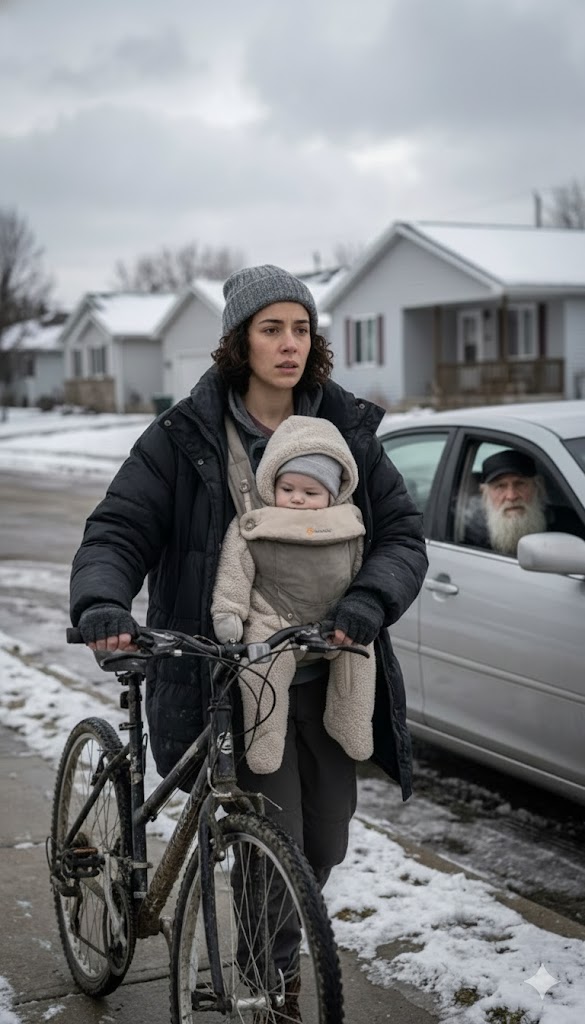
The cold that morning wasn’t the postcard kind of winter cold.
It was vicious. The kind that turned eyelashes brittle and made every breath burn like shattered glass. The sidewalks gleamed with ice, not beauty—warning. The city, our tidy suburb outside Chicago, felt stripped down to one thing only: survival.
I was outside anyway.
Ethan’s formula was almost gone.
That was the reason. Nothing noble. Nothing optional. Just the hard math of motherhood: baby eats, baby lives. And the store didn’t care that my husband was deployed overseas, or that my parents treated me like a guest who had stayed too long.
Ethan was strapped to my chest in a worn baby carrier I’d bought secondhand. The fabric was soft from years of other mothers’ panic. He was quiet—too quiet. His wide eyes watched the world like he was already learning something about it.
With one numb hand, I pushed a battered bicycle beside me. The tire had gone flat the moment I left the driveway, collapsing like it couldn’t survive another day in that house either.
My fingers were stiff. My body still didn’t feel like my own after childbirth. I’d been sleeping in fragments, the kind that keep you alive but never restore you.
Then the black sedan pulled up.
At first, I barely registered it—just the clean lines, the tinted windows, the way it moved with certainty, like it belonged wherever it stopped.
The rear window slid down.
“Olivia.”
The sound of my name cut straight through the cold.
My stomach dropped. The dread that flooded me had nothing to do with the weather.
My grandfather’s face appeared in the window—Victor Hale. Silver hair. Steel eyes. The kind of man who made boardrooms go quiet without raising his voice.
“Why aren’t you driving the Mercedes I gave you?” he asked.
It wasn’t curiosity. It was an accusation.
I stopped walking. The bike tipped, and I caught it just in time. Ethan stirred, his tiny hands tightening against my sweater.
I hadn’t seen Grandpa Victor in nearly a year—not since Ethan was born, not since Ryan was deployed, not since I’d moved back in with my parents “temporarily.” Their version of help came with conditions. His came with power.
His gaze moved from the bicycle, to my baby, back to my face. Something hardened.
Fear tried to take over—the old instinct to soften the truth. But looking down at Ethan, something in me refused to lie.
“I don’t have it,” I said quietly. “Mary’s driving it.”
My younger sister. Pretty. Performatively helpless. Always taken care of.
Victor’s expression changed instantly. The calm vanished, replaced by something cold and absolute. He didn’t ask why. He didn’t ask if I was sure.
He lifted one hand toward the driver.
The door opened.
“Get in,” he said.
That door wasn’t just an invitation into warmth. It was the first exit I’d seen in months.
I climbed in, Ethan pressed close. Heat wrapped around us—leather, quiet, safety. Ethan relaxed instantly, letting out a soft sound that nearly broke me. Outside, the bicycle lay abandoned in the snow, looking like a version of myself I was finally leaving behind.
Victor didn’t speak as we pulled away. Silence filled the car, heavy and deliberate.
“This isn’t just about the car,” he said finally. “Is it?”
My chest tightened. Telling the truth meant consequences. My parents knew how to retaliate. They’d already hinted at custody. At Ryan.
But Ethan’s steady breathing grounded me.
“No,” I said. “It’s not.”
And then I told him everything.
The Mercedes kept “for safekeeping.” My debit card “managed.” Bank alerts turned off. Money disappearing while I was told there wasn’t enough for formula. Mail intercepted. Decisions made for me while I was exhausted, isolated, postpartum.
I didn’t cry. I listed facts.
Victor listened without interruption.
When I finished, he said one thing to the driver.
“Police station.”
Panic flared. “Grandpa—”
He took my hand, firm and grounding. “They are using the word family as a shield while stealing your future,” he said calmly. “This is no longer personal. It’s criminal.”
At the station, the tone changed quickly. Especially when Victor revealed the trust I’d never known existed—money meant for Ethan and me that I had never received.
The officer’s posture straightened.
“This is theft,” she said. “And coercive control.”
For the first time, there was a name for what had been choking me.
From there, everything moved fast.
Lawyers. Accountants. Records. Truth.
Threats came next—texts warning me not to “act unstable,” hints about telling Ryan I’d kidnapped my own child. I forwarded every message without responding.
“Good,” Victor said when he read them. “Now they’ve documented their own crimes.”
They tried CPS. It failed.
They tried public shame. It collapsed.
They tried intimidation. It backfired.
Because once silence breaks, control dies with it.
The judge granted a permanent protective order. The Mercedes was returned. The stolen money traced. Forged documents uncovered.
My parents avoided prison through a plea deal. Accountability, not mercy.
The day I drove the Mercedes to buy Ethan’s formula—without panic, without counting pennies—I understood what they’d really stolen from me.
Not money.
Dignity.
As snow fell softly around the parking lot, I buckled my son into his seat and started the engine. For the first time in a year, I wasn’t surviving.
I was building.
A life. A future. A home where family would never mean fear.
And somewhere behind me, a house built on lies was finally quiet—not because it found peace, but because it lost access.
That’s the difference between being trapped and being free.