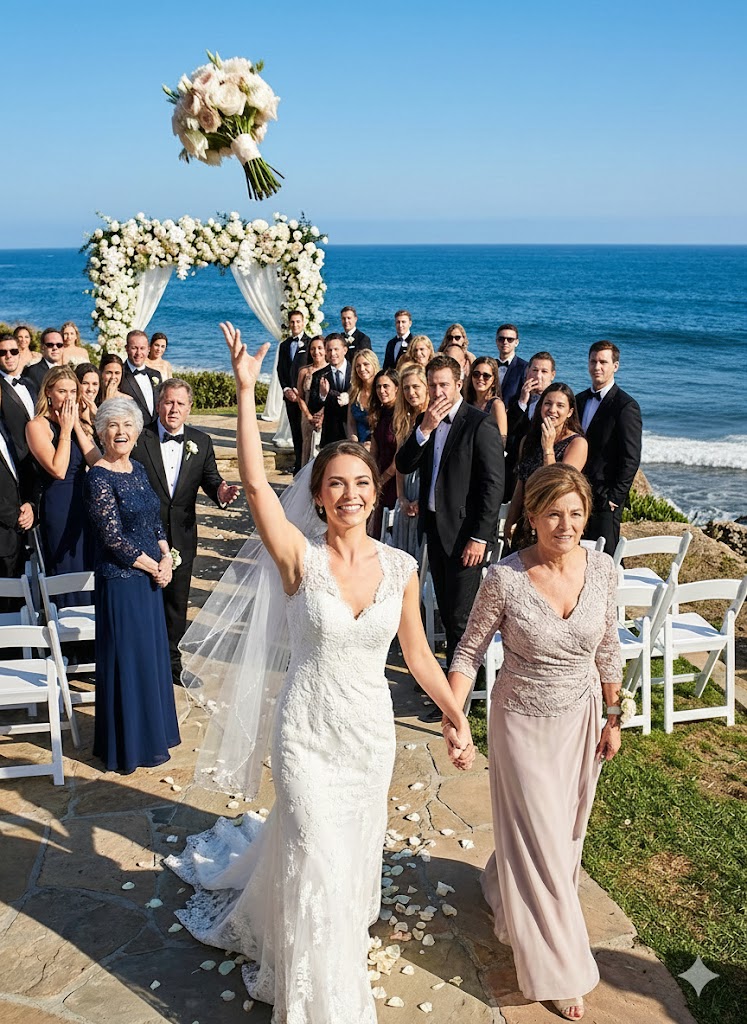
I never planned to walk away from my own wedding. Truly. But the moment I heard his mother lean in and murmur, “People like her should know their place,” something inside me fractured so cleanly it felt almost calm. I let the bouquet slip from my hands, removed my veil, took my mother’s hand—and walked out of a ceremony that cost more than my entire childhood. So tell me honestly: would you have stayed?
My name is Claire Morgan, and the morning I was supposed to get married unfolded exactly the way glossy magazines promise happiness always does. Sunlight spilled across the Pacific. A soft ocean breeze stirred white linen curtains. The Malibu cliffside venue—so expensive it barely felt real—waited like a monument to excess. It belonged to the Whitmore family, a name synonymous with Southern California real estate, charity galas, and quiet political influence. That name was supposed to become mine.
In the bridal suite, stylists hovered, assistants adjusted hems, mirrors reflected every angle. My dress fit flawlessly. The veil was hand-stitched. The flowers had been flown in overnight. Everything gleamed with the sterile perfection money demands. And yet my stomach was tight with a feeling I couldn’t ignore—the sense that I was stepping into something irreversible.
I loved my fiancé, Andrew Whitmore. Genuinely. He was thoughtful, grounded, warm in ways that had nothing to do with wealth. We met years earlier, when he was still determined to prove he could succeed without the Whitmore name clearing his path. He never questioned my background. He never needed to.
His parents did.
I grew up in Bakersfield. My father left early. My mother, Susan, worked whatever jobs kept food on the table—waitressing, cleaning offices at night, folding motel laundry on weekends. We didn’t have vacations or designer clothes, but we had loyalty, humor, and a shared belief that people are worth more than what they own.
When my mother arrived at the venue in her simple pale-blue dress, holding her purse like armor, the atmosphere shifted. Conversations softened. Smiles tightened. Eyes lingered a second too long. Nothing blatant—nothing you could call out without sounding paranoid—but it was there, humming beneath the surface.
As we passed a group of Andrew’s relatives, I heard his aunt murmur, “At least she looks… clean,” followed by a restrained laugh.
My mother kept walking. I didn’t miss it.
The moment that changed everything came just before the ceremony. I stood near the aisle when I heard Andrew’s mother, Victoria, speaking behind a marble column. She didn’t realize I was close enough to hear every word.
“This wedding is generous,” she said coolly. “But let’s be honest—girls like her don’t end up here by accident. They see opportunity, and they take it. Her mother should be grateful she was even invited.”
My chest hollowed out. I looked at my mom, adjusting the strap of her purse, shoulders stiff, smile carefully rehearsed. She had heard enough. Maybe not every word—but enough.
That was when clarity arrived—not loud or explosive, but terrifyingly calm.
The music began. Guests rose. I took one step down the aisle. Then another. Halfway through, I stopped.
I lifted the bouquet and let it fall.
The sound was soft. The reaction wasn’t. Gasps rippled through the room. Before anyone could respond, I unclasped my veil and let it slip onto the marble floor.
Then I turned, walked straight to my mother, and took her hand.
“I’m not doing this,” I said, my voice carrying farther than I expected. “Not like this.”
Silence swallowed the space.
I faced Andrew’s parents. “I won’t marry into a family that treats kindness as optional and respect as conditional,” I said. “You can keep the venue. You can keep the money. But you don’t get to look down on the woman who raised me.”
My mother whispered, “Claire, honey—”
“I know,” I said softly. “But I’m done pretending.”
I turned and walked out, my heels echoing with every step. My heart raced, but my spine felt straight for the first time all day.
“Claire—wait!” Andrew’s voice cut through the shock.
I stopped, but I didn’t turn around. He ran toward us, breathless, shaken in a way I’d never seen.
He looked at my mother first. “Mrs. Morgan, I’m so sorry. None of this should have happened.”
Then he faced me. “You’re right. I should’ve stopped this long ago. I thought I could keep the peace. I was wrong.”
Behind him, his parents stood frozen—angry, exposed.
“I can’t spend my life defending my worth,” I said quietly. “And I won’t make my mother feel small so others can feel superior.”
Andrew nodded once, as if choosing something frightening but right. Then he turned to his parents.
“We’re leaving,” he said. “If you want to be part of our lives, things change. If not, that’s your choice.”
Victoria opened her mouth. No words came.
Andrew slipped off his jacket and draped it over my mother’s shoulders. “You didn’t ruin anything,” he told her. “You showed us what matters.”
Outside, the air felt lighter. The sun dipped toward the ocean, and for the first time that day, the beauty didn’t feel staged.
We didn’t get married that day.
Instead, we went home. We spent a week in Bakersfield, sitting at my mom’s small kitchen table, eating simple food, talking late into the night. Andrew listened—to stories, to pain, to truths he’d never fully faced.
Months later, we married quietly on a public beach. No guest list weighted with expectations. No speeches about legacy. My mother walked me down the sand, barefoot, smiling freely.
Andrew’s parents didn’t come.
And that was okay.
The life we built afterward—steady, respectful, honest—was worth more than any ceremony money could buy.
Happiness didn’t arrive all at once. It never does for people who’ve had to unlearn shame.
For a long time, I still flinched at certain things: polished laughter in upscale rooms, casual talk of “pedigree,” the assumption that money equals virtue. Even in joy, I waited for someone to remind me I didn’t belong.
Andrew noticed first.
One night, months later, he found me scrubbing a spotless counter until my hands were red.
“You don’t have to earn your place here,” he said gently.
I broke then—not loudly, but in that quiet, shaking way that comes from holding yourself together too long. Walking away had been brave. Healing would be harder.
I began therapy—not because I was broken, but because I was tired of carrying voices that weren’t mine. Slowly, I learned to separate who I was from how I’d been treated.
Andrew changed too.
When he declined a senior role at his family’s company, his father didn’t hide his disappointment.
“You’re throwing away your future.”
“No,” Andrew replied. “I’m choosing one.”
That choice cost him connections, invitations, status. Doors closed quietly. The power his parents wielded began to thin.
A year later, an investigation into one of the Whitmores’ development projects surfaced. Not sensational—just thorough. Long-standing shortcuts. Ethical gray zones. Influence stretched too far.
Andrew’s father resigned. His mother vanished from charity boards. They weren’t ruined—but the illusion of invincibility cracked.
What surprised me was how little satisfaction it brought.
Instead, there was closure.
My mother summed it up best. “They spent their lives looking down,” she said. “No wonder they never saw the ground coming.”
Her catering business grew steadily, built on trust and fairness. She hired women who’d been overlooked and paid them well. Watching her thrive felt like justice without cruelty.
Andrew and I built a life that looked small from the outside and felt vast within. A modest home. Long dinners. Honest arguments. Apologies without scorekeeping.
When we had a child, we made one promise: our love would never come with conditions.
Years later, I ran into Victoria at a grocery store. She looked older—less sharp, less commanding.
“You look well,” she said.
“I am,” I replied.
She nodded, swallowing something unspoken. “I suppose you always were.”
There was no apology. And for the first time, I didn’t need one.
Because my happiness no longer depended on the approval of people who once tried to diminish me.
I had my life. My family. My peace.
And that, I learned, is the most complete ending of all—not revenge, not spectacle, but the quiet certainty that those who chose cruelty lost access to me, while I went on to live freely, fully, and without ever looking back.