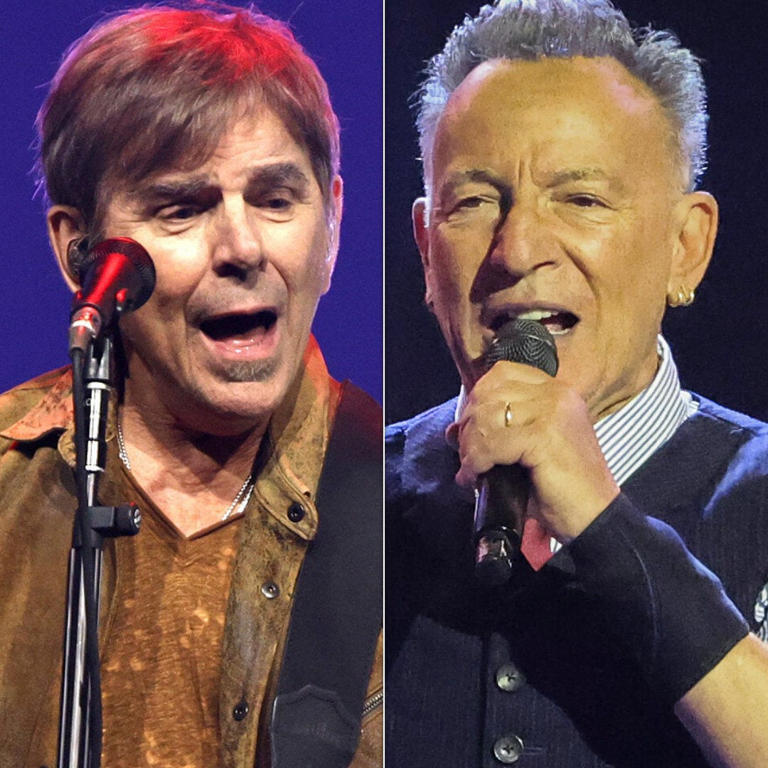
A war of words has erupted between two veteran rock musicians after Journey keyboardist Jonathan Cain sharply criticized Bruce Springsteen for bringing politics into his concerts. The comments have sparked widespread discussion among music fans, raising familiar questions about whether artists should use their platforms to speak about political issues or focus solely on entertainment. Journey Bruce Springsteen
Cain’s Remarks Draw Attention
The controversy began after Jonathan Cain appeared on The Complete Disaster Network podcast, where he discussed his own political beliefs and his views on celebrities who address politics during live performances.
Cain, who described himself as a “diehard conservative,” said he believes musicians should avoid political speeches at concerts. During the interview, he singled out Springsteen, saying the rock legend should “shut up” about politics and later calling him “an annoying, bitter old man.”
Cain explained that although audiences know about his Christian faith and conservative views, he does not believe concerts are the appropriate place to discuss politics. Instead, he said artists should focus on bringing people together through music.
Criticism of “Born in the U.S.A.”
Cain also took aim at one of Springsteen’s most famous songs, “Born in the U.S.A.”
He argued that many people misunderstand the song, describing it as critical of America rather than patriotic. Cain questioned why Springsteen continues to criticize the country while performing a song associated with American pride.
Music historians have long noted that while “Born in the U.S.A.” is often mistaken for a patriotic anthem, its lyrics actually tell the story of a struggling Vietnam veteran and examine the hardships faced by working-class Americans. The song has frequently been interpreted as both patriotic and critical, depending on the listener’s perspective.
Springsteen’s Political Activism
Bruce Springsteen has never hidden his political opinions.
During his recent Land of Hope & Dreams American Tour, Springsteen repeatedly criticized President Donald Trump’s administration during onstage speeches, describing the political climate as a difficult period for the country. He has said that speaking out reflects his belief in what he calls “critical patriotism”—loving one’s country while acknowledging its flaws and encouraging it to improve.
Springsteen has supported Democratic candidates for decades and has often spoken publicly about democracy, civil rights, veterans, and economic inequality.
Cain Says Music Should Unite
Throughout the interview, Cain emphasized that he believes concerts should be places where political differences are set aside.
Referencing a quote he attributed to Paul McCartney, Cain said that when audiences sing together, political divisions disappear. He noted that Journey fans of different political backgrounds all sing classics like “Don’t Stop Believin'” together, which he believes reflects music’s true purpose.
Cain argued that artists have an opportunity to unite audiences rather than divide them through political discussions.
Cain’s Own Political Identity
Although Cain said he tries not to make politics part of Journey’s concerts, he openly discussed his personal beliefs during the interview.
He explained that he was once a Democrat before becoming a conservative and has recently released patriotic music, including “Winds of Freedom,” a song celebrating America’s 250th anniversary. Cain also praised fellow conservative musicians such as Kid Rock and Ted Nugent, saying he is proud of his beliefs and his faith.
Cain’s political profile has become more visible in recent years. He is married to Paula White-Cain, a longtime evangelical leader who serves in the Trump administration’s White House Faith Office.
A Long-Running Debate in Music
The disagreement between Cain and Springsteen reflects a broader debate that has existed in popular music for decades.
Some artists believe music should offer audiences an escape from politics, while others argue that musicians have both the right and the responsibility to speak out on social and political issues. Rock history is filled with artists who have used their songs and performances to address war, civil rights, poverty, and government policies.
Springsteen has consistently defended his decision to speak on political matters, saying that patriotism includes recognizing problems and encouraging positive change. Cain, by contrast, believes artists are most effective when they allow their music—not political commentary—to bring people together.
No Public Response From Springsteen
As of now, Bruce Springsteen has not publicly responded to Jonathan Cain’s comments. Reports indicate that Springsteen’s representatives did not issue an immediate statement following Cain’s interview.
While the exchange has generated headlines, it also highlights the different philosophies held by two respected musicians whose careers have each spanned more than five decades. Whether artists should use their fame to advocate for political causes or simply entertain remains a question that continues to divide audiences just as much as it divides some of rock’s biggest names.