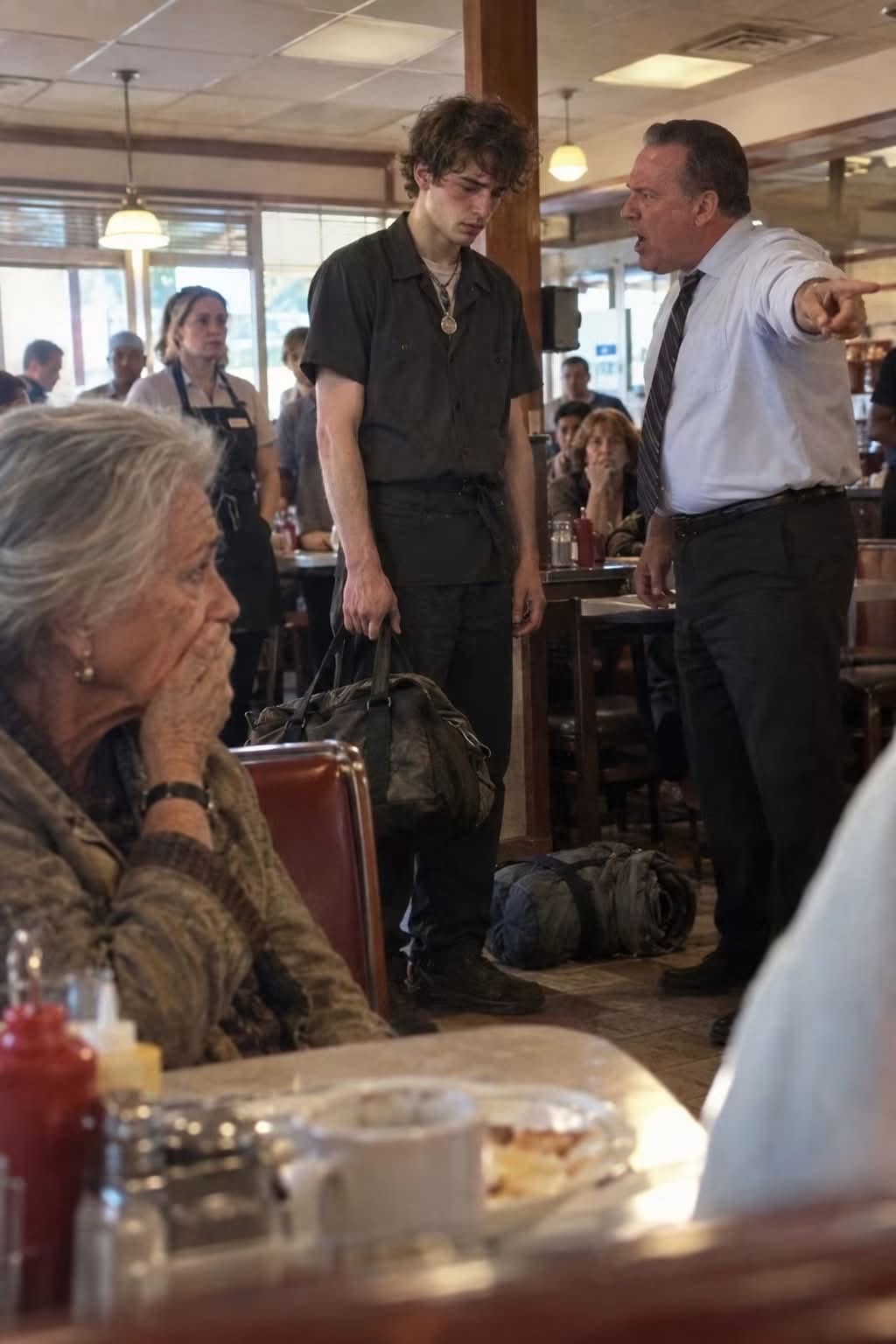
Eleanor Hale remained seated long after Ethan Cole disappeared through the diner’s glass doors.
Outside, the nineteen-year-old stopped beneath the striped awning, shifted the duffel bag on his shoulder, and looked up at the gray October sky. Rain had begun falling in thin, slanted lines, but he did not open his bag for an umbrella. He simply stood there for a moment, as if trying to decide which direction a person should walk when he had nowhere left to go.
Then he turned toward the highway.
Eleanor’s fingers tightened around the edge of her paperback.
The necklace.
She could still see it against the boy’s pale skin, the silver chain disappearing beneath his worn collar. The oval pendant had been scratched near the clasp, exactly where hers had been damaged twenty years earlier. She remembered dropping it on the kitchen tiles while wrapping it in blue tissue paper. She remembered the tiny metallic sound it made when it struck the floor.
Most painfully, she remembered what she had engraved inside.
Always find your way home.
It had been a gift for David’s twenty-fourth birthday, given three months before he disappeared.
Eleanor had searched hospitals, police stations, train terminals, abandoned buildings, and homeless shelters across three states. She had hired private investigators, placed newspaper advertisements, and spent years waiting for an unknown number to appear on her telephone.
She had received hundreds of false leads.
But she had never seen that necklace again.
Until now.
“Eleanor?”
The voice startled her.
A waitress named Maria stood beside the booth, holding a coffee pot. She was in her early fifties, with tired eyes and a silver streak in her dark hair.
“Would you like a refill?”
Eleanor looked up slowly.
“No, thank you.”
Maria glanced toward the door through which Ethan had disappeared.
“That was awful, wasn’t it?”
Eleanor kept her expression neutral. “Does Mr. Dunbar usually speak to his employees that way?”
Maria’s mouth tightened.
“Only when he thinks nobody important is watching.”
“Isn’t the owner important?”
Maria let out a short, humorless laugh.
“The owner lives somewhere in a big house and reads reports prepared by people like him. She probably has no idea what happens in this building.”
Eleanor looked down at her six-dollar watch.
“You might be surprised.”
Maria studied her for a moment, perhaps wondering why an ordinary-looking retiree had asked such a pointed question.
Then she leaned closer.
“That boy didn’t deserve what happened to him.”
“Tell me about him.”
Maria glanced toward the office. Richard Dunbar was standing inside, speaking on his phone while gesturing angrily at an employee near the kitchen.
“His name is Ethan. He’s been here about four months. He comes early, stays late, and never complains. Sometimes he gives away his own food to people who come in looking hungry.”
“Does he have family?”
“I don’t know. He doesn’t talk about himself much.”
“Where does he sleep?”
Maria hesitated.
“Until this morning, he was sleeping in the supply room. He told Mr. Dunbar before he started that he didn’t have a stable place to live. The manager said he could work and save money until he found somewhere. Then, last week, he suddenly started calling him a thief and threatening to fire him.”
“Did he steal anything?”
“Not that I’ve seen.”
“Why did Dunbar change his mind?”
Maria lowered her voice.
“Because Ethan found something.”
Eleanor’s heart seemed to stop.
“What did he find?”
“I don’t know exactly. A few days ago, I heard them arguing in the office. Ethan kept saying, ‘I promised I would return it.’ Mr. Dunbar told him he should forget what he’d seen.”
Before Eleanor could ask another question, the office door opened.
Richard Dunbar emerged, his expression settling into a practiced smile when he noticed the customers watching him.
“Maria, table six needs cleaning.”
Maria straightened.
“Yes, sir.”
She walked away, but not before giving Eleanor a quick look that seemed to contain a warning.
Eleanor waited until Dunbar disappeared into the kitchen.
Then she reached into her worn handbag and removed a small telephone.
She had come to the diner without her usual security detail, without her executive assistant, and without telling anyone at corporate headquarters where she was going. She had wanted to see the truth without anyone knowing who she was.
Now she needed one person to know exactly where she was.
She dialed the number of her attorney, Thomas Reed.
He answered on the second ring.
“Mrs. Hale?”
“Thomas, I need you to do something for me.”
“Of course.”
“Find everything you can about a young man named Ethan Cole. Nineteen years old. He works at our diner on Route 17.”
There was a pause.
“Is there a problem?”
“Possibly. And I need you to be discreet.”
“How discreet?”
Eleanor looked toward the door.
“Do not contact the police yet. Do not contact the manager. I want his employment records, emergency contacts, previous addresses, and any information connected to his childhood.”
“I’ll begin immediately.”
“And Thomas?”
“Yes?”
“Find out whether he has ever been reported missing, abandoned, or placed in foster care.”
Another pause.
“Why would a restaurant employee—”
“Because he is wearing something that belonged to my son.”
Thomas fell silent.
Eleanor ended the call before he could ask another question.
Outside, the rain was getting heavier.
And somewhere beyond the parking lot, a nineteen-year-old boy was carrying the only possession that might lead Eleanor back to the child she had spent twenty years trying to find.
She had no idea that Richard Dunbar had watched her make the telephone call.
And he had recognized the name of her attorney.
For the first time that morning, the manager looked genuinely afraid.
## Chapter Two: Twenty Years of Silence
Twenty years earlier, Eleanor Hale had been a different woman.
She was fifty-four, energetic, stubborn, and almost impossible to intimidate. Her husband had died when their son David was sixteen, leaving her with a small roadside diner, a mortgage, and a boy who had suddenly become the only family she had left.
Eleanor had turned that diner into a regional restaurant business through relentless work.
She washed dishes when employees failed to show up. She slept in the office during snowstorms. She learned bookkeeping at night and negotiated supply contracts during the day. By the time David graduated from college, the original diner had grown into a chain of fourteen restaurants.
She had built the business for him.
At least, that was what she told herself.
David never wanted it.
He wanted to work with troubled teenagers, especially young people who had grown up without stable homes. He volunteered at shelters and community centers, spending weekends helping children fill out school applications and find temporary housing.
Eleanor loved his kindness, but she feared it would destroy him.
“You cannot save everyone,” she had told him repeatedly.
“I’m not trying to save everyone, Mom. I’m trying to help one person at a time.”
“And what happens when they take advantage of you?”
“Then I’ll learn something.”
“What happens when you give away everything you have?”
David had smiled.
“Then I’ll have to learn how to live with less.”
Those conversations had become arguments as David grew older.
Eleanor wanted him to join the company. David wanted to create a foundation for homeless teenagers. She offered him a senior management position, a generous salary, and a house near her own.
He refused all three.
At twenty-three, he fell in love with a young woman named Rebecca Cole.
Rebecca had grown up in foster care and understood the loneliness of children who had nobody to call when they were frightened. She was gentle but strong-willed, with a quiet determination that Eleanor initially mistook for defiance.
David adored her.
Eleanor did not.
She believed Rebecca encouraged David to abandon his responsibilities. She disliked the fact that Rebecca had no wealthy family, no professional connections, and no interest in the life Eleanor had spent decades building.
“You are throwing away your future,” Eleanor told her son one evening.
David stood in the doorway of her kitchen, holding a folder containing plans for a youth shelter.
“No, Mom. I’m trying to build one.”
“With what money?”
“My savings. Donations. Whatever I can raise.”
“You could have this company someday.”
“I don’t want it.”
The words had hurt more than Eleanor admitted.
“Your father would have wanted you to take care of what we built.”
David’s expression changed.
“Please don’t use Dad to make me feel guilty.”
“I am not making you feel anything. I am telling you the truth.”
“No. You’re telling me the truth as you want it to be.”
He had left shortly afterward.
For several weeks, they barely spoke. Then David returned to her house carrying a small jewelry box wrapped in blue paper.
Inside was a silver necklace with an oval locket.
Eleanor stared at it.
“What’s this?”
“Your birthday present. I know it’s early.”
She opened the locket. Inside were two tiny photographs, one of David as a child sitting on his father’s shoulders and another of the three of them outside the original diner.
Eleanor laughed softly despite herself.
“You chose the photographs?”
“Obviously. You’re the one who keeps everything.”
She touched the locket with her thumb.
“It’s beautiful.”
“I wanted you to have something that reminded you of home.”
“Home is here.”
“Sometimes,” David said gently, “home is the person who still wants you back after you’ve made a mess of things.”
She had not understood the meaning of that sentence until much later.
Three months afterward, David disappeared.
His car was found abandoned beside a county road, its driver’s door open. His wallet was inside, along with his telephone and the folder containing his shelter plans. There was no blood, no clear evidence of an accident, and no witness who could explain where he had gone.
Rebecca was missing, too.
At first, the police believed the couple had left voluntarily. David was an adult, and he had argued with his mother shortly before his disappearance. There were no signs of violence in the car.
Eleanor insisted he would never vanish without contacting her.
The police told her they had no evidence of a crime.
Then a letter arrived.
It was short, typed, and unsigned.
David was leaving. He did not want the company, the money, or his mother’s interference. He wanted to build a life with Rebecca and had no intention of returning.
Eleanor recognized neither the paper nor the typing style, but she believed the letter was genuine because it confirmed her greatest fear: David had chosen someone else over her.
For years, she convinced herself that her son was alive somewhere, living a life he had deliberately kept secret.
She never stopped looking.
Yet she never told anyone how often she reread that letter or how many times she wondered whether she had pushed him away.
She kept his room exactly as he had left it. She kept his childhood drawings in a wooden box. And she kept the empty space beside her at the dinner table.
The necklace had been the last gift she had given him.
Now it was hanging around Ethan Cole’s neck.
A boy who had been born only a year after David disappeared.
A boy with Rebecca’s surname.
And a boy who had somehow ended up homeless at nineteen.
Eleanor rose from the booth.
She left cash beneath her coffee cup, walked toward the entrance, and stopped beside the front window.
Richard Dunbar was standing near the kitchen, staring at her.
Their eyes met.
For one brief second, his expression revealed something Eleanor had learned to recognize during forty-five years in business.
He was not merely afraid of being caught doing something wrong.
He was afraid that she had discovered something he had spent years trying to keep hidden.
## Chapter Three: The Boy at the Bus Stop
Ethan had reached the bus stop when a dark sedan pulled alongside the curb.
He tightened his grip on his duffel bag.
“You’re Ethan Cole?” a man asked through the open passenger window.
Ethan stepped back.
“Who wants to know?”
The man wore a gray suit and held a leather folder. He looked to be in his sixties, with neatly combed white hair and the kind of calm expression Ethan had learned never to trust automatically.
“My name is Thomas Reed. I represent Eleanor Hale.”
Ethan’s face changed.
“The owner?”
“Yes.”
“If she wants me to apologize, tell her I’m sorry I broke the rules. But I didn’t steal anything.”
“I’m not here about your job.”
“Then what?”
Thomas glanced at the necklace visible above Ethan’s collar.
“I think Mrs. Hale would like to ask you some questions about that pendant.”
Ethan immediately covered it with his hand.
“Why?”
“Because she believes it may have belonged to someone she lost.”
For several seconds, neither man spoke.
Then Ethan shook his head.
“I can’t help her.”
“You haven’t heard what she wants to ask.”
“I know what people want when they see this necklace.”
Thomas kept his voice gentle.
“What do they want?”
“They want to know where I got it. They want to know whether I stole it. Sometimes they want to take it away because they think a kid like me shouldn’t own anything valuable.”
“Mrs. Hale doesn’t think you stole it.”
Ethan looked toward the highway.
“Then she knows more than the last person who asked.”
Thomas felt a chill.
“Who asked you?”
Ethan’s jaw tightened.
“A man who said he was helping me find a place to stay.”
“Was his name Richard Dunbar?”
The boy looked at him sharply.
“No.”
“Do you remember his name?”
“Daniel something. I don’t know. It was years ago.”
“How many years?”
Ethan looked down at the pendant.
“Since I was little.”
Thomas opened the passenger door.
“Would you come with me? Mrs. Hale would like to speak with you somewhere private. No police, no reporters, and no pressure to answer anything you’re not comfortable answering.”
Ethan studied him carefully.
“Why should I trust you?”
“You shouldn’t trust a stranger simply because he asks you to. But you can ask Mrs. Hale questions, too.”
The bus arrived at the opposite end of the street, brakes hissing in the rain.
Ethan watched it stop.
That bus would take him to the shelter where he had slept two nights before, but the shelter had a waiting list, and he had already used his allotted emergency nights. He could spend the afternoon at the public library, but that would not solve the problem of where to sleep after it closed.
He looked back at Thomas.
“Is she really the owner?”
“Yes.”
“Does she know what happened in there?”
“She does now.”
Ethan hesitated, then opened the rear passenger door.
He kept the duffel bag on his lap and his hand over the necklace for the entire drive.
When they reached Eleanor’s private office above the company’s regional headquarters, she was standing beside the window, looking down at the traffic.
She turned as the door opened.
For a moment, she and Ethan simply stared at each other.
Up close, the resemblance was even more unsettling.
The same long nose. The same slightly uneven eyebrows. The same habit of pressing his lips together when he was trying not to reveal what he felt.
David had worn that expression at seventeen, when he was determined to hide a disappointment from his mother.
Eleanor forced herself to breathe.
“Thank you for coming.”
Ethan remained near the door.
“I don’t know why I’m here.”
“Because I saw your necklace.”
His fingers closed around the pendant.
“It’s mine.”
“I’m not suggesting otherwise.”
“Then what do you want?”
Eleanor walked slowly toward the table and sat down, leaving the chair opposite her empty.
“I want to understand how you came to have it.”
Ethan did not move.
“Before you answer, I need you to know something. I’m not going to take it from you. I’m not going to call the police. And I’m not going to offer you money in exchange for telling me what I want to hear.”
“People say things like that when they want you to trust them.”
“You’re right.”
The answer seemed to surprise him.
Eleanor continued.
“So don’t trust me yet. Listen to what I have to say, ask whatever you need to ask, and decide for yourself.”
She told him about David. She explained the photographs inside the locket, the engraving, the damaged clasp, and the night she had last seen it.
Ethan listened without interrupting.
When she finished, he slowly removed the chain from beneath his shirt.
“I was told this belonged to my mother.”
Eleanor’s eyes filled with tears.
“Your mother?”
“Rebecca Cole.”
The room seemed to tilt around Eleanor.
“Rebecca was your mother?”
Ethan nodded.
“She died when I was young. That’s what the people who raised me said.”
“Who raised you?”
“A couple named Martin and Helen Price. They took me in when I was about three.”
“Did they adopt you?”
“They said they did. I don’t remember the paperwork.”
Eleanor reached for the edge of the table.
“Where are they now?”
Ethan looked away.
“Martin died when I was twelve. Helen died two years later.”
“I’m sorry.”
“They were good to me at first.”
The final words were so quiet that Eleanor almost missed them.
“What happened afterward?”
Ethan rubbed his thumb over the pendant.
“After Helen died, I went to foster care. I moved between homes. Some were fine. Some weren’t. I stopped expecting things to stay good.”
“Did you ever know your father?”
“No.”
“Did your mother tell you anything about him?”
Ethan shook his head.
“Just that he loved me. She told me that before she died.”
Eleanor’s throat tightened.
“Did she give you the necklace?”
“No. Helen did.”
“Did she tell you where it came from?”
Ethan stared at the pendant.
“She said my mother had left it with me when I was a baby. She said it was the one thing I wasn’t supposed to lose.”
Eleanor pressed a hand over her mouth.
The inscription had not been intended for Ethan.
It had been intended for David.
Yet somehow, twenty years after David’s disappearance, his necklace had passed into the hands of a boy who had been told that his mother loved him.
A boy born at the exact moment Eleanor’s own family had been torn apart.
She looked at him through her tears.
“Ethan, do you know when your mother died?”
He nodded.
“She was twenty-five. The records said she died in a hospital outside Millbrook. That’s all I know.”
“What year?”
“2010.”
Eleanor closed her eyes.
David had disappeared in 2006.
Four years separated the disappearance from Rebecca’s death, and the timing was suddenly impossible to ignore.
“Did your mother ever tell you about a man named David?”
Ethan’s face became unreadable.
“No.”
“Never?”
“Not to me.”
Eleanor leaned forward.
“Then why did you say you couldn’t help me?”
Ethan looked at her for a long moment.
Then he unzipped his duffel bag and removed a folded piece of paper, worn soft at the edges.
“I didn’t say I couldn’t help you because I didn’t know anything.”
He placed the paper on the table.
“I said it because I was afraid of what would happen if I did.”
## Chapter Four: The Letter in the Locket
The paper was a photocopy of a handwritten letter.
Eleanor recognized the handwriting before she read a single word.
David’s letters leaned slightly to the right. His capital D was unusually large, and he often joined words that should have been separated when he wrote too quickly.
She had kept hundreds of his childhood notes.
This was his handwriting.
Her hands began to tremble.
“Where did you get this?”
“It was in a box Helen kept under her bed. I found it after she died.”
“Why didn’t you take it to the police?”
Ethan gave a small, bitter smile.
“I was fourteen. I was in a foster home where people searched my belongings whenever they felt like it. I didn’t know whether the letter meant anything. I didn’t know who David was. I only knew Helen had told me never to let anyone take the necklace.”
Eleanor unfolded the photocopy.
The letter was addressed to someone named Michael.
*Michael,*
*If you are reading this, then something has happened that I could not prevent. Please keep Rebecca and the baby safe. Do not tell my mother where we are until I can make sure it is safe for all of us.*
*I know Eleanor believes I am making a mistake. She believes I am throwing away everything she built. She does not understand that I am not running away from my responsibilities. I am trying to protect the people I love.*
*If I cannot return, tell my son that I wanted him. Tell him that his mother loved him. And tell him that there was never a day when I stopped trying to find my way home.*
*David.*
Eleanor read the final sentence twice.
There was never a day when I stopped trying to find my way home.
She pressed the letter to her chest.
For twenty years, she had believed David had chosen to abandon her. She had built an entire life around that belief, protecting herself from the possibility that he had been hurt, trapped, or killed.
Now a single page had torn that certainty apart.
“Who is Michael?” she whispered.
Ethan shook his head.
“I don’t know. Helen never mentioned him.”
“Was there anything else in the box?”
“An envelope with some hospital papers. I kept those, too.”
He reached into his bag and removed a second bundle.
The first document was a birth record.
The mother’s name was Rebecca Anne Cole.
The child’s name was Ethan David Cole.
Eleanor stared at the middle name.
David.
She felt something break open inside her.
“He’s your father,” she whispered, though she had not yet proved it.
Ethan looked frightened.
“How do you know?”
“Because that is his handwriting. Because he disappeared four years before your mother died. Because this necklace was a gift from me to him.”
She looked up.
“And because your name is Ethan David Cole.”
Ethan sat down for the first time.
He looked as if the room had become too large and the air too thin.
“So you’re saying my father was your son?”
“I believe he was.”
“That would make you my grandmother.”
Eleanor could not answer.
She had imagined this moment in a thousand different ways. She had imagined finding David at a hospital, in a foreign country, or sitting in a prison visiting room. She had imagined a telephone call in the middle of the night and a stranger standing at her door.
She had never imagined that her grandson would arrive carrying a sleeping bag, a toothbrush, and the remains of a life he had barely been allowed to understand.
She reached across the table, then stopped before touching him.
“May I?”
Ethan looked at her hand.
After a moment, he nodded.
She took his hand in both of hers.
It was cold.
“I’m sorry,” she said.
He frowned.
“For what?”
“For everything I don’t know yet. For the years you spent alone. For the possibility that my son was alive while you needed him and I couldn’t find either of you.”
Ethan looked away.
“You didn’t know I existed.”
“No. But I should have known something was wrong.”
“You can’t blame yourself for everything.”
The words sounded so much like David that Eleanor almost laughed through her tears.
He had always said the same thing.
Then Ethan asked the question she had been dreading.
“If David was your son, why didn’t he come back?”
Eleanor looked at the letter.
“I don’t know.”
“But he said he was trying to come home.”
“Yes.”
“Then somebody stopped him.”
Neither of them spoke.
Outside the office, a telephone rang.
Then another.
Thomas Reed appeared in the doorway, holding a folder.
His face was pale.
“Eleanor, I need to speak with you privately.”
She glanced at Ethan.
“Whatever it is, you can say it here.”
Thomas looked down at the documents.
“I’ve been checking the diner records and the personnel files. Richard Dunbar has been making unusual inquiries about Ethan’s background for months. He also contacted a former employee of the company who was involved in the original investigation into David’s disappearance.”
Eleanor felt the blood drain from her face.
“Who?”
“Michael Voss.”
The name from David’s letter.
Ethan looked at the page on the table.
“That’s the man Helen told me to avoid.”
Eleanor turned toward him.
“What?”
Ethan swallowed.
“She said if a man named Michael ever came looking for me, I should leave immediately. She said he would pretend to help, but he would only be trying to get the necklace.”
Thomas closed the office door.
“Eleanor, there’s something else. Michael Voss worked for your company twenty years ago. He was your regional operations director. He was the last person known to have spoken to David before the disappearance.”
Eleanor stared at the letter.
The man David had trusted to protect his family had been connected to the very business Eleanor believed would one day belong to her son.
And now that same man had been searching for Ethan.
For the first time in twenty years, Eleanor understood that David might not have abandoned her.
He might have been running from someone.
Someone who had known exactly how to make a disappearance look like a choice.
## Chapter Five: The Manager’s Secret
Richard Dunbar had been working for Hale’s restaurant group for eleven years.
He had started as a shift supervisor and climbed the ranks through a combination of efficiency, charm, and an ability to make problems disappear before they reached the people above him.
Eleanor had met him twice.
The first time, he had presented a proposal for improving labor costs. The second time, he had been among the managers congratulated for increasing profitability across the region.
He had seemed ambitious, but not unusual.
Now Thomas was showing Eleanor spreadsheets that told a different story.
Over the past eighteen months, Dunbar had altered employee schedules, removed incident reports, and submitted invoices for services that could not be verified. Several former employees had complained about missing wages, but their complaints had been closed as administrative errors.
More troubling was a payment of $8,400 made from a company account to a private consulting business connected to Michael Voss.
The payment had been approved by Dunbar.
Three weeks later, Ethan had been hired.
“Why would Voss be interested in a busser?” Eleanor asked.
Thomas placed another document on the desk.
“Because Ethan applied using the name Ethan Cole. The same name appeared in a confidential document Michael Voss accessed from our archived files six months ago.”
“What document?”
“The original police report concerning Rebecca Cole’s death.”
Eleanor stood abruptly.
“Why was a former employee accessing police records?”
“He wasn’t accessing police records directly. He was looking through a set of legal documents retained by the company because of a civil claim involving a property Rebecca visited shortly before she died.”
“What property?”
“An old roadside motel outside Millbrook. It was demolished in 2014.”
Eleanor remembered Millbrook.
It was a small town roughly ninety miles from the diner, known for a county hospital, a railway station, and a shelter David had visited while working on his youth project.
“Did David know about the motel?”
“We don’t know yet.”
“Then find out.”
Thomas nodded.
Eleanor looked toward Ethan, who had been listening quietly from the opposite chair.
“Did you know about any of this?”
He shook his head.
“I only knew Michael wanted the necklace. He came to see me twice when I was younger. The first time, he said he had known my mother. The second time, he offered to pay for school if I gave him the locket.”
“How old were you?”
“Ten, maybe eleven.”
“What did you tell him?”
“That I wouldn’t give it away.”
Eleanor felt a wave of anger so intense she had to sit down.
A man who might have known what happened to her son had approached her grandson when he was a child and tried to buy the last link to his family.
“What happened after that?”
“Helen told him to leave. She said if he came back, she’d call the police.”
“Did he return?”
“Not while she was alive.”
Eleanor turned to Thomas.
“Where is Voss now?”
“He left the company years ago. According to the records, he lives in a house outside Millbrook.”
“Then we’re going to see him.”
Thomas hesitated.
“I wouldn’t recommend confronting him without more information.”
“I’m not going to accuse him of anything. I’m going to ask him why he has been looking for my grandson.”
Ethan stood.
“I’m coming with you.”
Eleanor turned toward him.
“No.”
His expression hardened.
“You’ve known me for three hours. You don’t get to decide what I can handle.”
She stared at him.
The resemblance to David was suddenly unmistakable.
The same stubborn chin. The same refusal to back down when he believed something mattered.
Eleanor softened her voice.
“You’re right. I don’t get to decide that for you. But I do get to tell you that if someone has been looking for you for years, I don’t want you put in danger.”
“I’ve been in danger before.”
The words landed heavily.
Ethan looked at the necklace.
“I’ve spent most of my life wondering why my mother died and why nobody wanted me. If someone knows the answer, I want to hear it from them.”
Eleanor understood that she could not protect him by keeping him ignorant.
She had tried that once with David.
She would not repeat the mistake.
“All right,” she said. “But we go together, and we don’t let anyone separate us.”
For the first time, Ethan gave her a small, uncertain smile.
“Deal.”
Neither of them noticed the message arriving on Richard Dunbar’s telephone across town.
*They found the letter.*
A second message followed.
*Get the boy before they reach Millbrook.*
## Chapter Six: The House at the End of the Road
Michael Voss lived in a two-story house surrounded by bare trees and a rusted iron fence.
When Eleanor’s car pulled into the driveway, the curtains in the front window moved.
Thomas noticed it.
“Someone’s watching us.”
Ethan stared at the house.
“That looks like the place Helen described.”
“She told you about this house?” Eleanor asked.
“She said there was a man who lived near the old road. She told me never to go there, even if he promised to tell me about my parents.”
Eleanor’s stomach tightened.
“Why didn’t you tell me earlier?”
“I didn’t know it was his house.”
Thomas reached into his coat for his telephone.
Before he could dial, the front door opened.
A thin man in his late sixties stepped onto the porch.
His hair was almost entirely white, but his posture remained straight. He wore a dark sweater and held a walking stick in one hand.
He looked first at Eleanor.
Then at Ethan.
When he saw the necklace, the walking stick slipped from his fingers and struck the porch.
For several seconds, Michael Voss could not speak.
Finally, he whispered, “You shouldn’t have brought him here.”
Eleanor stepped forward.
“You knew my son.”
Michael’s eyes filled with tears.
“I knew David.”
“Then tell me where he is.”
He looked at Ethan again.
“I can’t.”
“Can’t, or won’t?”
Michael gripped the doorframe.
“You don’t understand what happened.”
“Then explain it.”
He looked toward the road.
“Not here.”
Eleanor’s patience snapped.
“You have had twenty years to explain it. My son disappeared. Rebecca died. My grandson grew up without either parent. And you’ve spent years trying to get that necklace from a child.”
Michael flinched.
“I never wanted the boy hurt.”
“Then why did you frighten him?”
“Because I was trying to protect him.”
Ethan stepped forward.
“From whom?”
Michael stared at him.
For the first time, he seemed to understand that Ethan was no longer a frightened child who could be sent away with a warning.
“From Richard Dunbar,” he said.
Eleanor froze.
“What does Richard have to do with any of this?”
Michael opened the door wider.
“Everything.”
They entered the house.
The living room was crowded with boxes, old photographs, and stacks of documents. On one wall hung a framed photograph of a younger David standing outside the original Hale diner.
Eleanor approached it slowly.
“Where did you get this?”
Michael sat heavily in an armchair.
“David gave it to me.”
“When?”
“The week before he disappeared.”
Eleanor turned toward him.
“You were his friend?”
“I was more than his friend. I was the person he came to when he discovered someone was stealing from your company.”
The room fell silent.
Michael continued.
“At first, it was small things. Supplies, cash, false invoices. David thought it was ordinary corruption. He wanted to report it quietly, correct the accounts, and protect the employees who might be blamed.”
“Who was stealing?”
“Richard Dunbar was involved, but he wasn’t the person who started it.”
“Who was?”
Michael looked down.
“I was.”
Eleanor stepped back.
For a moment, she could not understand the words.
Michael explained that he had been struggling with gambling debts and had begun falsifying expenses. He told himself the amounts were temporary loans, money he would repay before anyone noticed.
Then other people discovered what he was doing.
Richard Dunbar was one of them.
Rather than report the fraud, Dunbar offered to help conceal it. He had access to payroll records and supplier accounts, and he knew which managers could be persuaded to sign false documents.
What began as one man’s theft grew into a network of manipulation.
David discovered the scheme while reviewing financial records for his mother’s company.
“He came to me because he trusted me,” Michael said. “He asked me to help him prove what was happening without destroying the business.”
“And you betrayed him.”
Michael’s eyes dropped.
“Yes.”
The answer was so direct that Eleanor felt a new kind of dread.
“What happened to my son?”
Michael took a long breath.
“David planned to meet a state investigator. He had copies of the records and evidence linking Richard to the fraud. Before the meeting, Richard learned what he intended to do.”
Ethan’s hand tightened around the necklace.
“What did Richard do?”
Michael stared at him.
“He arranged for David to be intercepted on the road.”
Eleanor felt the room spin.
“Was he killed?”
Michael’s lips trembled.
“I don’t know.”
“You don’t know?”
“I was supposed to meet David that night. When I arrived at the location, his car was abandoned. Richard told me David had left the state. He said Rebecca had gone with him and that I should keep quiet if I wanted the company to survive.”
“You believed him?”
“I was afraid. I had stolen money, and he had proof. He told me he could make me look responsible for everything, including David’s disappearance.”
Eleanor’s voice became cold.
“So you let me believe my son abandoned me.”
Michael bowed his head.
“Yes.”
“And you let me spend twenty years searching for him.”
“I was a coward.”
Eleanor turned away.
She wanted to scream. She wanted to strike him. She wanted to take every photograph in the room and tear it apart.
Instead, she asked the only question that mattered.
“Where is Rebecca?”
Michael looked at Ethan.
“She escaped.”
Ethan went still.
“What do you mean?”
“After David disappeared, Rebecca came to me. She was pregnant. She believed Richard was watching her, and she was terrified that he would take the baby.”
“Why didn’t she go to the police?”
“Because she had seen what happened to David.”
Eleanor grabbed the back of a chair.
“What happened?”
Michael’s face crumpled.
“She told me Richard had arranged for David to be taken somewhere. She didn’t know where. She had received a message saying that if she went to the police, David would never come home.”
Ethan’s voice was barely audible.
“So my father might have been alive.”
Michael closed his eyes.
“Yes.”
Ethan stepped back as if someone had struck him.
For nineteen years, he had lived with the belief that he was an orphan. He had imagined his parents as people who had died before he was old enough to remember them.
Now he was being told that his father might have spent years somewhere, separated from him by a man who had deliberately destroyed their family.
Eleanor reached for his arm.
He pulled away.
“Don’t.”
She stopped.
“I need a minute.”
He walked to the window and stared out at the road.
Eleanor watched him, feeling the terrible weight of all the years she could not return to him.
Behind them, Michael opened a drawer and removed a small envelope.
“There is one more thing.”
Eleanor turned.
Inside was a photograph of Rebecca holding a newborn baby.
The date was written on the back.
March 14, 2007.
And beneath it, in David’s handwriting, were six words:
*If anything happens, find my son.*
Michael handed the photograph to Ethan.
The young man stared at his mother’s face.
For the first time in his life, he had a picture of her holding him.
But on the back of the photograph was another line, written in different ink.
*Richard knows where David is.*
## Chapter Seven: The Woman Who Never Stopped Looking
Eleanor could barely sleep that night.
She sat in the guest room of her home with the photograph beside her and David’s letter spread across the bed.
For twenty years, she had lived with unanswered questions.
Now she had answers, but each one opened another wound.
David had not abandoned her willingly. Rebecca had been afraid. Michael had betrayed them. Richard Dunbar had been connected to the disappearance.
And somewhere in the middle of it all was Ethan, a young man who had spent his childhood moving from one temporary home to another while his family remained trapped in a mystery that powerful adults had chosen not to solve.
At two in the morning, Eleanor heard a knock.
Ethan stood in the doorway, wearing a borrowed sweatshirt and holding a glass of water.
“Sorry,” he said. “I didn’t mean to wake you.”
“You didn’t.”
He looked at the photograph on the bed.
“Can I see it again?”
Eleanor handed it to him.
He sat in the chair beside the window and studied his mother’s face.
“She looks tired.”
“She had been through a lot.”
“Do you think she loved me?”
Eleanor looked at him.
“Yes.”
“How can you know?”
“Because she risked everything to protect you.”
Ethan stared at the photograph.
“Then why did I end up alone?”
There was no easy answer.
Eleanor sat beside him.
“Sometimes people do everything they can, and terrible things still happen. It doesn’t mean you weren’t wanted.”
He swallowed.
“When I was little, I used to think maybe my parents didn’t want me. Maybe they left me somewhere because I was difficult, or because I cried too much, or because I wasn’t worth keeping.”
Eleanor felt tears burning behind her eyes.
“You were worth keeping.”
“You didn’t know me.”
“No. But I know my son. And if he was your father, I know he would have loved you.”
Ethan looked at her for a long time.
“Would he have wanted me to work in a diner?”
Eleanor smiled sadly.
“David would have wanted you to do something that made you feel useful. He never cared much about titles.”
“Would he have been ashamed of me because I’m homeless?”
“No.”
The answer came without hesitation.
“He would have been ashamed of the people who made you believe that being homeless made you less valuable.”
Ethan looked down at his hands.
For a moment, he seemed very young.
“I don’t know how to be someone’s grandson.”
Eleanor reached for his hand.
“You don’t have to know. We can figure it out together.”
He did not pull away this time.
They sat quietly until the rain stopped.
Then Ethan asked a question that changed everything.
“Grandma, if Richard knows where my father is, why hasn’t he tried to find him?”
Eleanor looked at him.
The word had come naturally.
Grandma.
She had not heard it in her direction for decades.
But the joy of hearing it vanished as she considered the question.
“Maybe he believes David is dead.”
“Or maybe he doesn’t want him found.”
Eleanor looked at the photograph again.
She had spent her life believing the company was her greatest achievement. She had built it to provide security for her family and a future for her son.
Instead, it had become the place where someone had hidden a crime, where managers had been allowed to intimidate employees, and where a boy carrying his family’s last secret had been fired in front of strangers.
She stood.
“Tomorrow, we’re going to the police.”
Ethan nodded.
“And we’re going to find out what happened to my father.”
For the first time since he had entered her office, he looked determined rather than frightened.
Eleanor placed a hand on his shoulder.
“We will.”
But neither of them noticed the shadow outside the house.
A car had been parked across the street for nearly an hour.
Inside it, Richard Dunbar watched the lights go out.
Then he made a call.
“The boy has the photograph,” he whispered.
The voice on the other end remained silent.
Richard continued.
“Eleanor knows about the letter. Michael has told them everything.”
A long pause followed.
Then the voice spoke.
“Then you have until tomorrow morning.”
“Until tomorrow morning for what?”
“To make sure neither of them reaches the police.”
The line went dead.
Richard sat motionless in the darkness.
For the first time in his career, he understood that he was no longer managing a problem.
He was trying to stop a twenty-year-old secret from destroying everyone who had helped conceal it.
Including himself.
## Chapter Eight: The File That Was Never Meant to Be Found
The following morning, Eleanor, Ethan, and Thomas met with a detective named Laura Bennett.
Detective Bennett had spent twenty-two years investigating missing-person cases and financial crimes. She listened without interruption as Eleanor described David’s disappearance, Michael’s confession, the necklace, and the documents Ethan had inherited.
When Eleanor finished, the detective opened a notebook.
“Mrs. Hale, I need to be careful about what we can establish. A letter and a photograph are important, but they don’t prove that Richard Dunbar harmed your son.”
“I understand.”
“We’ll need to examine the original documents, trace the payments, and verify Michael Voss’s account.”
“What about the original investigation?”
Detective Bennett looked at her notes.
“According to the file, David’s disappearance was treated as voluntary. The letter sent to you was included as evidence that he intended to leave.”
“Who submitted it?”
“Michael Voss.”
Eleanor closed her eyes.
“Of course.”
“The report also mentions a witness who claimed to have seen David’s car near Millbrook.”
“Who?”
“A motel employee named Samuel Price.”
Ethan looked up.
“Price?”
Detective Bennett noticed his reaction.
“Does that name mean something to you?”
Ethan swallowed.
“The couple who raised me were Martin and Helen Price.”
The detective leaned forward.
“Was Martin related to Samuel?”
“I don’t know.”
Thomas immediately opened his folder.
“We need to check that.”
Detective Bennett nodded.
“There’s another issue. Rebecca Cole’s death certificate states that she died from complications following a medical emergency. But the hospital records are incomplete. Several pages are missing from the file.”
“How is that possible?” Eleanor asked.
“The hospital changed ownership twice. Some records were transferred to an archive, and others were apparently destroyed under its retention policy.”
“Apparently?”
The detective gave her a measured look.
“I have learned not to accept apparently when a case has this many unanswered questions.”
She arranged for the original evidence to be reviewed and requested authorization to examine the archived company records.
Then she turned to Ethan.
“I want to ask you about the necklace.”
Ethan touched the pendant.
“What about it?”
“Have you ever taken it apart?”
“No.”
“May I see it?”
He hesitated, then removed the chain.
Detective Bennett examined the clasp through a magnifying glass.
“There’s something unusual here.”
She turned the locket over and studied the small nick.
“Do you know whether the pendant opens?”
Ethan shook his head.
“I’ve never tried. It looks like it’s sealed.”
The detective applied gentle pressure to the oval frame.
A tiny click sounded.
The back of the locket shifted.
Eleanor stood so quickly that her chair scraped across the floor.
Inside the pendant, behind the photographs, was a narrow strip of folded paper.
Ethan stared at it.
“I’ve had this for years. I never knew.”
Detective Bennett carefully removed the strip and placed it beneath a document light.
The paper was yellowed, but the writing remained legible.
It contained a series of numbers, a date, and a short sentence.
*Locker 214. Millbrook Station. If I don’t return, give this to Eleanor.*
Below it was David’s signature.
Eleanor felt her knees weaken.
“He left something for me.”
Detective Bennett photographed the note and entered it into the evidence log.
“We’ll need to verify the locker number and establish whether anything remains there.”
“When can we go?”
“I can arrange for an officer to accompany you this afternoon.”
Ethan stared at the tiny piece of paper.
“Maybe my father left us something.”
Eleanor took his hand.
“Maybe he did.”
For the first time in twenty years, she felt something she had almost forgotten how to feel.
Hope.
It was fragile and frightening, but it was there.
Then Detective Bennett’s telephone rang.
She listened for several seconds, her expression growing increasingly serious.
When she ended the call, she looked at Eleanor.
“There’s been an incident at the old Millbrook archive building.”
“What kind of incident?”
“A fire.”
Eleanor felt her stomach drop.
“Was anyone hurt?”
“Not according to the first report. But the room containing the original records from Rebecca Cole’s case was damaged.”
Thomas stood.
“Could it have been accidental?”
The detective closed her notebook.
“Possibly.”
Ethan looked at the necklace.
“But if someone knew about the note—”
Nobody finished the sentence.
They did not need to.
Someone had spent twenty years trying to keep the truth buried.
And now, just as the first real evidence had emerged, the records that might explain everything were burning.
## Chapter Nine: Locker 214
Millbrook Station had changed very little since David disappeared.
The old brick walls had been painted beige, the ticket office had been replaced by an electronic kiosk, and a coffee shop occupied the space where a newspaper stand once stood. But the row of metal lockers remained along the eastern corridor.
Detective Bennett accompanied Eleanor, Ethan, and Thomas to the station.
A railway employee checked the archived records and confirmed that locker 214 had been rented under David’s name in the spring of 2006.
The rental had been paid for six months in advance.
It had never been officially closed.
The employee brought a master key and led them to the lockers.
Eleanor stood in front of number 214, her hands trembling.
“Are you ready?” Ethan asked.
She looked at him.
“No.”
He gave her a small smile.
“Me neither.”
Detective Bennett turned the key.
The lock clicked.
Inside was a narrow metal box, a folded jacket, and a sealed envelope.
Thomas photographed the contents before anything was moved.
The envelope was addressed to Eleanor.
Her name was written in David’s handwriting.
She held it carefully, as if the paper might disappear if she moved too quickly.
Then she opened it.
*Mom,*
*If you are reading this, then I have failed to return when I promised.*
*I need you to understand something before you hear the rest. I did not leave because I stopped loving you. I left because I discovered that people inside the company were using your name to hide crimes, and I believed they would hurt anyone who tried to expose them.*
*I wanted to tell you everything. I wanted to bring Rebecca home. I wanted you to meet your grandson.*
Eleanor stopped reading.
Her eyes filled.
She looked at Ethan.
“Your father knew about you.”
Ethan’s face crumpled.
He sat down on the nearest bench, pressing his hands against his forehead.
For nineteen years, he had wondered whether he had ever mattered to the people who brought him into the world.
Now he was reading proof that his father had imagined meeting him.
Eleanor continued.
*I was supposed to meet Michael at the station the night I disappeared. He said he had information about the people involved in the thefts. Instead, someone followed me. I managed to get away from the first car, but there was another one waiting near the bridge.*
*I don’t know who was inside it.*
*If I survive, I will find a way to contact you.*
*If I don’t, please find Rebecca and our son. Do not let them grow up believing I chose to abandon them.*
The final paragraph was written in a hurried hand.
*The truth is in the blue ledger. Michael knows where it is. But there is one person you must never trust, even if he tells you he is trying to help.*
The letter ended there.
No name.
No explanation.
No indication of where David had gone after the encounter near the bridge.
Detective Bennett examined the envelope.
“There’s a second document.”
She removed a small folded sheet from behind the letter.
It was a list of dates and payments, each linked to a company account. Some names were familiar to Eleanor. Others belonged to managers who had left the business years ago.
At the bottom was a single line.
*Transfer authorized by R.D.*
Eleanor stared at the initials.
Richard Dunbar.
The detective photographed the page.
“This is significant, but we need to verify the transactions.”
“Can it prove what happened to David?” Ethan asked.
“Not by itself.”
Eleanor looked at the metal box.
“Then what is the blue ledger?”
Detective Bennett studied the letter again.
“Possibly an accounting record. Possibly something else. We need to find Michael and ask him.”
Thomas checked his telephone.
“I’ve been trying to reach him since this morning. He’s not answering.”
Eleanor’s chest tightened.
“Then we go to his house.”
But Detective Bennett shook her head.
“I’ve already sent officers there.”
“Why?”
“Because Michael Voss is missing.”
The words fell like stones.
“Missing since when?” Eleanor asked.
“His neighbor says she saw a vehicle leaving his property before sunrise. The front door was unlocked. His walking stick was still inside.”
Ethan stood.
“Richard took him.”
“We don’t know that.”
“But we know Richard has been following us. We know he wanted the necklace. We know the archive caught fire after we found the note.”
Detective Bennett did not argue.
Instead, she took out her telephone.
“I’m issuing an alert for Michael Voss and requesting a formal investigation into Richard Dunbar’s connection to the old case.”
Eleanor looked down at David’s letter.
Twenty years earlier, her son had come to the station hoping to leave behind the truth.
Now she was standing in the same place, holding the words he had written when he still believed he might come home.
She folded the letter carefully and slipped it into a protective sleeve.
“We are going to find him,” she said.
Ethan looked at her.
“My father?”
“Your father. Michael. Everyone who knows what happened.”
She paused.
“And this time, nobody gets to tell us to stop looking.”
## Chapter Ten: The Blue Ledger
The search for the blue ledger led them to an abandoned storage facility on the outskirts of Millbrook.
Michael Voss had rented a unit there under a different name. The rental agreement was discovered in a folder inside his house, along with a receipt dated three weeks before David disappeared.
Detective Bennett obtained the necessary authorization to search the unit.
Inside, they found old furniture, boxes of company records, and a locked filing cabinet.
There was no blue ledger.
But beneath a stack of newspapers lay a photograph of a man standing outside a small rural hospital.
The man was David.
He looked older than in the photographs Eleanor remembered, with a short beard and a bandage wrapped around his left hand. The date printed on the photograph was December 2006, six months after his disappearance.
Eleanor pressed her fingers to her lips.
“He was alive.”
Ethan stared at the photograph.
“Where was this taken?”
Detective Bennett turned it over.
On the back was written the name of a town three hundred miles away.
And beneath it, a message:
*He asked for Eleanor. We told him nobody could find her.*
Eleanor felt a coldness spread through her body.
“Who told him that?”
Nobody answered.
The detective placed the photograph in an evidence bag.
“If this is authentic, it changes the entire timeline.”
Thomas examined the surrounding documents.
“There’s another name here. A private medical transport company.”
“Can we contact them?”
“The company no longer exists, but its owner may still be alive.”
Detective Bennett photographed the document.
“We’ll find him.”
Ethan sat on a box, staring at the picture of his father.
“He was alive after I was born.”
“Yes,” Eleanor whispered.
“He might have known I existed.”
She sat beside him.
“Your father wrote that he wanted to meet you. We have his letter.”
“But he didn’t.”
Eleanor had no answer.
She could tell him that people had lied, that fear had controlled decisions, and that a system meant to protect vulnerable people had failed them. She could tell him that none of it was his fault.
All of it was true.
None of it could replace the years he had lost.
Ethan wiped his face with his sleeve.
“I used to imagine what he’d be like. I thought maybe he’d be angry, or maybe he’d be someone who didn’t want a child.”
“He wanted you.”
“Then why did nobody bring him back?”
Eleanor looked at the photograph.
“Because someone made sure we couldn’t find him.”
The detective approached them with another document.
“I’ve been reviewing the hospital records. The private transport company transferred a patient under an alias in December 2006. The patient had serious injuries and was listed as unidentified.”
Eleanor stood.
“Could it have been David?”
“Possibly. The date and location match the photograph.”
“Where was the patient taken?”
“To a rehabilitation facility in northern Pennsylvania. It closed in 2012.”
Ethan rose beside her.
“Can we find the records?”
“We’re trying.”
Detective Bennett paused.
“There is another complication. The patient was discharged under a different name. According to the surviving paperwork, he was transferred to a residential care facility.”
“Which one?”
The detective looked down at the page.
“That record has been removed from the digital archive.”
“Removed?”
“Not lost. Removed.”
Eleanor felt the same anger she had felt in the diner when Richard had humiliated Ethan.
Someone had not merely allowed the truth to disappear.
Someone had kept returning to erase it.
Thomas’s telephone rang.
He answered, listened, and turned pale.
“Eleanor, the police have located Richard Dunbar.”
“Where?”
“At the diner.”
“Why?”
Thomas swallowed.
“Because he reported a burglary.”
Detective Bennett took the telephone from him.
“What was stolen?”
Thomas listened for a moment, then looked at Eleanor.
“The manager says someone broke into his office and stole a set of financial records.”
Ethan stared at the photograph.
“The blue ledger.”
Detective Bennett ended the call.
“We need to move.”
They hurried toward the exit.
But before they reached the door, Eleanor noticed something beneath the photograph of David.
A second picture.
It showed a young woman standing outside a church, holding the hand of a small boy.
Rebecca.
And the boy was Ethan.
On the back, in unfamiliar handwriting, were five words:
*She knows where he lives.*
Eleanor turned the photograph over again.
There was a name beneath the message.
Helen Price.
Ethan stared at it.
“Helen knew where my father was?”
The room fell silent.
For the first time, Eleanor wondered whether the couple who had raised Ethan had not simply protected him from the truth.
Perhaps they had been part of the reason it had remained hidden.
## Chapter Eleven: What Helen Price Took to Her Grave
Ethan had spent years remembering Helen Price as a complicated woman.
She had been kind when he was small. She made him soup when he was sick, read to him at bedtime, and kept a photograph of Rebecca beside the kitchen telephone. She had taught him how to repair a bicycle and how to fold a shirt neatly enough to fit inside a small bag.
But after Martin died, something changed.
Helen became anxious whenever Ethan asked about his parents. She stopped answering questions about the necklace. She began locking the bedroom where she kept the wooden box.
At the time, Ethan had assumed grief had made her secretive.
Now he wondered what else she had been hiding.
Detective Bennett located Helen’s surviving sister, a retired nurse named Margaret Price, who lived in a small apartment outside Harrisburg.
Margaret agreed to meet them that afternoon.
When she saw Ethan, she immediately began to cry.
“You have your mother’s eyes,” she said.
Ethan stood awkwardly beside Eleanor.
“You knew my mother?”
“Yes. Not well enough. But I knew her.”
“Did you know my father?”
Margaret looked toward Detective Bennett.
“I knew what Helen told me.”
“What did she tell you?”
Margaret took a folded envelope from her handbag.
“Helen gave me this two months before she died. She said that if anyone ever came looking for the boy, I should give it to him.”
Ethan accepted the envelope.
Inside was a letter written by Helen.
*Ethan,*
*If you are reading this, then I have failed to tell you the truth while I was alive.*
*I am sorry.*
*Your mother was not careless, and your father did not abandon you. They loved you more than I ever knew how to explain.*
*When Rebecca came to us, she was frightened and exhausted. She had spent months moving between temporary rooms and hiding from people she believed were watching her. Martin wanted to call the police, but Rebecca begged us not to.*
*She said your father had been taken after discovering a crime. She said she had received a message promising that he would be released if she stopped searching for him.*
*She did not believe the promise, but she believed that fighting would put you in danger.*
*When you were three, a man came to our house and told us your father was dead. He showed us a document and said that if we wanted to keep you, we should stop asking questions.*
*Martin believed him. I did not.*
*I began searching quietly. I found a medical record connecting David to a rehabilitation facility, but the name on the record was different. Before I could learn more, the man returned and threatened to report us for illegally keeping you.*
*I was afraid of losing you.*
*That is the truth I have been ashamed to admit.*
*I told myself I was protecting you. But every year I waited, the truth became harder to explain.*
*Your mother died believing your father might still be alive. She asked me to keep the necklace safe until you were old enough to understand what it meant.*
*I hope you can forgive me.*
*Helen.*
Ethan read the letter twice.
Then he lowered it.
“She knew.”
Eleanor put a hand on his shoulder.
“She was frightened.”
“She knew my father might be alive, and she let me grow up believing he was dead.”
Margaret wiped her eyes.
“She thought the man would hurt you.”
“Who was the man?”
Margaret hesitated.
“She never told me his name. But I saw him once.”
“Describe him.”
“He was tall, with dark hair. He wore a silver ring shaped like a horse’s head.”
Eleanor felt her blood turn cold.
She knew that ring.
Richard Dunbar had worn it during the two corporate meetings she had attended.
Detective Bennett immediately wrote down the description.
Ethan stepped away from the table.
“I need some air.”
Eleanor followed him outside.
He stood beside the building, staring at the traffic.
“Everyone knew something,” he said. “My mother knew. Helen knew. Michael knew. And I was the only person who didn’t.”
“You were a child.”
“I was a child who needed answers.”
Eleanor stood beside him.
“You deserved them.”
He looked at her, and she saw the anger in his eyes.
“Did my father look for me?”
“His letter says he wanted to meet you.”
“That’s not what I asked.”
Eleanor struggled to answer.
“I don’t know how long he searched. But the photograph proves he was alive months after you were born. We have to find out what happened after that.”
Ethan looked away.
“What if he forgot me?”
“He didn’t.”
“What if he stopped trying?”
Eleanor took a slow breath.
“Then we will have to understand why. But nothing about what happened changes the fact that he wanted you.”
Ethan looked down at the necklace.
“I used to think this was just something my mother left behind.”
“It was more than that.”
“What do you think it means now?”
Eleanor reached for the pendant but did not touch it.
“I think it was the one thing your family managed to keep when everything else was taken away.”
Ethan closed his fingers around it.
For a moment, neither spoke.
Then Detective Bennett appeared at the doorway.
“We have a lead on the rehabilitation facility.”
Eleanor turned.
“What kind of lead?”
“The former medical director is still alive. He has agreed to speak with us.”
Ethan looked up.
“Does he know my father?”
The detective hesitated.
“He remembers a patient who arrived in 2006 with a serious head injury. The patient had no identification and couldn’t remember his own name.”
Eleanor gripped Ethan’s arm.
“Was he called David?”
“No.”
“What was he called?”
Detective Bennett looked at the notes in her hand.
“Daniel Reed.”
Ethan stared at her.
Then he slowly turned toward Eleanor.
“Grandma, what if my father has been alive all this time under another name?”
Eleanor could barely breathe.
For twenty years, she had imagined her son living a life that excluded her.
Now she was beginning to understand something far more painful.
David might have been living somewhere in the world, unable to remember the family that was still waiting for him.
And someone had known exactly where he was.
## Chapter Twelve: The Man Called Daniel Reed
The former medical director lived in a retirement community surrounded by gardens and walking paths.
His name was Dr. Samuel Bennett, and he remembered the unidentified patient immediately.
“Daniel Reed,” he said. “Yes. I remember him.”
Eleanor sat forward.
“What happened to him?”
“He was brought in by a private transport service after an accident. He had severe head trauma, several broken ribs, and a fractured wrist. He remained unconscious for nearly two weeks.”
“Did he recover?”
“Physically, yes. His memory was another matter.”
Dr. Bennett explained that the patient had experienced significant memory loss. He could remember fragments of childhood, but he could not identify himself or provide reliable details about his past.
He had no wallet, no telephone, and no family members who could be contacted.
The medical team had treated him under the name supplied by the transport company.
“Who brought him to you?” Detective Bennett asked.
“A man who said he was responsible for his care. He provided the name Daniel Reed and paid the initial expenses.”
“Can you describe him?”
The doctor thought for a moment.
“Dark hair. Around forty. Very polite. He said Daniel had no family and that the hospital should not release information about his condition.”
Eleanor looked at the detective.
“Richard Dunbar?”
Dr. Bennett shook his head.
“I can’t be certain. I saw him only twice.”
“Do you remember anything else?”
The doctor frowned.
“The man wore a silver ring. A horse’s head, I think.”
Ethan stood abruptly.
“It was Richard.”
Dr. Bennett continued.
“After several months, Daniel began remembering small things. He knew how to repair engines, how to cook simple meals, and how to play the piano. He would sometimes wake up calling for a woman named Rebecca.”
Eleanor covered her mouth.
“And then?”
“He was transferred to another facility. The man who paid his bills said he had arranged a long-term placement.”
“Where?”
Dr. Bennett checked an old notebook.
“I believe it was a private residential center near Ashford.”
“Do you have the address?”
“The center closed years ago. But I kept the discharge paperwork.”
He went to a cabinet and returned with a thin folder.
Inside was a form bearing the name Daniel Reed and a signature that looked nothing like David’s.
But there was another document.
A handwritten note.
*If he asks about Eleanor Hale, tell him she is gone. If he asks about Rebecca, tell him she died. Do not allow him to contact anyone from his previous life.*
The note was unsigned.
Eleanor read it once, then again.
Someone had deliberately cut David off from every person he loved.
Not by locking him in a room or chaining him to a bed, but by destroying his memories and feeding him lies.
She looked at Dr. Bennett.
“Did you follow these instructions?”
The doctor lowered his head.
“I believed the man had legal authority to make decisions on the patient’s behalf. I was young, and I did not question him as I should have.”
“Did you ever see the patient again?”
“No. But I remember that he was frightened when he left. He kept asking whether he could telephone someone.”
“Who?”
“The name was difficult to understand. I believe he said Eleanor.”
Eleanor began to cry.
For twenty years, she had imagined David choosing not to come home.
All the while, he might have been asking to call her.
And someone had told him she was gone.
Detective Bennett carefully placed the documents in an evidence folder.
“We’ll investigate the transfer and identify the person who signed the paperwork.”
Ethan remained standing beside the window.
“If my father was moved to another facility, he might still be alive.”
“Yes,” the detective said. “It’s possible.”
“Then let’s go there.”
“The center no longer exists. We’ll need to locate its former staff and residents.”
Eleanor turned toward him.
“We’ll do whatever it takes.”
But Ethan did not look relieved.
He stared at the photograph of David, the man who had wanted to meet him but might not remember his own name.
“What if he doesn’t know who I am?”
Eleanor walked over and stood beside him.
“Then we’ll introduce ourselves.”
“What if he doesn’t believe us?”
“Then we’ll show him the letter.”
“What if he doesn’t want to come home?”
Eleanor’s voice softened.
“Then we’ll give him the choice I never gave him when he was young.”
Ethan looked at her.
For the first time, he seemed to understand that the search was not simply about finding a missing person.
It was about giving a family the opportunity to choose one another again.
Detective Bennett returned with her telephone.
“I’ve located a former nurse from the Ashford center. She remembers a patient who went by Daniel Reed.”
Eleanor felt her heart race.
“Where is she?”
“She’s in Millbrook. She agreed to meet us tonight.”
“What did she say?”
The detective looked at Ethan.
“She said the patient left the center in 2013.”
“With whom?”
The detective paused.
“With a woman who claimed to be his sister.”
Eleanor frowned.
“David had no sister.”
The detective nodded.
“That’s what the nurse said, too.”
Then she revealed the name written on the discharge form.
Rebecca Cole.
## Chapter Thirteen: The Woman Who Came Back
For several seconds, nobody spoke.
Rebecca had supposedly died in 2010.
Yet the medical records suggested she had returned for David three years later.
Ethan stared at the name.
“My mother was alive?”
Detective Bennett answered carefully.
“The record suggests that someone using her identity collected him. We need to verify that the woman was actually Rebecca.”
“But why would she leave without telling anyone?”
Eleanor looked at the photograph of Rebecca holding Ethan as a newborn.
“Perhaps she thought she was protecting him.”
“By leaving him with Helen?”
“Perhaps.”
Ethan shook his head.
“I don’t understand any of this.”
“Neither do I,” Eleanor admitted.
They drove to Millbrook that evening.
The former nurse, Patricia Moore, was waiting in a small café near the railway station. She was in her seventies, with careful handwriting and a memory sharpened by years of keeping personal notes.
She had brought a notebook containing information she had copied from the Ashford center’s discharge records before the building closed.
“I remember Daniel,” Patricia said. “He was a quiet man. He had trouble remembering his past, but he was gentle with the other residents.”
“Did he ever mention a son?” Eleanor asked.
“Not directly. He often asked about a young boy. He said he had a feeling someone was waiting for him, but he couldn’t remember who.”
Ethan lowered his eyes.
Patricia continued.
“In 2013, a woman arrived and said she was his sister. She had identification, legal documents, and a letter from a physician. She said she had found him after years of searching.”
“Was she Rebecca Cole?”
“I can’t say for certain. But she looked very much like the woman in this photograph.”
Patricia studied the picture Eleanor had brought.
Then she nodded.
“Yes. I believe that was her.”
Ethan could barely speak.
“Did she take him home?”
“She said she was taking him to a place where he could recover. He seemed happy to see her, though he was frightened about leaving the center.”
“Did she tell him who he was?”
“She said she would explain everything when he was stronger.”
Eleanor leaned forward.
“Where did they go?”
Patricia opened the notebook.
“The discharge papers listed a rural property near Bellweather. There was no telephone number, and the address was incomplete.”
Thomas checked the location on his phone.
“That property is still standing. It belongs to a charitable residential trust.”
“Who runs the trust?” Eleanor asked.
Thomas looked up.
“An organization registered under the name Hale Family Recovery Fund.”
Eleanor froze.
“What?”
The fund had been created twenty years earlier to support medical treatment for vulnerable people. Eleanor had established it after David disappeared, believing it was one way to continue the work he had cared about.
She had donated money every year.
She had never personally managed its operations.
Thomas searched the records.
“The trust’s administrator is listed as Richard Dunbar.”
Eleanor felt sick.
Richard had not merely hidden David.
He had used her own charitable fund to pay for the facility where her son was kept.
The money Eleanor had intended to help people had been redirected to maintain the lie that her son no longer existed.
Ethan stood.
“Then we know where he is.”
Detective Bennett shook her head.
“We know where the records say he may have been taken. That is not the same as knowing where he is now.”
Ethan’s expression hardened.
“We’re going there.”
“We’ll arrange the search properly,” the detective replied. “If Richard has been involved, we need to avoid alerting anyone who might destroy evidence.”
Eleanor looked at the photograph.
For twenty years, she had funded a charitable organization believing it was honoring David’s values.
Now she wondered how many other people had been betrayed in her name.
She turned toward Thomas.
“Freeze every payment connected to that trust. Preserve the records. Notify the bank that all further transactions require independent approval.”
“Understood.”
“And Richard Dunbar is no longer authorized to enter any of our properties.”
Thomas nodded.
Eleanor’s voice became firm.
“I want every employee who was intimidated, underpaid, or dismissed under his management contacted. Nobody should have to remain silent because they’re afraid of losing their livelihood.”
She paused.
“Especially not Ethan.”
Ethan looked at her.
For the first time, he saw the woman behind the faded jacket and thrift-store watch.
She was not simply a wealthy stranger who had discovered a family secret.
She was a woman who had spent decades building something, only to discover that the people she trusted had used it to conceal the destruction of her family.
And she was finally ready to fight back.
## Chapter Fourteen: The Empty House
The property near Bellweather stood behind a line of pine trees, several miles from the nearest town.
It had once been a small residential care home, but the building was now boarded up. The driveway was overgrown, and the mailbox leaned sideways beneath a faded sign.
Detective Bennett obtained a search warrant after confirming the connection between the property and the Hale Family Recovery Fund.
Officers entered first.
The house was empty.
Dust covered the furniture. The kitchen cupboards were bare, and the bedrooms contained only old mattresses and broken lamps. In the office, investigators found medical records, payment receipts, and boxes of correspondence.
There was no sign of David.
Eleanor stood in the doorway of a small bedroom.
A child’s drawing had been taped to the wall.
It showed a house, a tree, and three people holding hands. Beneath the picture, written in uneven letters, were the words:
*Me and Mom and Dad.*
Ethan entered behind her.
He stared at the drawing.
“That’s my handwriting.”
Eleanor turned.
“Are you sure?”
“I remember drawing things like this. Helen kept my school papers in a box.”
He walked toward the wall and touched the paper gently.
“I must have been about six.”
Eleanor looked around the room.
This was where Ethan had lived as a child.
And if the records were correct, his father might have been only a short distance away when he drew the picture.
“Did you ever visit this place?” she asked.
Ethan shook his head.
“No. I lived with Helen in Pennsylvania. She never brought me here.”
Detective Bennett entered the room holding a document.
“We found a payment record showing that the property received money for a patient named Daniel Reed until 2013. After that, the payments stopped.”
“Where did he go?” Eleanor asked.
“We’re still looking.”
Thomas approached from the hallway.
“There is a locked cabinet in the office. The officers found a list of names inside. Several belong to former employees of the company.”
Eleanor took the list.
At the bottom was a name she recognized.
Richard Dunbar.
Beside it was an address.
Not his home.
A private airport outside Millbrook.
Detective Bennett checked her telephone.
“An aircraft registered to a company linked to Michael Voss departed from that airport early this morning.”
“Where did it go?” Ethan asked.
“Flight records show it landed in northern Maine.”
Eleanor stared at the list.
“Could Michael have been on it?”
“Possibly. We haven’t confirmed the passengers.”
“Then Richard might be going after him.”
Detective Bennett immediately contacted her colleagues.
Eleanor turned toward the drawing on the wall.
The little house had three people holding hands.
A child who believed his parents would always be there.
A father who might have been trapped somewhere beyond his reach.
A mother who had been forced to choose between revealing the truth and protecting her son.
Eleanor carefully removed the drawing from the wall and placed it in a protective folder.
She would not allow this to become another piece of evidence that vanished.
As they left the house, Ethan stopped near the gate.
“Grandma?”
She turned.
“What is it?”
He looked toward the empty building.
“What if my mother brought my father here and he was already too damaged to remember us?”
Eleanor stepped closer.
“Then we will help him remember what he can.”
“And what if she left him because she couldn’t take care of him?”
“Then we will find out why.”
Ethan’s eyes filled with tears.
“I don’t want to keep discovering that the people I loved lied to me.”
Eleanor took his hand.
“Neither do I.”
They stood together in the cold afternoon air.
For the first time, they were not searching as strangers.
They were searching as family.
And somewhere far away, a man who had once been called David Hale might still be waiting for someone to tell him that home had not forgotten him.
## Chapter Fifteen: The Call from Maine
At 8:43 that evening, Detective Bennett received a call from a sheriff’s office in northern Maine.
A man had been found at a roadside motel, confused and injured. He had been carrying no identification, but he possessed an old photograph of a woman holding a newborn baby.
The woman was Rebecca Cole.
The sheriff had contacted local hospitals and discovered that a missing-person alert had recently been entered into the system under the name David Hale.
Eleanor was standing in her living room when the detective called.
“Mrs. Hale, we may have found your son.”
She sat down so quickly that her knees struck the coffee table.
“Is he alive?”
“Yes. He’s alive.”
The room seemed to disappear around her.
Ethan stood beside the staircase, listening.
“Where is he?” Eleanor whispered.
“He’s being treated at a local hospital. He has a head injury, but he’s conscious.”
“Can I speak to him?”
The detective hesitated.
“He’s confused. He keeps asking about a woman named Rebecca and a boy named Ethan.”
Eleanor covered her mouth.
Ethan began to cry.
“He remembers me?”
“We don’t know how much he remembers,” Detective Bennett said. “But he has asked for you both.”
Eleanor rose.
“We’re coming.”
The detective gave her the hospital’s name and told her to wait until officers could coordinate the visit.
Eleanor barely heard the rest.
She was already reaching for her coat.
Twenty years of waiting had led to this moment.
She imagined David standing in a doorway, smiling the way he had when he was young. She imagined touching his face, asking him why he had stayed away, telling him about the restaurants, the house, and the years she had spent looking for him.
She imagined introducing him to Ethan.
She imagined hearing him say, “Mom.”
Then the telephone rang again.
This time, it was Thomas.
“Eleanor, stop. You cannot leave yet.”
She frowned.
“What are you talking about?”
“The police have just received new information. The man in Maine may not be David.”
“Why not?”
“Because the hospital has discovered that his fingerprints match a patient who disappeared from a residential care facility in 2013.”
Eleanor felt the room grow cold.
“Then it is him.”
Thomas’s voice tightened.
“Not necessarily. The patient was registered under the name Daniel Reed. His medical history suggests he has been using that identity for years.”
“That is David’s alias.”
“Maybe. But there is a complication.”
Ethan stepped closer.
“What complication?”
Thomas hesitated.
“The man in Maine says he has never heard of Eleanor Hale.”
Eleanor stared at the telephone.
“That doesn’t mean anything. He has memory loss.”
“There’s more.”
Thomas lowered his voice.
“The hospital has found a recent photograph in his belongings. It was taken only two months ago.”
“What does it show?”
“A man standing beside Richard Dunbar.”
Silence filled the room.
Ethan’s face went pale.
“Richard was with my father?”
Thomas continued.
“The photograph was taken outside a private clinic. On the back, someone wrote a date and a message.”
“What message?”
Thomas took a breath.
“Twenty years is long enough. The boy must never know.”
Eleanor felt a terrible certainty settle over her.
Richard had known where David was.
He had known that Ethan existed.
He had known about the necklace.
And even now, after all these years, he had continued trying to control what the family was allowed to know.
Eleanor looked at Ethan.
“We’re still going.”
He nodded.
But before they could leave, Detective Bennett called again.
Her voice was urgent.
“Mrs. Hale, the hospital has just received a visitor claiming to be David’s sister. She has identification, and the patient appears to recognize her.”
Eleanor’s heart pounded.
“Who is she?”
The detective was silent for a moment.
Then she answered.
“Her name is Rebecca Cole.”
Ethan stopped breathing.
“That’s my mother,” he whispered.
Eleanor gripped the telephone.
“Rebecca died in 2010.”
“According to the records, yes. But the woman at the hospital is alive, and she has asked to speak with you.”
For a moment, Eleanor could not move.
The woman she had believed dead for sixteen years was standing beside the son she had spent twenty years trying to find.
And she had returned just as Ethan was beginning to learn the truth.
Eleanor looked at her grandson.
He was trembling, his hand pressed against the silver necklace.
“Grandma,” he whispered, “what if she doesn’t want to see me?”
Eleanor reached for him.
“Then we will listen to what she has to say.”
The telephone crackled.
Detective Bennett spoke again.
“There is one more thing you need to know.”
Eleanor closed her eyes.
“What?”
“The woman claiming to be Rebecca has asked us not to tell David that Ethan is alive.”
The room fell silent.
Ethan slowly lowered his hand from the necklace.
For the first time since the search began, he looked genuinely afraid.
Because if his mother had survived all these years, if she had found his father, and if she had known where both of them were, then the most painful question was no longer why they had disappeared.
It was why she had come back now.
And why, after everything they had lost, she still wanted her son to remain a secret.
Eleanor picked up her coat.
“We’re going to that hospital.”
She looked at Ethan, then at the necklace that had brought them together.
“Whatever the truth is, this family has been separated for long enough.”
But as they stepped toward the door, another message arrived on Thomas’s telephone.
It contained a photograph of the silver locket lying open on a hospital bedside table.
Beside it was a handwritten note.
*Eleanor, if you want your son to survive the truth, do not let Ethan see what is hidden beneath the second photograph.*
Eleanor stopped.
The second photograph.
She had seen it before, tucked behind the picture of David and his father.
She had never removed it.
And now, for the first time, she wondered whether the necklace had been hiding something even more important than the name of the man who had disappeared.
Something that could explain why Rebecca had stayed away.
Something that could explain why Richard Dunbar had spent twenty years trying to control the family’s past.
Something that might reveal that the truth about David Hale was far more dangerous than any of them had imagined.
Eleanor turned toward Ethan.
“Stay close to me.”
He nodded, his face pale.
Outside, the rain began again.
And somewhere in a hospital hundreds of miles away, a woman who had been declared dead was waiting to tell Eleanor Hale why she had never brought her grandson home.
But before Eleanor could reach her, she would have to discover what was hidden beneath the second photograph.
Because the message on the back of that photograph contained a name that none of them had expected to find.
A name that belonged to someone who had been standing beside Eleanor for years.
And someone who had known the truth from the very beginning.